La Laguna Botanical Garden, Botanical garden in Antiguo Cuscatlán, El Salvador
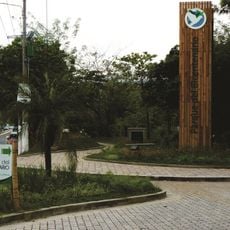
La Laguna Botanical Garden is a garden inside a volcanic crater in Antiguo Cuscatlán, El Salvador, covering 46 hectares. The collection holds more than 3,500 plant species arranged in 32 thematic zones, each with signage explaining botanical details and origin.
A lagoon lay at the bottom of a volcanic crater for centuries until the last eruption at the end of the 18th century turned it semi-swampy; the 1873 earthquake drained most of it. The fertile land was long used for livestock and a private garden with century-old trees. In the 1960s and 1970s an industrial complex was built on part of the area, and the private garden was handed to a nonprofit association. It opened to the public on 22 December 1978 with 30 hectares, of which 3.15 hectares are open to visitors.
The name Plan de La Laguna recalls the lagoon that lay at the bottom of the crater for centuries, until the 1873 earthquake drained most of it. The garden opened on 22 December 1978. Its herbarium, coded LAGU, holds over 45,000 plant specimens collected in El Salvador, and its records and photographs are accessible through the JACQ database and the GBIF portal.
The garden lies at kilometre 8 of the Carretera Panamericana, in the Plan de La Laguna industrial zone south of Antiguo Cuscatlán, at 805 m above sea level. Only 3.15 of its 30 hectares, the flat part, are open to visitors; the rest is strictly protected forest. Expect about 23 °C and 75% relative humidity, and allow time for the 32 labelled zones.
Some areas remain as protected native forest, where local plants like bananas, grasses, spurges, and bromeliads grow in their natural state. These zones show what the land looked like before human settlement.
The community of curious travelers
AroundUs brings together thousands of curated places, local tips, and hidden gems, enriched daily by 92,704 contributors worldwide.