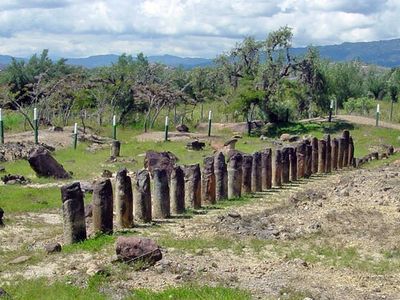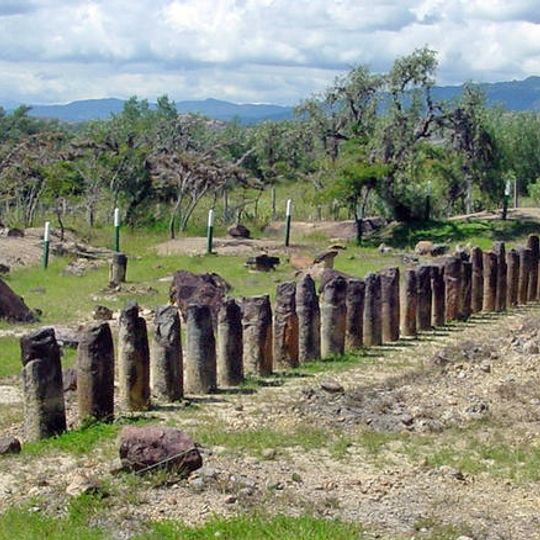
El Infiernito, Archaeological park in Villa de Leyva, Colombia.
El Infiernito is an archaeological park containing roughly 109 pink sandstone columns arranged in two parallel lines running east to west. The site sits in the Monquirá Valley at approximately 2089 meters elevation.
Radiocarbon dates from charcoal at the site reach about 2,880 years before present, and the columns were already half-buried when geographer Joaquín Acosta counted 25 of them in 1847. Alexander von Humboldt later linked the alignments to solstices and equinoxes. Archaeologist Eliecer Silva Celis led the first formal excavations in 1981, when the site became an archaeological park; by then the central column Acosta had described, about 5 metres high, was missing.
The standing stones represent Muisca customs and reveal how this civilization tracked seasons and sky events. Locals view the site as a connection to their ancestors' knowledge.
The site is best explored during daylight hours when you can see the stones and surroundings clearly. Wear sturdy shoes as the terrain is uneven and the altitude requires physical adjustment.
In 2006 a dolmen-type stone burial urn was found on the eastern side of the park, holding pottery and the remains of a child about two years old with beads of marine shells. Bone remains around it suggest a collective tomb for high-ranking spiritual figures.
The community of curious travelers
AroundUs brings together thousands of curated places, local tips, and hidden gems, enriched daily by 93,807 contributors worldwide.