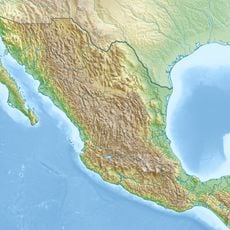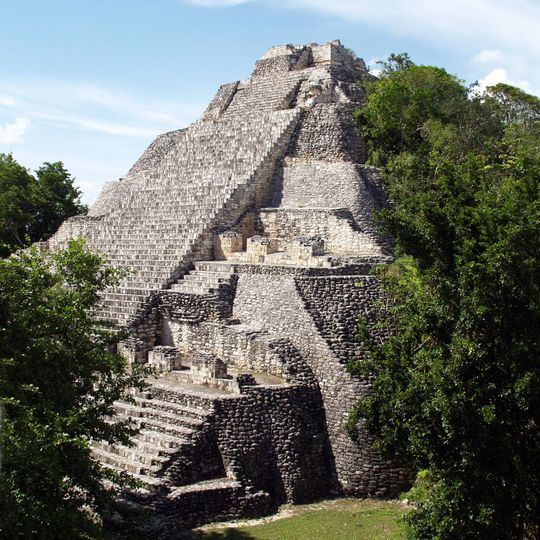
Becan, Archaeological ruins in Campeche, Mexico.
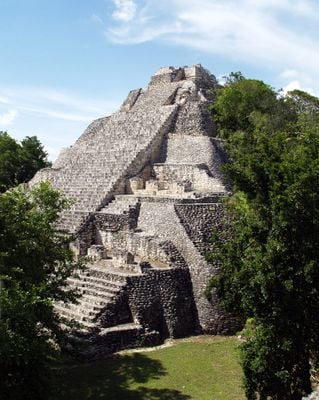
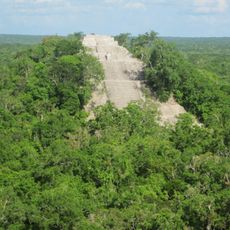
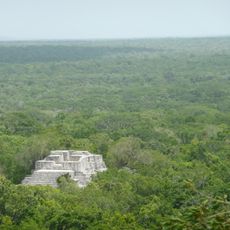
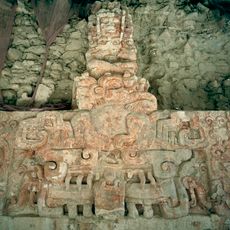
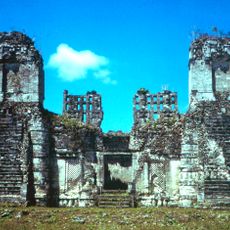
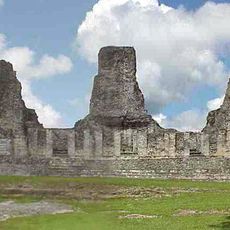
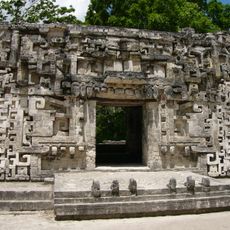
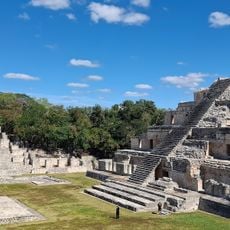
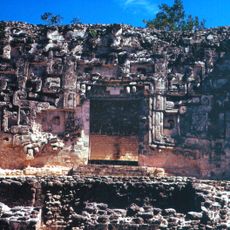
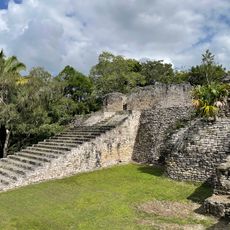
Becan is a Maya archaeological site in Campeche whose centre is enclosed by an artificial ditch and ramparts covering about 25 hectares, with seven entrances; the current access is the eastern one. Its tallest building, Structure IX, rises 42 m and still shows remains of two jaguar heads guarding the top. Structure I has two solid truncated towers 15 m high with four openings at the summit, and Structure IV has rounded corners and zoomorphic masks of stone mosaic on its facade.
Becan was occupied from about 550 BCE and became a major ceremonial centre in the late Preclassic. A ditch and ramparts were built around the 25-hectare core in the early Classic, when Teotihuacan trade goods reached the site. Construction of major buildings stopped about 830, and the city was probably abandoned by about 1200. Karl Ruppert and John Denison documented it in 1934.
The buildings display Rio Bec architectural style with stone masks and decorative false stairs on narrow towers. These carved details remain visible today and show how craftspeople of that time displayed their skill.
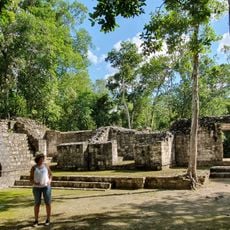
The site is accessible daily and can be explored on foot, with paths between structures varying in difficulty depending on the season. Visitors should bring comfortable shoes and allow time to see the different buildings scattered across the grounds.
The moat system has seven passages that served as access points through the fortification. This type of defensive engineering is unparalleled in Maya architecture and makes the site particularly valuable to researchers.
The community of curious travelers
AroundUs brings together thousands of curated places, local tips, and hidden gems, enriched daily by 93,811 contributors worldwide.