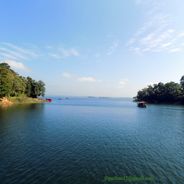
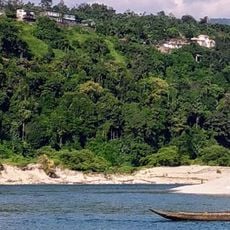
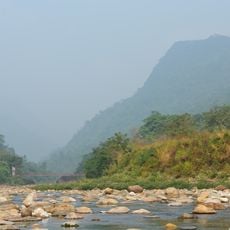
Ratargul Swamp Forest, Freshwater swamp forest in Gowainghat, Bangladesh
Ratargul Swamp Forest is a 3,325.61-acre freshwater swamp forest in Gowainghat, about 26 km from Sylhet, where the Gowain River meets Chengir Khal. Most trees are koroch (Dalbergia reniformis), forming a canopy up to 15 m tall above a lower layer of murta. In the monsoon (May to early October) the forest is submerged under 20–30 ft of water; in the dry season the water drops to about 10 ft and the forest emerges.
Bangladesh's government designated a portion of the forest as a protected wildlife area in 1973, recognizing its importance for animal conservation. This decision marked the beginning of formal protection for the region and its animal populations.
In Sylhet's local language, the murtа or pati plant is called rata, and the forest takes its name from it. The lower layer of the swamp is dense with this Schumannianthus dichotomus, whose stems are woven into mats. Visitors glide past it in small dinghy boats, since only those can pass inside the forest.
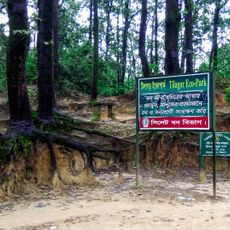
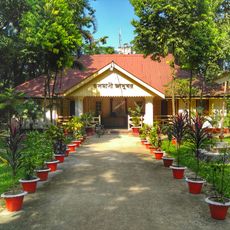
Visitors need permission from the Ratargul forest beat office before entering, and must hire a local engine boat, called a traller, from Gowainghat to reach the forest. The wet season runs from May to early October, when trees stand under 3 to 9 metres of water; in the dry months the water drops and small channels become walkable paths.
The forest is named after the rata tree, the local name for murtа or pati (Schumannianthus dichotomus), whose dense lower layer fills the swamp floor. Its leaves are woven into mats, and the canopy above reaches about 15 m. The forest office has also planted water-tolerant species such as cane, kadam and hijal.
The community of curious travelers
AroundUs brings together thousands of curated places, local tips, and hidden gems, enriched daily by 93,469 contributors worldwide.