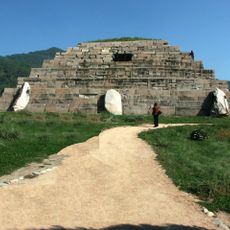
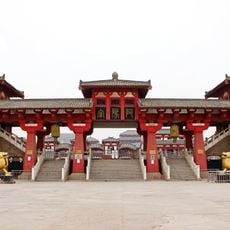
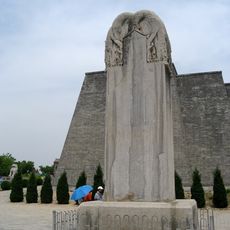
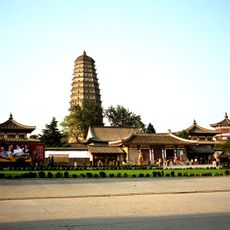
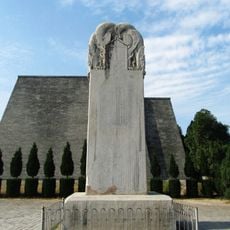
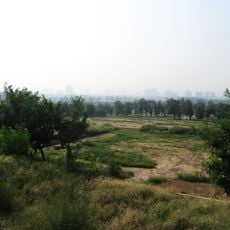
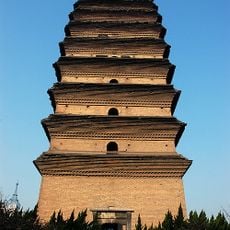
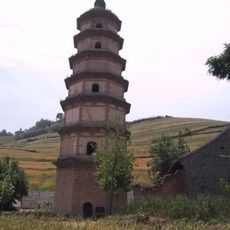
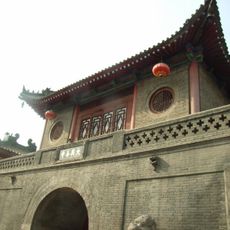
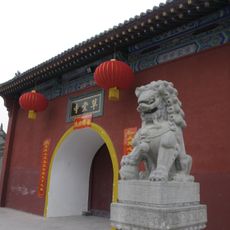
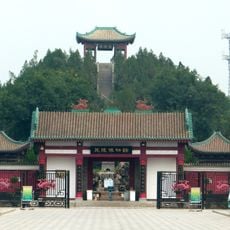
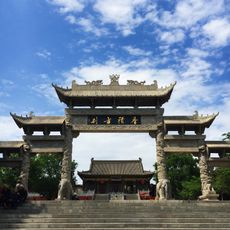
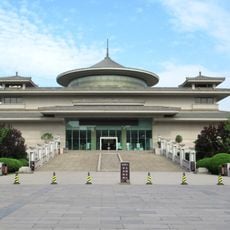
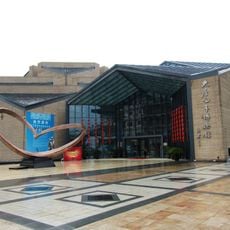
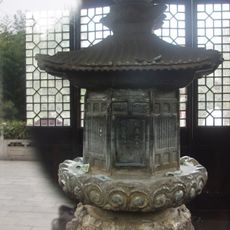
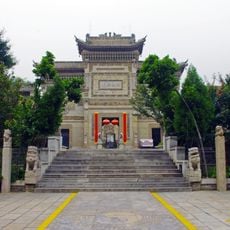
Louguantai, Taoist temple in Zhouzhi County, Shaanxi Province, China.
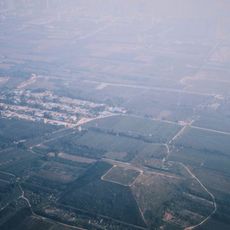
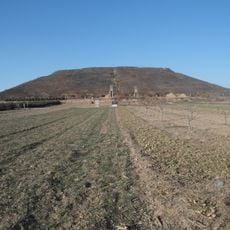
Louguantai stands in Tayu village, Louguan town, Zhouzhi county, Shaanxi, about 70 km west of Xi'an, below the northern slopes of the Qinling at the foot of Zhongnan Mountain. Its core is the Laojun shuojing tai, a teaching platform built on a hillock at 580 m elevation, facing the Wei River plain of the Guanzhong. The site covers roughly 5 km²; the surviving Shuojing Tai buildings date from the Ming and Qing dynasties and the modern era and cover about 9,000 m².
Louguantai was first built in the Western Zhou. Tradition holds that Yin Xi, keeper of the Hangu Pass, built a thatched tower here to observe the sky, giving the name Caolouguan. In 624 Emperor Gaozu of Tang renamed it Zongsheng Palace and expanded it; Emperor Xuanzong enlarged it again, making it the largest imperial Taoist temple of the time. It was listed as a national key Taoist temple in 1983 and restored from 1980 after damage in 1966-1976.
The name Louguantai comes from the grass tower (caolou) that Yin Xi, keeper of Hangu Pass, built to watch the sky, and the platform where Laozi is said to have taught the Daodejing. The site is called the origin of Louguan Dao and the "ancestral court" of Taoism. Visitors can see the Shuojingtai, the platform on the 580 m ridge where the teaching is placed.
The temple sits west of Xi'an and is easy to reach with clear signage at the entrances. Visitors should wear comfortable shoes since the grounds are spread out and exploring the different areas means walking a lot.
The "platform" is the Shuojingtai, a terrace on a hilltop 580 m above sea level where Laozi is said to have preached the Daodejing after writing its 5,000 characters. The Northern Song poet Su Shi visited and wrote that from this terrace the Qin plain looks small.
The community of curious travelers
AroundUs brings together thousands of curated places, local tips, and hidden gems, enriched daily by 92,764 contributors worldwide.