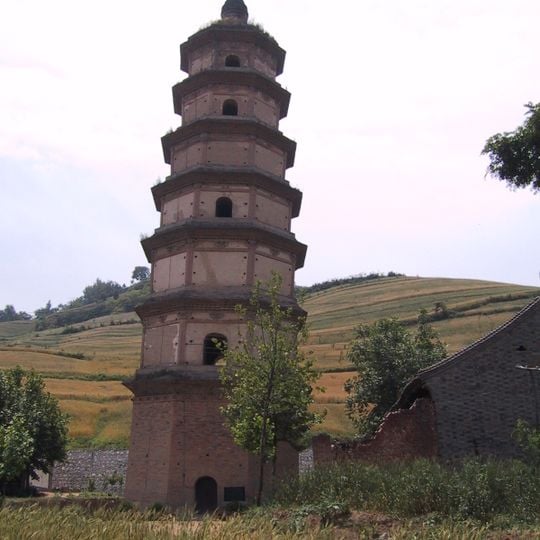
Daqin Pagoda, Buddhist pagoda in Zhouzhi County, China.
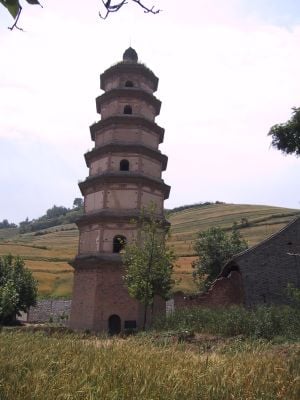
Daqin Pagoda is a seven-storey octagonal brick tower about 34 metres high, each side of its first storey measuring 4.3 metres. It stands in Zhouzhi County, Shaanxi, roughly two kilometres west of Louguantai temple. The weathered reddish-brown brick rises in stacked tiers with shallow overhanging ledges; several tiers have small arched openings, and a larger arched doorway with a rectangular plaque above it sits near the base.
The pagoda is first attested in 1065, when the poet Su Dongpo visited and wrote his poem "Daqin Temple"; his brother Su Zhe wrote a reply mentioning the temple's monks. An earthquake in 1556 severely damaged the building, which was then abandoned, and many underground chambers became unreachable. Martin Palmer's 2001 claim that it was a Church of the East church built around 640 remains disputed by scholars.
The name Daqin was the ancient Chinese term for the Roman Empire and later for Syria and the Near East. Some researchers identify carvings of the Nativity and of Jonah at Nineveh on the walls, along with Syriac graffiti, though these claims remain disputed. A copy of the 781 Nestorian Stele stands at the pagoda on a bixi turtle base.
The pagoda stands about two kilometres west of Louguantai temple in Zhouzhi County, roughly 70 kilometres southwest of central Xi'an. The 1556 earthquake left many of the underground chambers unreachable, and periodic flooding, not earthquakes, now threatens the structure. A copy of the 781 Nestorian Stele, set on a bixi turtle, stands beside the pagoda.
A copy of the 781 Nestorian Stele stands at the pagoda on a bixi turtle base; the original is kept in the Forest of Steles museum in Xi'an. The stele was erected by members of the same Assyrian Church of the East whose missionaries are said to have built the monastery here.
The community of curious travelers
AroundUs brings together thousands of curated places, local tips, and hidden gems, enriched daily by 93,702 contributors worldwide.