Pagoda of Chengtian Temple, Buddhist pagoda in Yinchuan, China.
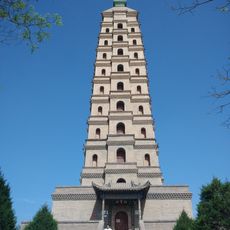
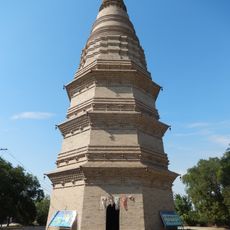
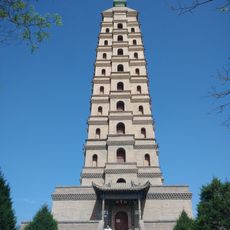
The Pagoda of Chengtian Temple is an eleven-storey octagonal brick tower standing on a square platform 26 metres across and 2.6 metres high. Its body rises 64.5 metres, with each side of the bottom storey measuring 5 metres. The exterior shows thirteen eaves, but the interior has only eleven levels; the top is capped by a green glazed-tile finial shaped like an octagonal peach, without a canopy. Wooden stairs inside lead to the eleventh floor.
The original structure rose during the mid-11th century under the Western Xia Dynasty and became an important landmark of that era. Following major earthquake damage, the entire building underwent substantial reconstruction, resulting in the form we see today.
The name Chengtian, "Bearing Heaven," comes from the phrase "to bear Heaven's mandate and issue decrees from the throne." The temple was built by Empress Dowager Meizang to protect her one-year-old son, Emperor Yizong. In 1055 Emperor Renzong of Song sent a set of the Tripiṭaka, which was deposited here. The Ming poet Wang Xun described the ruined temple in his poem "Sound of a Bell at the Tall Pagoda."
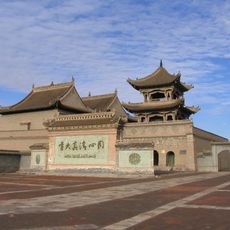
The entrance is in the east wall, and wooden stairs inside the hollow brick shaft lead up to the eleventh storey, where windows face four directions. The stairwell is narrow and unlit in places, so carry your own light. The pagoda stands in the centre of Chengtian Temple's grounds in western Yinchuan, beside the museum that once occupied the temple.
Iron bells hang from the corners of each level and ring when the wind moves them, creating subtle sounds that change throughout the year. This acoustic feature was incorporated into the design as a way to link physical movement with sensory experience.
The community of curious travelers
AroundUs brings together thousands of curated places, local tips, and hidden gems, enriched daily by 94,536 contributors worldwide.