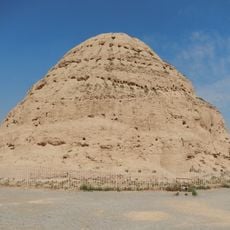
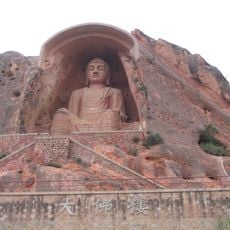
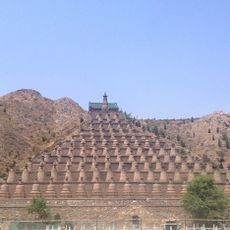
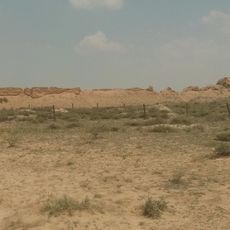
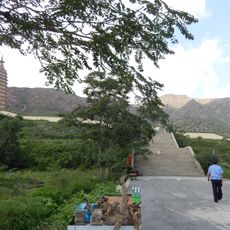
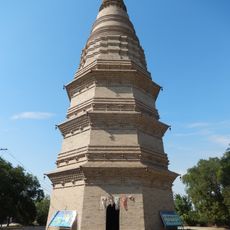
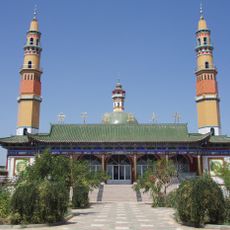
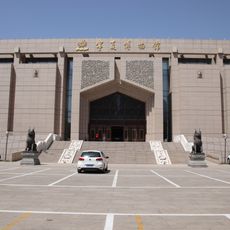
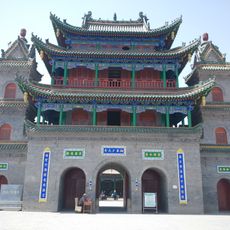
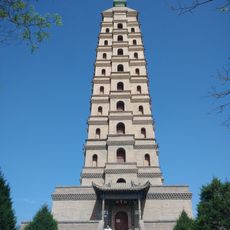
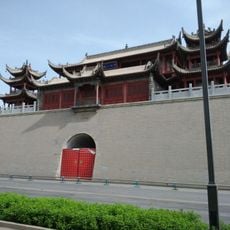
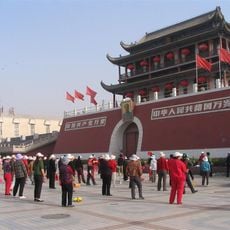
Baisigou Square Pagoda, Pagoda ruins in Helan County, Ningxia, China
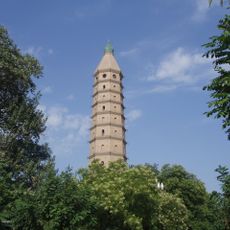
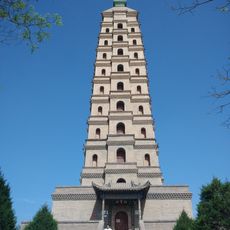
Baisigou Square Pagoda was a 13-story brick tower positioned at the eastern edge of the Helan Mountains, with small rooms and windows distributed across multiple levels. The interior housed thousands of miniature stupas alongside religious manuscripts that were carefully stored within its structure.
Built in 1075–1076 under Emperor Huizong of Western Xia, the pagoda was dated by an ink inscription on its pine central pillar. A Tangut tablet records repairs between 27 June and 7 July 1113, under Emperor Chongzong. In 1990 looters blew it up; only a fragment of the northwest corner survived.
The pagoda's name links it to Baisigou, the valley where it stood. Its tenth- and twelfth-story chambers opened to the south and became a roost for birds, so the relics were found mixed with branches and bird skeletons. Among the recovered texts was the first known collection of Chinese poetry written by Tangut poets, alongside Buddhist sutras.
The archaeological site is located approximately 10 kilometers into Baisigou Valley, northwest of Yinchuan, in a remote location. The recovered artifacts and discoveries are now on display at the Ningxia Museum, making them accessible to visitors.
The nine-volume Auspicious Tantra of All-Reaching Union, a Tangut translation of a Tibetan Buddhist text, was found in the rubble. Its many inverted characters led researchers to identify it as the earliest known book printed with wooden movable type.
The community of curious travelers
AroundUs brings together thousands of curated places, local tips, and hidden gems, enriched daily by 94,049 contributors worldwide.