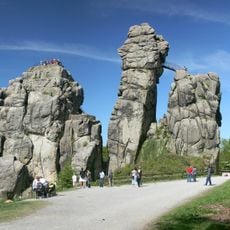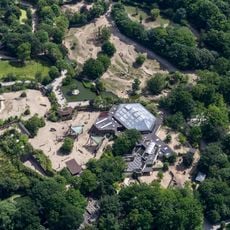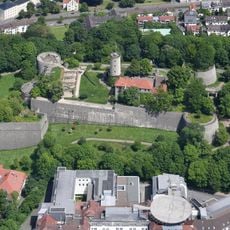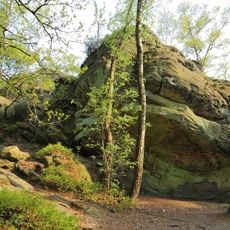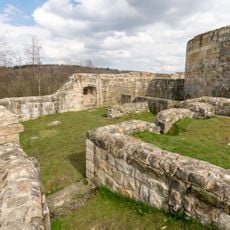
Teutoburg Forest, Natural forest in Lower Saxony and North Rhine-Westphalia, Germany.
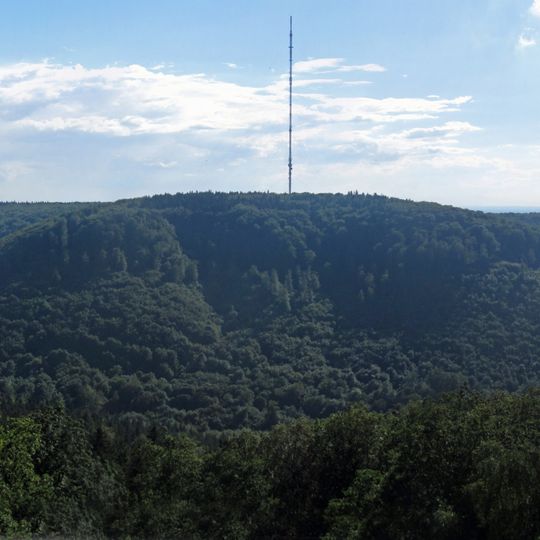
The Teutoburg Forest is a low, forested hill range of three ridges running about 105 km from the Tecklenburger Land past Osnabrück and Bielefeld to Horn-Bad Meinberg. Its highest point is the Barnacken at 446.4 m; the Bielefeld Pass divides it into a northern and a southern section.
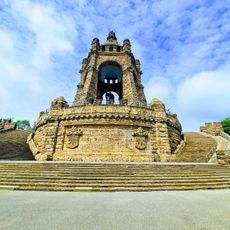
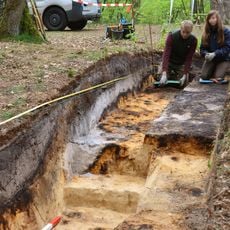
Germanic tribes inflicted a crushing defeat on three Roman legions in the year 9, ending Rome's northward expansion. In the 19th century, the Hermannsdenkmal statue was erected to honor Arminius, the leader who commanded that decisive battle.
The name Teutoburg Forest was coined by geographer Philipp Clüver in 1616, replacing the older name Osning; locals still call the section around the Ebberg near Bielefeld the Osning. The composer Johannes Brahms took walks in these woods during his stay in Detmold.
Two nature parks maintain networks of trails that thread through different woodland sections, accessible from several trailheads. Most paths suit walkers of average fitness, though some stretches climb steeper slopes and call for sturdy footwear.
The source of the Ems River emerges deep inside this woodland, forming the start of a river system that flows to the North Sea. The watershed between the Ems and Weser also runs here, so rain falling on neighboring slopes drains in opposite directions.
The community of curious travelers
AroundUs brings together thousands of curated places, local tips, and hidden gems, enriched daily by 92,376 contributors worldwide.