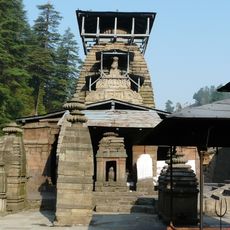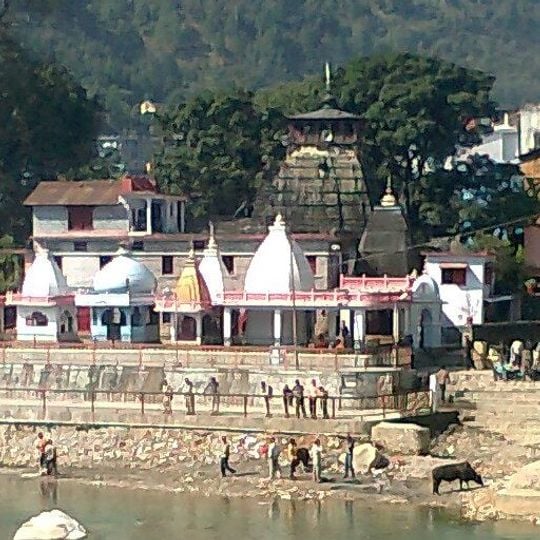
Bagnath Temple, Hindu temple at the confluence of Sarayu and Gomati rivers, Bageshwar, India
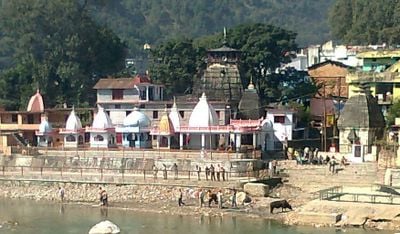
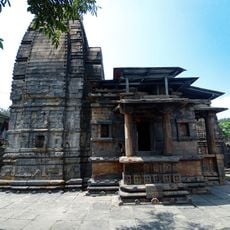
Bagnath Temple rises above a stone embankment at the confluence of the Sarayu and Gomti rivers in Bageshwar. Its central structure is a tall, dark, roughly pyramidal stone tower with a small finial, standing behind a lower white hall. In front of the hall, on a red-trimmed base, sit several white domed pavilions and one yellow-arched shrine with pillars and a red railing; to the right, another white building carries a small golden finial. The complex is built of stone, white plaster and red-painted trim.
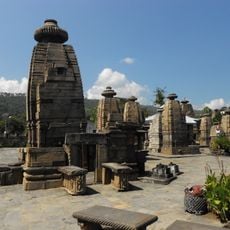
The current temple structure was constructed in 1450 by King Laxmi Chand, though religious devotion at this location extends back to the 7th century. Over the centuries, the site evolved into a center of worship while maintaining its status as a sacred place.
The town of Bageshwar takes its name from this temple. Each January the Uttarayani fair is held at Makar Sankranti: pilgrims bathe before daybreak at the Sarayu-Gomati confluence, then offer water to Shiva inside the shrine. The more devout repeat the rite for three days, a practice called Trimaghi.
The temple is accessible by buses departing from Delhi to Bageshwar, with Kathgodam railway station located approximately 151 kilometers away serving as the nearest rail connection. It is advisable to check bus schedules in advance as they may vary by season.
In 1996 the Uttarakhand Archaeology Department took over the temple and sealed inscriptions and idols from the 8th to 10th centuries inside it, among them images of Shiva, Ganesha, Vishnu, Chaturmukhi Shiva, Mahishasura Mardini and the Navagraha. They are walled in rather than displayed, so visitors cannot see them.
The community of curious travelers
AroundUs brings together thousands of curated places, local tips, and hidden gems, enriched daily by 92,863 contributors worldwide.