Paigah Tombs, Noble cemetery in Phisal Banda, India
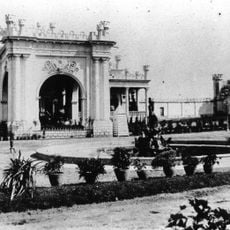
The Paigah Tombs are a burial complex featuring marble mausoleums with stone lattice screens, detailed carvings, and geometric patterns distributed across multiple acres. The site contains several structures of varying ornamental complexity spread throughout the grounds.
The burial site was established in 1786 when Abdul Fateh Khan, a military commander and nobleman serving the Nizams of Hyderabad, was interred here. This founding marked the beginning of an important family tomb complex for the Paigah aristocracy.
The tombs are named Maqbara Shams al-Umara after Shams-ul-Umra, "sun among the nobles", the title given to Abdul Fateh Khan Tegh Jung. The Paigah nobles, descendants of the caliph Omar bin Al-Khattab, kept their graves open to the sky following the simple tenets of Islam, as the Nizams did before the seventh ruler. The stucco decoration of Lateefunnisa Begum Saheba's tomb, grandmother of Sir Khursheed Jah, appears in no other tomb here.
The tombs lie 4 km southeast of the Charminar, in the Pisal Banda suburb, down a small lane across from Owaisi Hospital near Santosh Nagar. The walled enclosure sits among concrete houses on a 30-acre property, with the Paigah graves concentrated in a two-acre plot.
The tomb of Nawab Sir Khursheed Jah's family has the largest arch in the complex, and its double maqbara, called a "Mahajar", appears in no other tomb. The stucco decoration on the tomb of his grandmother Lateefunnisa Begum Saheba is likewise found nowhere else on the site.
The community of curious travelers
AroundUs brings together thousands of curated places, local tips, and hidden gems, enriched daily by 92,955 contributors worldwide.