Tōdai-ji, Buddhist temple in Nara, Japan
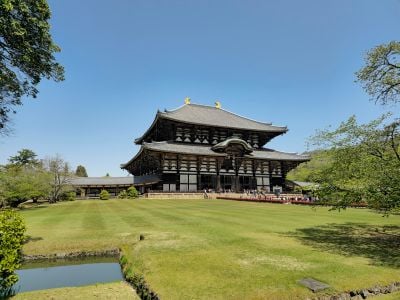
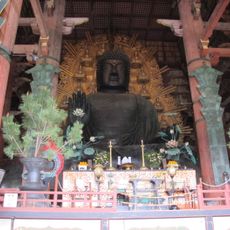
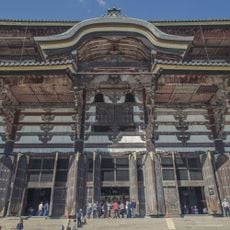
Tōdai-ji is a Buddhist temple complex in Nara whose main hall, the Daibutsuden, houses a bronze Vairocana Buddha about 14.7 metres tall. The present hall, rebuilt in 1709, has a dark tiled two-tiered roof with golden ornaments at each end of the top ridge, white plaster panels between dark timber beams, and a central porch under a curved gable.
The temple began as Kinshōji at the foot of Mount Wakakusa, founded in 733 according to temple records, and was renamed Kinkōmyōji in 742 as Yamato's provincial temple. Emperor Shōmu commissioned the Great Buddha in 743; casting began in 747, the eye-opening ceremony followed in 752, and the hall was finished in 758. Fire destroyed the complex in 1181 and again in 1567; the present hall was rebuilt in 1709.
The grounds draw daily pilgrims who pray before the Buddha statue and light incense sticks. During the annual Omizutori ritual each March, thousands gather at Nigatsu-do shrine to watch the torch procession.
Access is through the Nandai-mon gate, from where you reach the main hall and additional buildings within the grounds. Weekends and cherry blossom or autumn foliage periods can get crowded, so early morning visits work better.
A wooden pillar in the hall has a hole matching the size of the Great Buddha's nostril, which visitors attempt to crawl through. This custom is believed to bring good fortune and is especially common among children and teenagers who try the challenge.
The community of curious travelers
AroundUs brings together thousands of curated places, local tips, and hidden gems, enriched daily by 92,154 contributors worldwide.