Nara Park, Urban park in Nara, Japan.
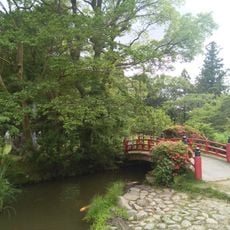
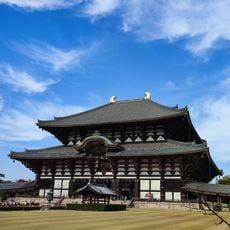
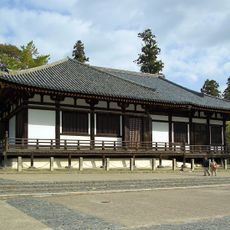
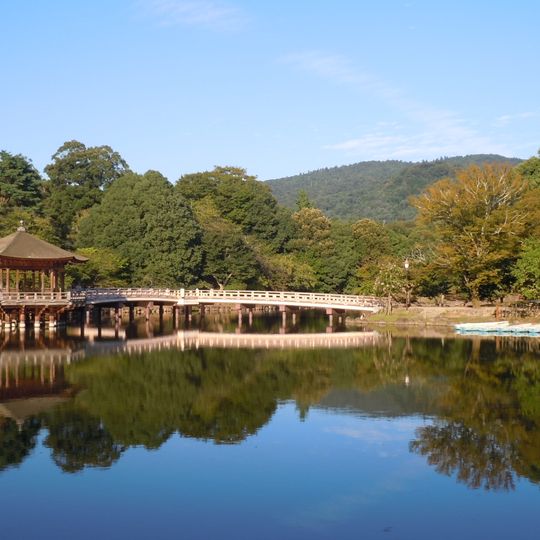
Nara Park is an urban park in Nara, Japan, covering 502 hectares, with a further 660 hectares including the grounds of Tōdai-ji, Kōfuku-ji, Kasuga Grand Shrine and Nara National Museum. About 1,200 wild sika deer roam freely across its lawns and wooded areas. The park includes a wooden pavilion with a square hipped roof at the edge of a pond, from which a wooden bridge with a low slatted railing extends across the water.
The park was established in 1880 as a fourteen-hectare section of government land within the Kofuku-ji temple precinct. Over the following decades it expanded by incorporating several neighboring religious and natural areas.
Deer are revered as messengers of Kasuga Grand Shrine, whose main deity Takemikazuchi is said to have arrived on Mount Mikasa riding a white deer. Killing one was a capital offense until 1637. Today the animals are wild, not captive, and designated a national natural monument; they bow when seeking crackers.
The park has no walls, gates or admission fee, so it can be walked through 365 days a year, around the clock. Deer-crackers are sold inside the grounds; the deer are wild animals, and the city posts signs in English, Chinese and Japanese asking visitors not to tease them while feeding. In spring, mothers with fawns can be aggressive, and touching a fawn may cause the mother to reject it.
A 2023 genetic study by Fukushima, Yamagata and Nara University of Education found that Nara Park's deer carry only one mitochondrial DNA genotype, S4, absent elsewhere on the Kii Peninsula. The split from other peninsula deer was estimated at roughly 1,400 years ago, close to the founding of Kasuga Grand Shrine.
The community of curious travelers
AroundUs brings together thousands of curated places, local tips, and hidden gems, enriched daily by 92,790 contributors worldwide.