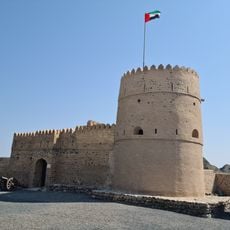
Rumailah, UAE, Historic castle in Al Ain, United Arab Emirates.
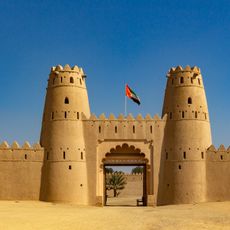
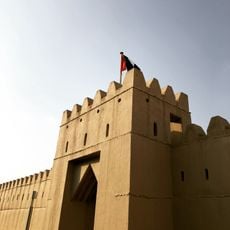
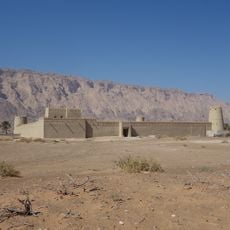
Rumailah is a rectangular fort with a nine-sided perimeter wall, built from coral and adobe, thought to date to the early 20th century. Its wall is decorated with triangular motifs and has a plain rectangular wooden door with three firing openings above it. The fort stands on a flat area without surrounding structures, and the site also includes a rectangular mound with remains of an Iron Age II settlement.
Excavations have revealed artifacts dating from 1100 to 500 BCE, indicating a settlement during the Iron Age period. These findings suggest the location was part of ancient trade networks connecting distant regions.
Rumailah's Iron Age II pottery carries snake motifs also found at Qusais, Masafi and Saruq Al Hadid, while chlorite vessels show turtles alternating with trees, as at Qidfa' and Al-Hajar in Bahrain. The site also yielded pyramidal seals echoing those from Bidaa Bint Saud.
Rumailah lies 3 km west of Hili Archaeological Park in Al Ain, reachable by road from Abu Dhabi. The rectangular mound and the coral-and-adobe fort stand in open, level ground with no enclosing structures, so there is little shade; bring sturdy footwear and sun protection.
Among the finds are short swords with crescent-shaped pommels, identical in form to the weapon carried by a native of Maka carved on the relief of Darius II's tomb at Persepolis. Herodotus records that Maka, as the Achaemenids called this region, supplied troops to Xerxes' army in 480 BCE.
The community of curious travelers
AroundUs brings together thousands of curated places, local tips, and hidden gems, enriched daily by 94,600 contributors worldwide.