Jebel Hafeet beehive tombs, Ancient burial grounds at Jebel Hafeet mountain, United Arab Emirates.
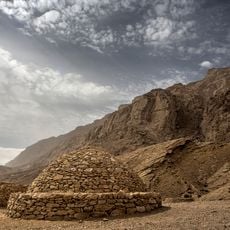
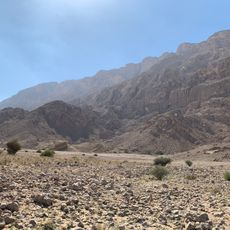
Jebel Hafeet beehive tombs are a cluster of Bronze Age burial structures at the mountain's foothills near Al Ain, in the Emirate of Abu Dhabi. Each tomb is a circular dry-stone chamber roofed by corbelled courses, giving the domed, hive-like profile that names the type. The cemetery lies on the lower slopes of the sole mountain in the emirate, a limestone anticline rising about 900 m above the surrounding plain.
The tombs gave their name to the Hafit Period of the Bronze Age, dated 3200 to 2600 BCE, when the mountain's foothills were used as a cemetery. Excavations in the 1950s and 1960s revealed the cluster of beehive-shaped graves, and the finds inside linked the people of Tawam to trade routes reaching Mesopotamia and Iran.
The tombs gave their name to the Hafit Period of the Bronze Age (3200–2600 BCE), a term used for the whole era in UAE archaeology after these foothill burials were identified. The mountain's Arabic name, Jabal Hafit, means "empty mountain". The site lies in Tawam, on the border between the UAE and Oman, near Al Ain and Al-Buraimi.
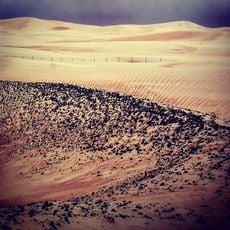
The tombs sit at the foot of Jebel Hafeet, near the Mezyad border crossing into Oman, south of Al Ain. The mountain road built in 1980 climbs 11.7 km with 60 turns to a parking lot, hotel and palace at the top. October to March stays mostly below 25 °C, so plan walks for those months and carry water; the site is open desert with little shade.
The tombs gave their name to the Hafit Period of the Bronze Age (3200–2600 BCE), a phase of UAE history defined by these very burials. The mountain itself is the only one in the Emirate of Abu Dhabi, rising about 900 m above the surrounding plain.
The community of curious travelers
AroundUs brings together thousands of curated places, local tips, and hidden gems, enriched daily by 92,779 contributors worldwide.