Ruins of the Church of the Holy Trinity, Colonial church ruins in Vila Bela da Santíssima Trindade, Brazil.
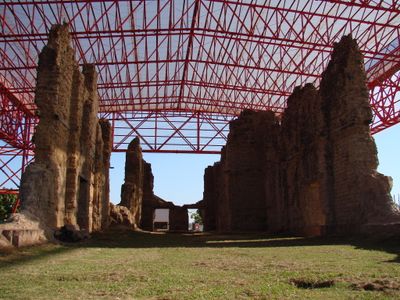
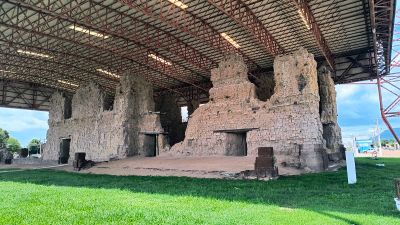
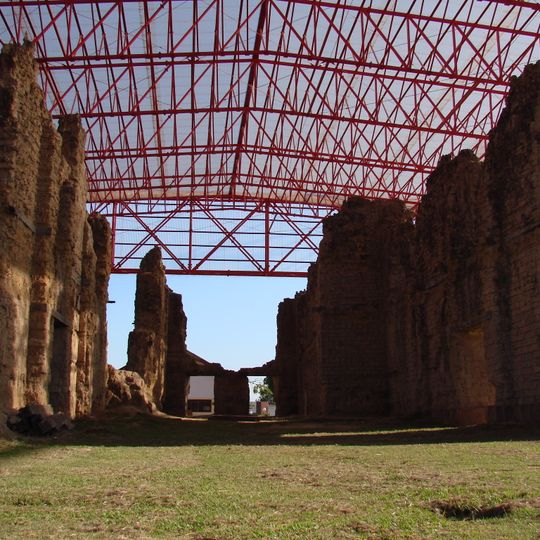
The Ruins of the Church of the Holy Trinity stand on the west bank of the Guaporé River in Vila Bela da Santíssima Trindade, Mato Grosso. The roofless rectangular shell has thick adobe walls, eroded and uneven along their tops, resting on foundations of cantaria stone laid over pedra canga. A narrow opening at the far end holds a small white sign, and a red metal truss covered with white translucent fabric shelters the whole structure.
Construction of the church began during the decline of Vila Bela, then the capital of the Province of Mato Grosso, and the building was never finished. Its thick adobe walls rest on foundations of cantaria stonework in pedra canga. The ruins were listed by IPHAN in 1988 and stand as a symbol of Portuguese colonial expansion on the Guaporé River.
The ruins mark the site of the old capital of Mato Grosso, founded in 1752 as Vila Bela da Santíssima Trindade, and stand as a symbol of Portuguese colonial expansion along the Guaporé River. The Festa do Congo is not held here; the sources record no such celebration at the ruins.
The ruins stand at the western edge of Mato Grosso, on the bank of the Guaporé River, at the far end of Vila Bela's street grid; the roofless shell is open to sun and rain, so visit in the morning and bring water and insect protection. The red metal canopy with white fabric protects part of the walls.
The thick adobe walls rest on foundations of cantaria stone, specifically pedra canga, an iron-rich local rock. The building was never finished, likely because construction began as Vila Bela was already declining. IPHAN listed the ruins in 1988, and the Guaporé River lies beside them.
The community of curious travelers
AroundUs brings together thousands of curated places, local tips, and hidden gems, enriched daily by 92,813 contributors worldwide.