Former convent of Saint Andrew, Religious complex in Calpan Municipality, Mexico.
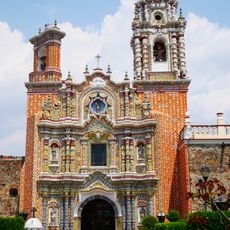
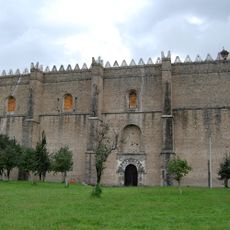
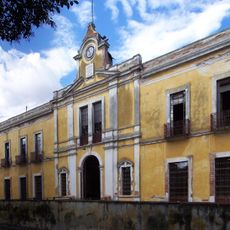
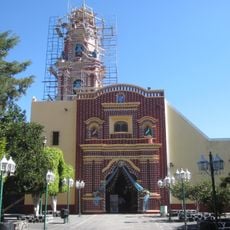
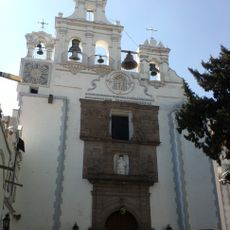
The former convent of Saint Andrew is a 16th-century Franciscan complex in San Andrés Calpan, Puebla. Its Plateresque church facade has two bodies: a rounded arch framed by candelabra columns, angels holding a cartouche with the five wounds, and a double window crowned by a large shell. The complex also includes four posa chapels with carved stone reliefs, an open chapel, a two-level cloister and a partially rebuilt convent.
The convent was built in the 16th century following Spanish conquest and served as a center for religious education and missionary work. It is now part of a group of monasteries recognized as a UNESCO World Heritage site.
The carved stone decorations show how Spanish colonial builders and local artisans worked together, blending two different artistic traditions into one style. You can see this fusion clearly in the ornamental details throughout the complex.
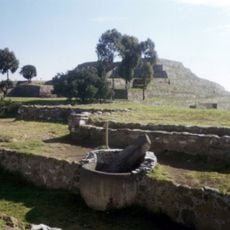
The convent stands in San Andrés Calpan, about 22 km from the city of Puebla de Zaragoza. The complex is partly rebuilt; the pilgrims' portal, the open chapel and the two-level cloister can be seen. The four posa chapels stand in the churchyard, so allow time to walk between them and the temple facade.
The carved stone of the four posa chapels was judged so fine that the same Calpan indigenous masons were later taken to Puebla to cut stone for its cathedral. The chapels were dedicated to Saint Michael, Saint John the Evangelist, the Assumption and Saint Francis, and by 1697 were consecrated to Saint Michael.
The community of curious travelers
AroundUs brings together thousands of curated places, local tips, and hidden gems, enriched daily by 94,129 contributors worldwide.