Lake Lugano, Glacial lake in Ticino and Lombardy regions, Switzerland and Italy
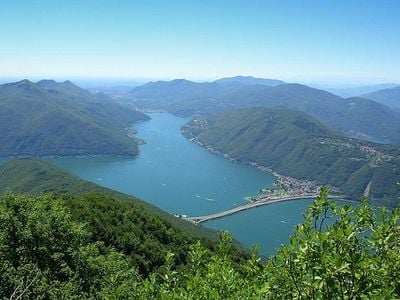
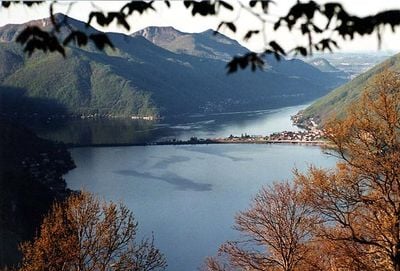
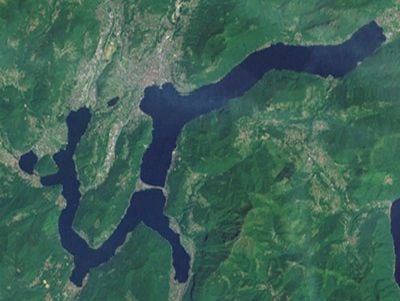
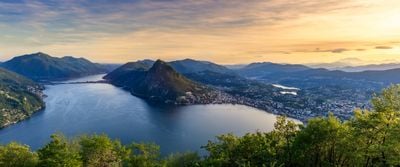
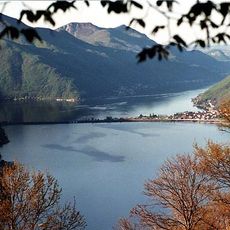
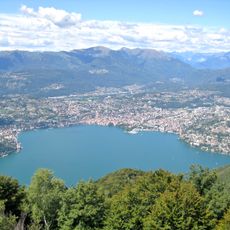
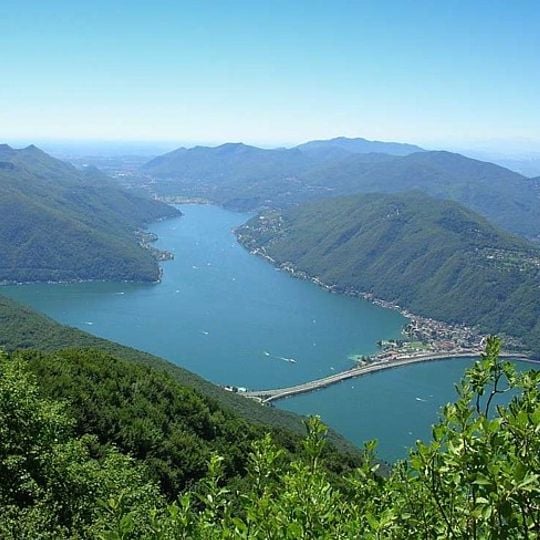
Lake Lugano is a pre-alpine lake of glacial origin, formed about ten thousand years ago where two glaciers met. It has a branched shape with three basins: the northern basin (27.5 km²), the southern basin (20.3 km²), and the small Laghetto at Ponte Tresa (1.0 km²). The artificial Melide causeway, carrying the A2 motorway and the Gotthard railway, divides the lake and is visible as a low bridge crossing the water.
Lake Lugano formed about ten thousand years ago at the end of the last glaciation, where two glaciers met. Its deepest point, 288 m, lies in the upper basin a few kilometres from Gandria. In 1848 the Melide causeway was built on moraine deposits, carrying the A2 motorway and the Gotthard railway and dividing the lake into a northern basin of 27.5 km² and a southern basin of 20.3 km².
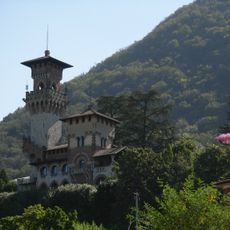
The alternative name Ceresio derives from the Latin Ceresium, of uncertain origin: some link it to cerasa, cherry, others to a Celtic word meaning branched, which matches the lake's forked shape. In Valsolda, on the Italian shore, Antonio Fogazzaro set his novel Piccolo mondo antico. Above Montagnola, the Torre Camuzzi houses a museum dedicated to Hermann Hesse, who lived there from age 42 until his death.
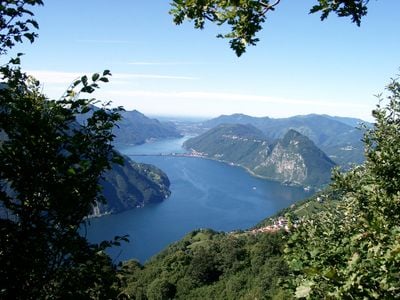
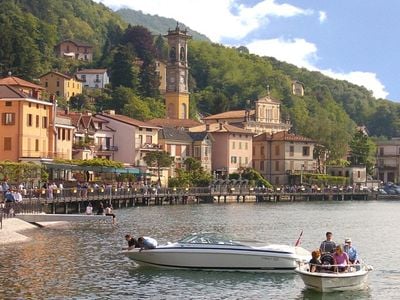
Ferries connect settlements on both shores, including villages that have no road access. Walking trails lead from the waterfront into the hills, offering different views of the water and the surrounding peaks.
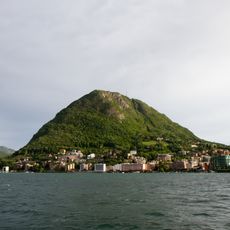
The fossil beds at Monte San Giorgio have yielded Middle Triassic finds since the 19th century, roughly 240 to 230 million years old, and the deposit continues west into Italy at Besano. Lower Jurassic fossils, about 180 million years old, occur further east along the southern shore at Osteno.
The community of curious travelers
AroundUs brings together thousands of curated places, local tips, and hidden gems, enriched daily by 92,755 contributors worldwide.