Donghai Bridge, Cable-stayed bridge in Shanghai, China
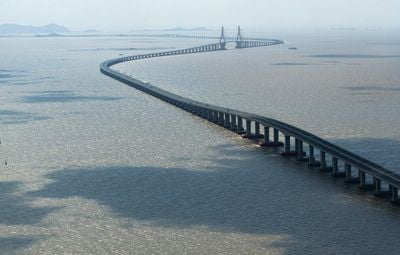
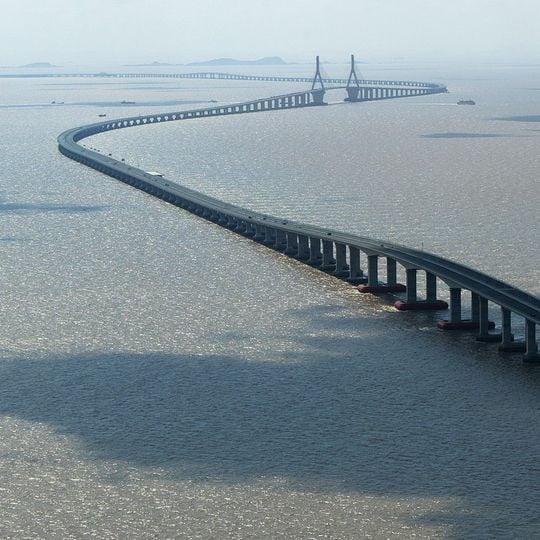
The Donghai Bridge runs 32.5 km from Shanghai's Pudong New Area to the Yangshan Deep-Water Port, mostly as a low viaduct on paired cylindrical piers. Near the far end, two slender pylons carry cables over the main navigation channel, a cable-stayed span of 420 m with 40 m clearance for ships. The deck is 31.5 m wide, six lanes, part of the S2 Hulu Expressway.
Shanghai began studying the Yangshan deep-water port project in 1996, and the bridge broke ground with it on 26 June 2002. Chen Liangyu and Xi Jinping unveiled the bridge's plaque on 12 July 2003; the span was joined on 25 May 2005 and opened to traffic on 10 December 2005. ETC lanes followed in 2021, and a dedicated autonomous-driving lane opened on 18 July 2022.
The bridge name was written by Jiang Zemin, who served as Shanghai's party secretary in the 1980s and later as China's president. The crossing is part of the S2 Hulu Expressway and carries a 110 kV power cable and a steel-framed plastic water pipe to Yangshan Port. Since 18 July 2022, the outermost lane is reserved for autonomous vehicles on weekdays from 10:00 to 13:00.
Drivers follow a clearly marked route that curves gently across the water, open only to motor vehicles. The maximum speed is eighty kilometers per hour (fifty miles per hour), and the crossing is easiest during calm weather and light traffic.
The bridge name was written by Jiang Zemin, then China's top leader, whose calligraphy appears on the structure. Since 18 July 2022, the outermost lane has been reserved for autonomous trucks every weekday from 10:00 to 13:00, with high-definition cameras tracking the test vehicles along the crossing.
The community of curious travelers
AroundUs brings together thousands of curated places, local tips, and hidden gems, enriched daily by 94,041 contributors worldwide.