Maijishan Grottoes, Buddhist cave complex in Tianshui, China
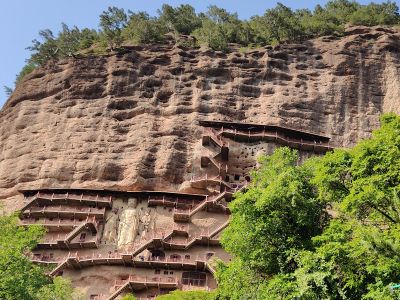
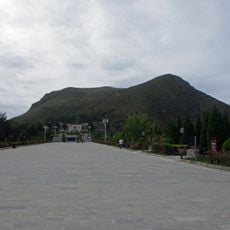
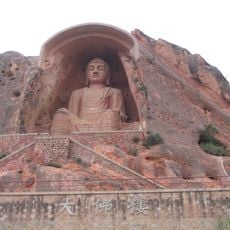
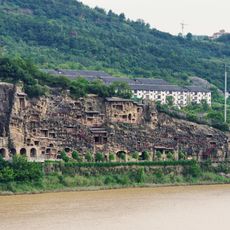
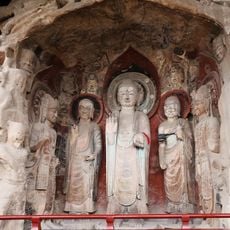
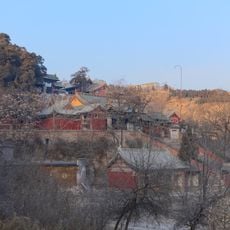
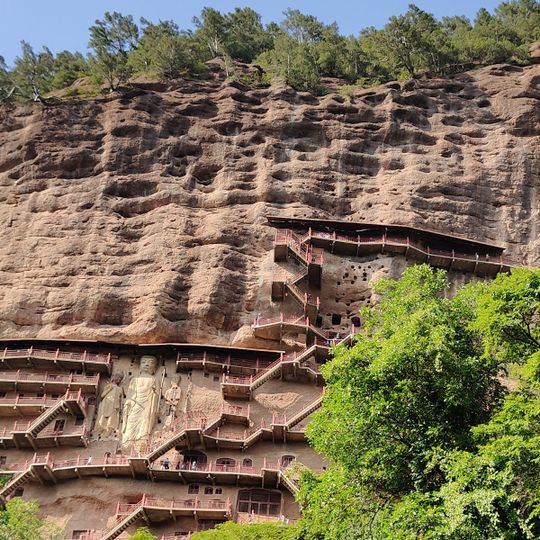
The Maijishan Grottoes are a series of 194 rock-cut caves on the southwest, south and southeast cliffs of Maijishan, a purplish-red sandstone hill near Tianshui. The caves are linked by stacked plank walkways and hold 7,866 clay sculptures, 3,995 stone carvings and 1,065.2 square metres of murals. A 734 earthquake split the site into an east cliff, 53 m long, and a west cliff, 63 m long.
Construction began under the Later Qin (384–417), when ruler Yao Xing promoted Buddhism. Around 420–422 the monk Tanhung founded a monastic community, later joined by Xuangao with 100 followers; it grew to 300 members. The earliest dated inscription, from 502, records the excavation of Cave 115. Renovations continued through the Song and Ming dynasties.
The sculptures here show how Buddhist art evolved across different periods, mixing styles from distant regions. As you walk through the caves, you notice how the artistic approaches changed over time.
You reach the caves by climbing steep stairways and walkways built into the mountainside. Wear sturdy shoes and be prepared for a moderate physical effort.
Cave 43, the earliest cliff-pavilion structure at the site, was the tomb cave of Empress Yifu of Western Wei, called "Jiling" in records. It combines a front corridor, a memorial hall with a Song-dynasty Buddha triad, and a rectangular coffin chamber beneath the platform. Cave 44 nearby holds a 1.60 m seated Buddha whose female features are thought to follow her portrait.
The community of curious travelers
AroundUs brings together thousands of curated places, local tips, and hidden gems, enriched daily by 94,219 contributors worldwide.