Fairy Cave, Sandstone cave in Mount Lu, Jiangxi, China
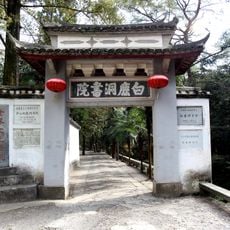
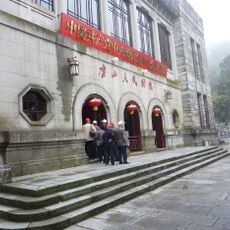
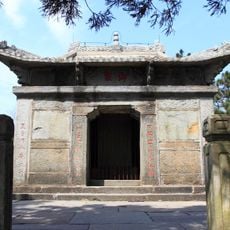
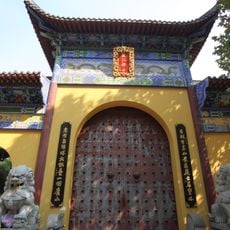
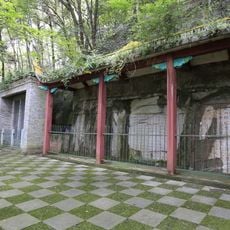
Fairy Cave is an eroded sandstone cavern on Mount Lu measuring about 14 meters long and 7 meters high with naturally formed rock shelters overhead. The entrance features a distinctive round gate marked with Chinese characters that opens directly into this protected space.
The cave was originally called Buddha's Hand Rock, after its rock formations resembling a human hand. Buddhist monks lived here from the Southern Song, when Zhu Xi recorded a monk's dwelling built against the rock, until at least 1804. A shrine to Lü Dongbin was later built below the rock, and during the Jiaqing reign the Taoist Yan Chunyi converted it into the Chunyang Hall. In 1905 Jingyangzi built the Laojun Hall beside the cave, and in 1925 Luo Lisong replaced the square western gate with a round one.
The name changed from Buddha's Hand Rock to Fairy Cave to honour Lü Dongbin, the Tang Taoist said to have become immortal here. A stone shrine inside holds a statue of Lü with a sword on his back, flanked by couplets reading "称师亦称祖,是道仍是儒" and "古洞千年灵异,岳阳三醉神仙". A nearby Laojun Hall, built in 1905 by Jingyangzi, houses a statue of Laozi riding an ox.
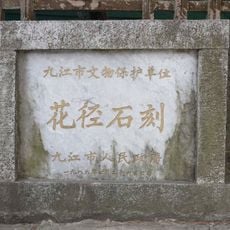
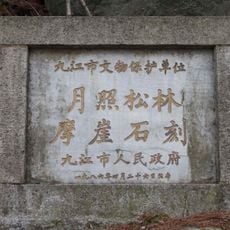
The cave is lit, so no torch is needed; the round gate on the west side leads in past the Toad Rock, and the paths to the Guanmiao Pavilion and the rocks above the Jinxiu Valley are uneven, so wear sturdy shoes. Allow time to look at the cliff inscriptions, which are protected as a provincial relic.
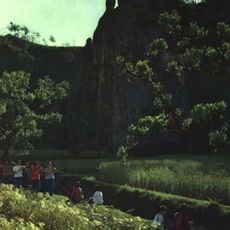
In 1961 Jiang Qing photographed the cave on Mount Lu; Mao Zedong, pleased with the image, wrote a poem on it: "Twilight gathers, watch the sturdy pine; wild clouds fly past, still composed. Nature made a Fairy Cave; boundless scenery lies on the perilous peak." It was first published in the December 1963 Poems of Chairman Mao.
The community of curious travelers
AroundUs brings together thousands of curated places, local tips, and hidden gems, enriched daily by 93,128 contributors worldwide.