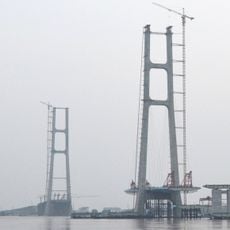
Jiujiang Yangtze River Bridge, Road and rail bridge in Jiujiang, China.
The Jiujiang Yangtze River Bridge is a road and rail crossing that carries traffic above and rail lines below on two separate levels. Its upper deck has four vehicle lanes alongside pedestrian paths, while trains run on two tracks on the lower level.
Planned as early as 1919 by Sun Yat-sen in his plan to make Jiujiang a north-south railway hub, the bridge was launched in December 1973 as the "702" project, a backup crossing should Wuhan and Nanjing bridges fail. Work halted in 1980 and again in 1984; Hu Yaobang's 1984 visit led to a proposal to build the road deck first with Jiangxi, Hubei and Anhui sharing costs. Construction resumed in April 1987; the road deck opened in January 1993 and the railway deck on 1 October 1994.
The bridge carries the Beijing–Kowloon railway and the Hefei–Jiujiang line, and National Highway 105 crosses on its upper deck. Each bank has a roughly 60-metre tower with a glass curtain wall, a lift and stairs linking riverside Binjiang Avenue to the road and rail decks; the ground floor holds an exhibition hall and the third floor a display on bridge-building techniques.
Drivers use the upper level while train passengers travel on the lower level, so you experience the crossing differently depending on your transport. Pedestrians can cross on the upper deck and see the river from above.
The bridge connects two provinces and serves as a major route for both trade and daily commuting between regions. Its combination of arch and truss design is more complex than typical river crossings in the country.
The community of curious travelers
AroundUs brings together thousands of curated places, local tips, and hidden gems, enriched daily by 93,861 contributors worldwide.