Nengren Temple, Buddhist temple in Xunyang District, China
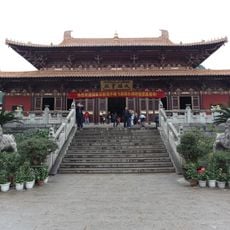
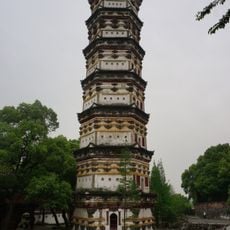
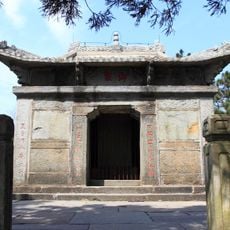
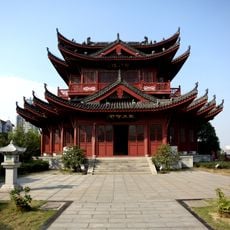
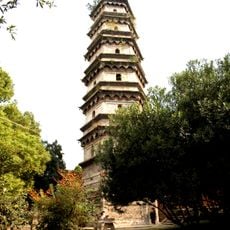
Nengren Temple is built along the slopes of a hill and divided into front, middle and rear routes. Its central axis runs from the Shanmen gate through Shuangyang Bridge, the Mahavira Hall, the Iron Buddha Hall and the Buddhist Texts Library. The seven-story Dasheng Pagoda, a 42.26-metre hexagonal brick-and-stone tower first built in 766, stands on the grounds.
Nengren Temple was first built between 502 and 549 under Emperor Wu of Liang and was called Chengtian Temple. It was rebuilt in the Dali period (766–779) of the Tang, destroyed by war in 1352, and rebuilt by the local government in 1379. In 1498, the second year of the Hongzhi era, it was renamed Nengren Temple.
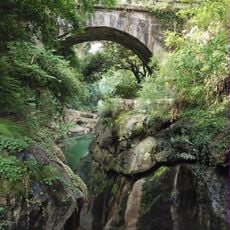
The temple's name changed from Chengtian Temple to Nengren Temple in 1498, during the Hongzhi era of the Ming dynasty. The Shuangyang Bridge, a marble three-arch span from the Yuanyou period (1086–1094), carries banisters engraved with flying phoenixes, lotuses, Hercules figures and monsters. The Iron Buddha cast in the same period was destroyed by Red Guards during the Cultural Revolution.
The temple stands in Xunyang District, Jiujiang, and is laid out along three routes up and down the hillside, so expect stairs between the gate, the halls and the pagoda. The central axis runs from the Shanmen through Shuangyang Bridge, the Mahavira Hall, the Iron Buddha Hall and the Buddhist Texts Library.
The Stone Boat is 5 metres long, 1 metre wide and 6 metres deep, and an iron Buddha was cast and placed on it during the Yuanyou period (1086–1094). Legend tells that a Northern Song monk dreamed of an iron Buddha ferrying across the river in a stone boat. Red Guards destroyed the iron statue during the Cultural Revolution.
The community of curious travelers
AroundUs brings together thousands of curated places, local tips, and hidden gems, enriched daily by 93,107 contributors worldwide.