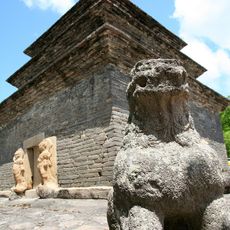
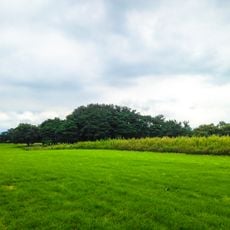
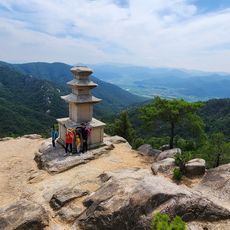
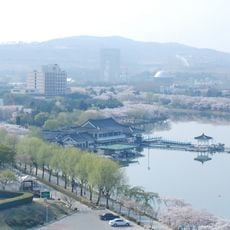
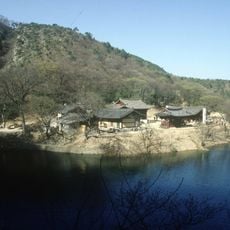
Tomb of Munmu of Silla, Royal tomb in North Gyeongsang, South Korea.
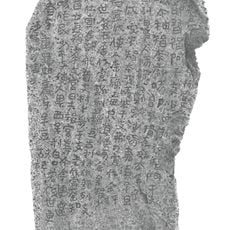
The Tomb of Munmu of Silla is an underwater royal tomb 200 metres off Bonggil-ri, Gyeongju, built on a rock that resembles a small rocky island. At low tide, surrounding rocks emerge like pillars. The monument on the rock collapsed soon after construction; two large sections and one small reddish-brown igneous stone (52 cm high, 64 cm wide, 24 cm thick) have been found. The Gyeongju National Museum manages the site.
Munmu (626–681), the 30th king of Silla, unified the Three Kingdoms of Korea and began building a temple on the eastern coast to guard against Japanese invasion. He died before it was finished, and his son King Sinmun completed it in 682 CE as Kamŭnsa. Munmu had asked that his body be cremated and his ashes buried in the East Sea, where his tomb was built in the belief that he would become a dragon and protect the land.
The city of Gyeongju holds a King Munmu culture festival in front of the tomb, reenacting the royal procession from Gamunsa temple to the tomb on the first day. Kites are flown and rituals dedicated to King Munmu are performed. A sunrise festival takes place near the tomb every New Year's Day, and the Chunhyang Daeje, a spring ancestral rite, draws more than 900 participants.
Visitors can view the tomb best during low tide when the stone formations become more clearly visible from the shore. Nearby viewpoints and cafes offer comfortable spots to observe and photograph the site without needing to enter the water.
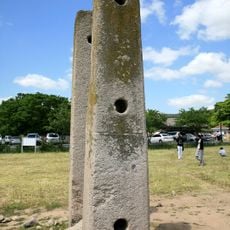
The tombstone could not be placed beside the body, so it is thought to have stood at Sacheonwang Temple, mentioned in the Samguk sagi. Its lower part was found in 1961; the upper part turned up in 2009, used as a laundry stone in a house in eastern Gyeongju.
The community of curious travelers
AroundUs brings together thousands of curated places, local tips, and hidden gems, enriched daily by 93,456 contributors worldwide.