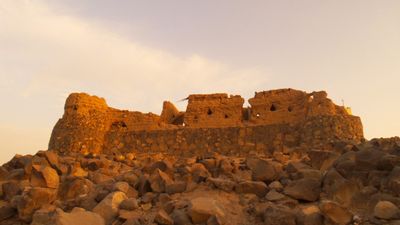
Ibn Thali Palace, ruined palace in Al-Mahani, near Taif, Saudi Arabia
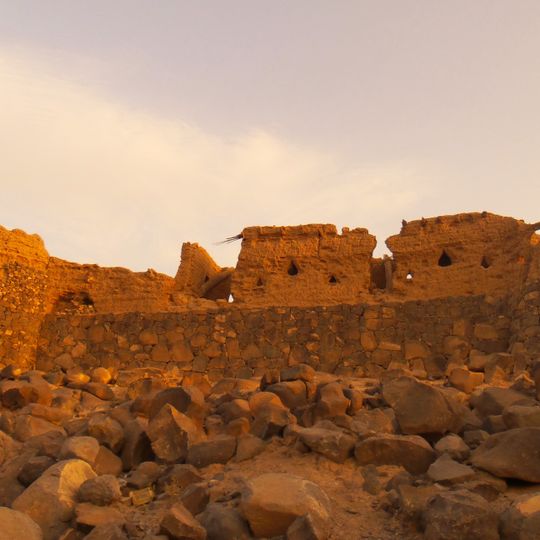
Ibn Thali Palace is a ruined two-storey complex of reddish-brown basalt and ochre mud-brick at Al-Mahani, about 170 km north of Taif. Its walls rise on a base of tightly packed irregular stones, with triangular and arched openings piercing the upper sections; the eastern of its two main palaces has largely vanished, leaving the western one standing. It covers roughly 2,000 square metres.
Ibn Thali Palace was built before 1118 AH (1707 AD) by the brothers Eid and Mu'tad, sons of Melfi Ibn Thali, in al-Mahani about 170 km north of Taif. It became the first base of the Saudi state in the Hejaz under Imam Saud al-Kabir, and Sheikh Eid Ibn Thali was among the first supporters of the Salafi call. In the third Saudi state the first banners of unification in the Hejaz set out from here under Sheikh Abdul Hadi Ibn Thali, and the palace served as the seat of the emirate and a security centre with a prison.
The palace takes its name from the Ibn Thali family, whose Sheikh Eid ibn Melfi ibn Thali and his brother Mu'tad built it before 1118 AH / 1707 AD. Eid was among the first supporters of the Salafi call in the Hejaz, and pilgrims on the old Zubeida route were protected from the palace. Sheikh Rakan ibn Hithlain visited it in 1290 AH.
The palace stands in Al-Mahani, about 170 km north of Taif, reached by the Taif road through Ashira, Al-Burka and Al-Hafair, or from Jeddah via Madrika and Rahat. It lies close to the old Darb Zubayda pilgrim route. Much of the structure is collapsed and long abandoned, so expect uneven ground and loose stone underfoot.
The palace held a prison in earlier periods and served as the seat of the emirate of Al-Mahani; its first emir was Sheikh Abdullah bin Muslih Ibn Thali in 1374 AH. In 1383 AH Sheikh Shabab bin Suwailih Ibn Thali took part in the Hodeidah campaign in Yemen under King Faisal.
The community of curious travelers
AroundUs brings together thousands of curated places, local tips, and hidden gems, enriched daily by 93,467 contributors worldwide.