White Horse Pagoda, Dunhuang, Buddhist monument in Dunhuang, China.
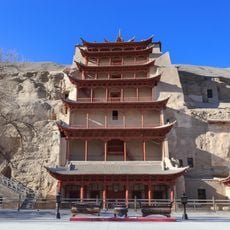
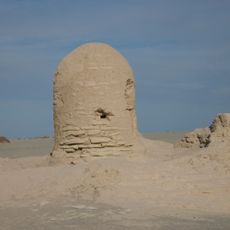
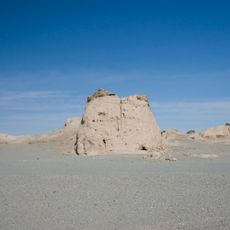
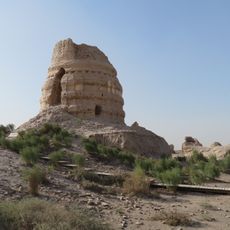
The White Horse Pagoda is a nine-story tower built from adobe bricks on an octagonal base, standing in the desert southwest of Dunhuang. It rises clearly above the flat, dry land around it and can be seen from a distance.
The pagoda commemorates Tianliu, the white horse that carried Buddhist scriptures from Kucha to Dunhuang around 384 CE with the monk Kumārajīva. Legend holds that the horse fell ill and died at Puguang Temple, where Kumārajīva built the pagoda after nine days of rites. Repairs are recorded in the Daoguang era (1821–1851) and again in 1992; Gansu lists it as a provincial cultural relic.
The pagoda takes its name from the horse that accompanied a Buddhist monk on his long journey carrying sacred texts. Visitors today find incense burners and small offerings left by people who come to pay respect to the animal.
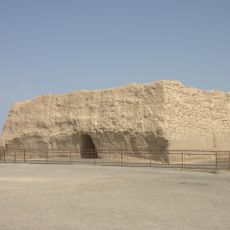
The site sits in open desert, so visitors should bring water and sun protection, as shade is almost nonexistent. Going in the early morning or late afternoon makes the heat more manageable.
Local people say the chime of the bells hanging at the corners of the hexagonal plate on the eighth level echoes the neighing of Tianliu, the white horse. The pagoda was built as a memorial, not a tomb: sources record no burial of the horse's ashes beneath it.
The community of curious travelers
AroundUs brings together thousands of curated places, local tips, and hidden gems, enriched daily by 93,148 contributors worldwide.