Ex-monastery of Santiago Apóstol, Dominican monastery in Cuilapan de Guerrero, Mexico
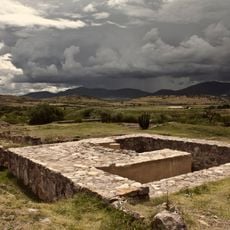
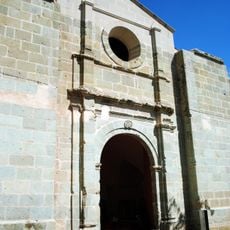
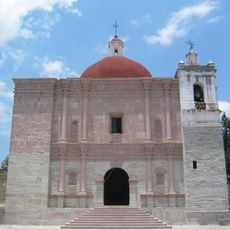
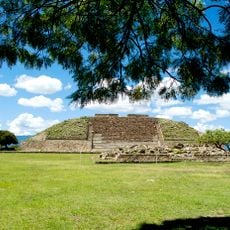
The Ex-monastery of Santiago Apóstol stands on a small hill in Cuilapan de Guerrero, built of green quarried stone and river rocks. Its walled atrium leads to a three-aisled, roofless basilica whose arcades, carved with geometric motifs, were meant to hold a roof, and to two round towers capped by conical vaults and crosses. A two-story cloister, a portería and small corner chapels complete the complex.
The Dominicans settled in Cuilapan in 1550 and received a building license from viceroy Luís de Velasco in 1555; work began in 1556 with Antonio de Barbosa as designer. Construction was halted in the 1570s for reasons that remain unclear: lack of funds, a dispute over whether the Cortés family or the Crown should pay, or the fall of the native population from some 43,000 in the 1520s to 7,000 in 1600. The pause became permanent, and the complex was secularized in 1753.
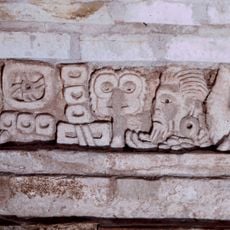
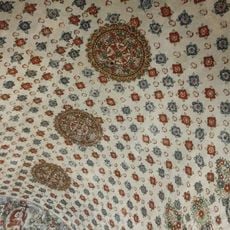
The monastery's murals show indigenous Mixtec and Zapotec elements worked into Christian imagery, a deliberate strategy to support evangelization. The complex was the centre of political, economic, social and religious life in Cuilapan, and its name comes from Santiago Apóstol, to whom the monastery is dedicated.
The site welcomes visitors every day and is easily reached by bus from Oaxaca City nearby. Comfortable walking shoes are recommended since you will explore stone hallways and courtyards throughout the grounds.
The unfinished basilica creates natural echoes as footsteps and voices resonate through the stone hallways and open courtyards. This acoustic quality may have been intentional, designed to enhance the sound of liturgical chants and processions.
The community of curious travelers
AroundUs brings together thousands of curated places, local tips, and hidden gems, enriched daily by 94,354 contributors worldwide.