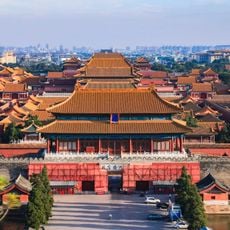
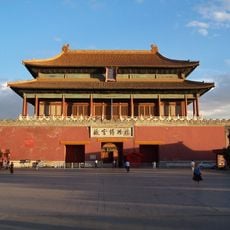
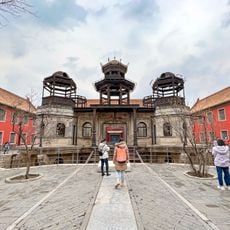
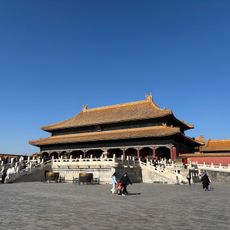
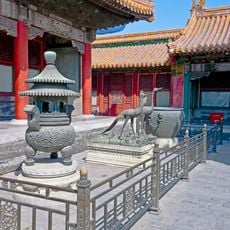
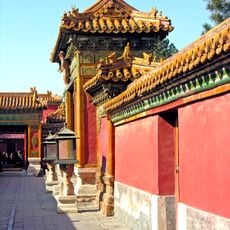
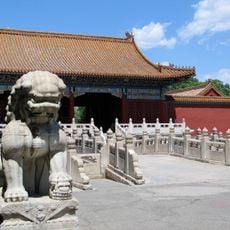
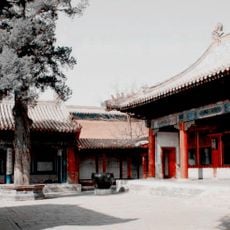
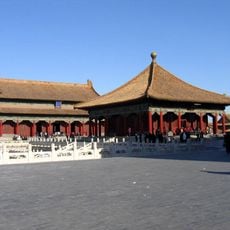
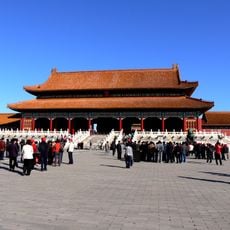
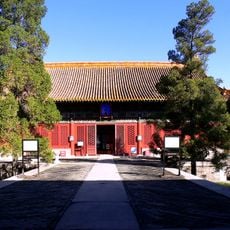
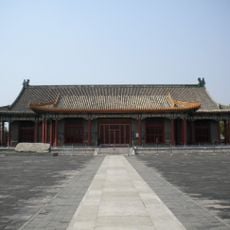
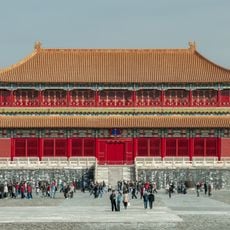
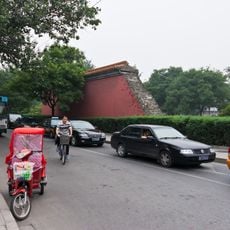
Belvedere of Spreading Righteousness, Imperial pavilion in Forbidden City, Beijing, China.
The Belvedere of Spreading Righteousness (Hongyi Ge) stands on the west side of the square before the Hall of Supreme Harmony in the Forbidden City's Outer Court, facing the Belvedere of Embodying Benevolence (Tiren Ge) to the east. The present structure preserves timberwork from a 1627 (Tianqi 7) rebuilding. It is a two-storey tower 23.8 m high, about seven-tenths the height of the hall, with a hip roof and a waist eave and balcony between the floors.
Built in 1420 under the Ming Yongle emperor as the "Martial Tower", it was renamed Wucheng Pavilion in 1562 and received its present name in 1646 under the Qing. In the Qing dynasty its side galleries held the six storehouses of the Imperial Household Department's Treasury, keeping gold, silver, coins, jewels and the gold and silver vessels used at imperial banquets.
The name changed over time: it was the "Martial Tower" under the early Ming, became the "Tower of Martial Completion" in 1562, and received its present name in 1646 under the Shunzhi emperor. In the Qing period its side galleries housed the six storehouses of the Imperial Household Department's Treasury, holding gold, silver, coins, jewels and the gold and silver vessels used at imperial banquets.
The pavilion is part of the Forbidden City and can be visited as part of exploring the complex. Early morning hours offer a better experience with fewer crowds.
The Manchu name of the Belvedere of Spreading Righteousness is Jurgan be Selgiyere Asari. The building was rebuilt in 1627, during the Ming Tianqi reign, and its Ming-era timber frame survives. In 2005 it reopened with an exhibition of Qing court ritual music, reconstructing pieces such as the Zhonghe Shaoyue.
The community of curious travelers
AroundUs brings together thousands of curated places, local tips, and hidden gems, enriched daily by 93,849 contributors worldwide.