The Palace Museum, National museum in Donghuamen, Beijing, China
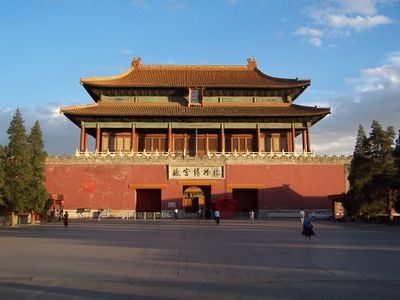
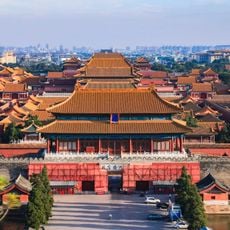
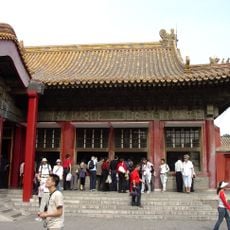
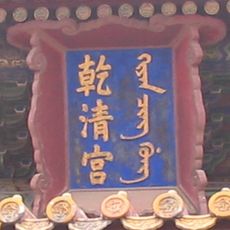
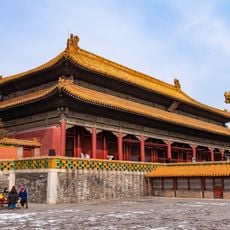
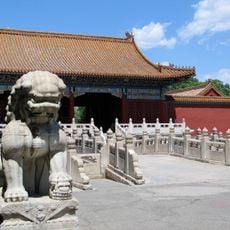
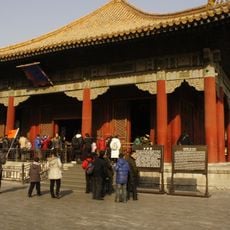
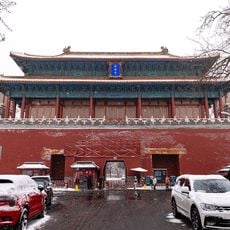
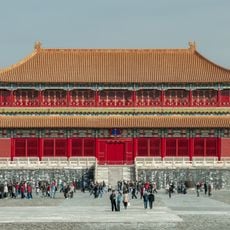
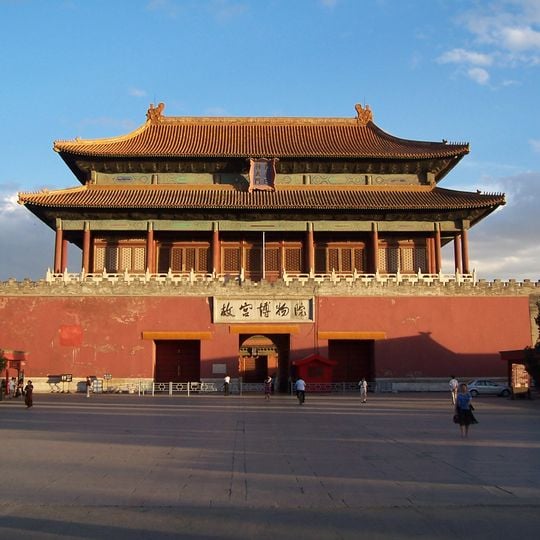
The Palace Museum occupies the Forbidden City, built from 1406 to 1420 and covering 720,000 square metres with 980 surviving buildings. Its entrance front has a deep red wall with three doorways, the central one under a small roof and a blue plaque with gold characters reading 故宫博物院. Above, red columns, green and blue painted beams and golden-yellow roof tiles with upturned eaves rise behind a white stone balustrade.
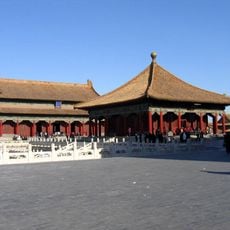
The Forbidden City was built between 1406 and 1420 during the Ming Dynasty and served as the center of imperial power for over 500 years. After the monarchy ended, the site was transformed into a museum and now preserves this exceptional architecture.
The name reflects its past as an imperial residence, with different courtyards and halls showing how the royal household was organized by rank and function. Walking through these spaces, visitors can see how daily life followed strict rules about who could enter where.
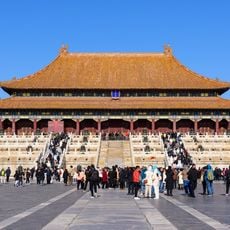
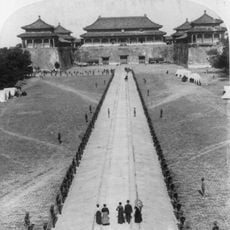
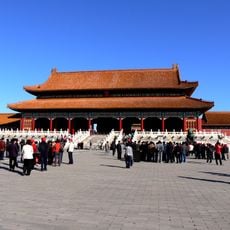
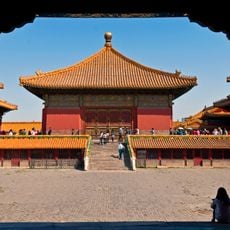
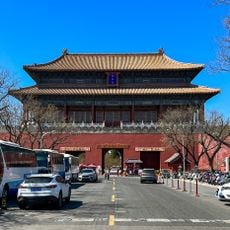
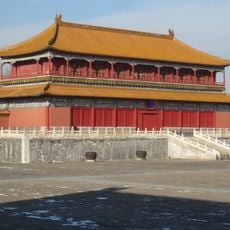
Since 2011 visitors follow a one-way route, entering through the Meridian Gate (Wumen) in the south and leaving by the Gate of Divine Prowess (Shenwumen) in the north, with the East Glorious Gate also used as an exit. Since 2015 daily admissions are capped at 80,000, so book ahead. The complex covers 720,000 square metres and holds 980 buildings, and the central halls are reached by stepped stone terraces.
The museum preserves large quantities of ritual objects that emperors used during ceremonies, many of them hundreds of years old. These items offer a rare window into the religious and political rituals that shaped imperial life.
The community of curious travelers
AroundUs brings together thousands of curated places, local tips, and hidden gems, enriched daily by 92,793 contributors worldwide.