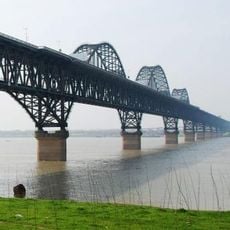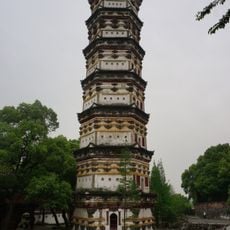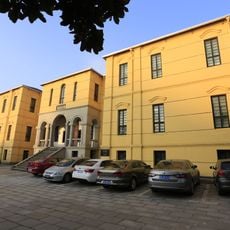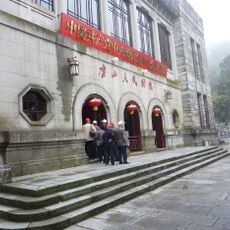
Bianyuzhou Yangtze River Bridge, Railway and cable-stayed bridge in Huangmei County and Chaisang District, China.
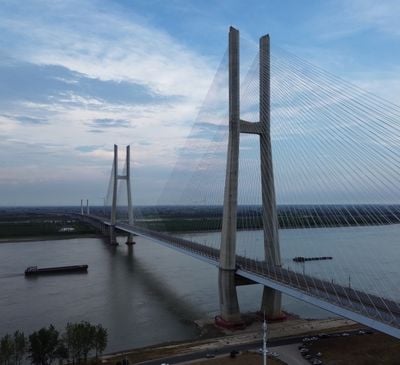
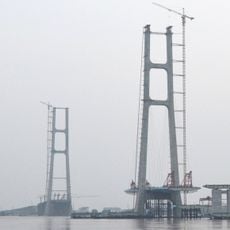
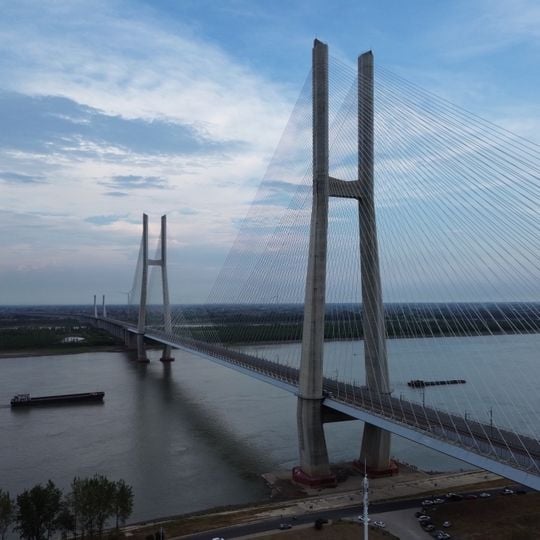
The Bianyuzhou Yangtze River Bridge is a four-track railway cable-stayed bridge across the Yangtze between Huangmei County, Hubei, and Chaisang District, Jiujiang. Its 1,320 m main span, with a 672 m cable-stayed opening, is carried by two 242 m H-shaped concrete pylons; the deck mixes a 1,060 m steel box girder with a 262 m concrete box girder.
Geological surveys for the pylon foundations began in March 2015, and the northern pylon's steel-pipe foundation was finished by late 2017. The main span was closed in June 2021, and the bridge opened on 30 December 2021 with the Anjiu high-speed railway. Its 5th pylon, 242 m tall, required pile drilling to 110 m, the deepest in Chinese high-speed rail construction.
The bridge carries the Beijing–Hong Kong high-speed line and a parallel conventional railway, opened with the Anjiu high-speed railway on 30 December 2021. Its name comes from Bianyu Island ("bream islet") in the Jiujiang waterway, which the viaduct crosses between the two cable-stayed spans.
The bridge carries only rail traffic, so it cannot be walked or driven across; views come from the riverbanks and from the Jiujiang Yangtze River Highway Bridge about 5.3 km downstream. The main span clears the navigation channel at a height of 24 m, and the deck sits 672 m between the two pylons, so the whole crossing is best taken in from a distance.
The main span of 672 metres is carried by two H-shaped concrete pylons, and the bridge was the first in China to use crossed stay cables, a measure that compensates for the limited stiffness of its long steel box girder. The deck carries four railway tracks: two passenger lines and two reserved freight lines.
The community of curious travelers
AroundUs brings together thousands of curated places, local tips, and hidden gems, enriched daily by 93,233 contributors worldwide.