Ventarron, Archaeological temple in Pomalca district, Chiclayo province, Peru
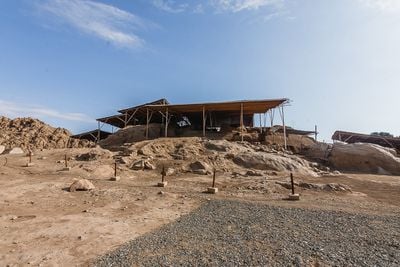
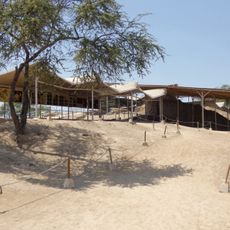
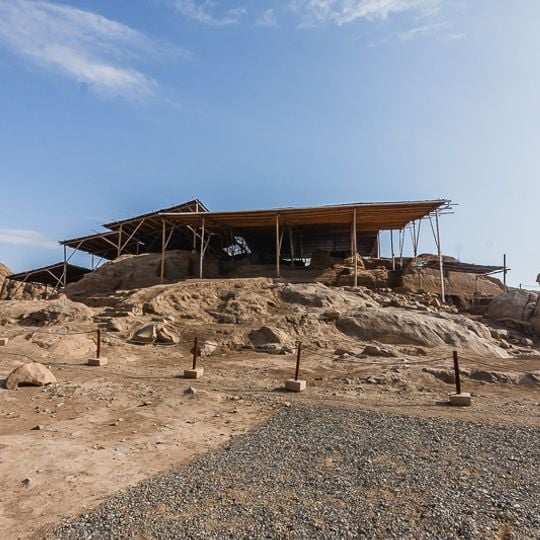
Ventarrón is a temple complex covering about 2,500 square meters in the Pomalca district, built around 2300 BC from irregular mud blocks made of river sediment rather than stone or adobe. Its walls carry the oldest painted murals found in the Americas: a deer caught in a net on two walls, surrounded by red-and-white zigzag designs. A stairway leads to a fire altar. The main structure now stands under a flat roof of woven material supported by thin dark poles on a mound of earth and stones.
Ventarrón was built around 2300 BC, according to carbon-14 dating, and its people buried the temple when they finished using it, which helped preserve it for millennia. Much of the surrounding area was looted in 1990 and 1992, but the temple itself was not found. Walter Alva's team, with his son Ignacio, excavated it in 2007; Ignacio Alva has directed work since, uncovering a high-relief Cupisnique frieze.
The name Ventarrón comes from the hill beside the temple. Its murals, dated to about 2300 BC, show a deer caught in a net on two walls, framed by red-and-white zigzag designs. Excavations found the skeletons of a parrot and a monkey from Peru's jungle and shells from coastal Ecuador, traces of exchange with distant regions.
Ventarrón lies in the Pomalca district, about 15 km east of Chiclayo and 1 km from the Reque River, on the west slope of the hill of the same name. The excavated complex covers roughly 2,500 square metres. The site is reached from Chiclayo via Pomalca; the temple was long buried and much of the surrounding area was looted in 1990 and 1992.
The temple was deliberately buried by its builders when they finished using it, which helped preserve it for thousands of years. Looters dug at the site in 1990 and 1992 without finding the temple, and locals had long taken blocks from the mound for their own houses.
The community of curious travelers
AroundUs brings together thousands of curated places, local tips, and hidden gems, enriched daily by 94,119 contributors worldwide.