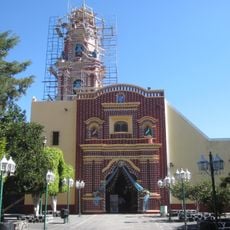
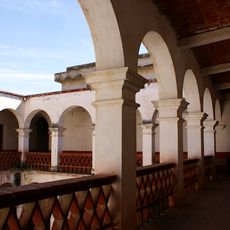
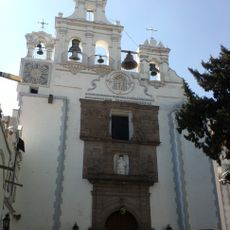
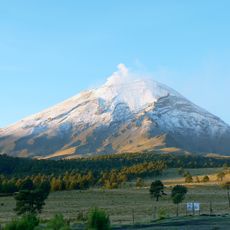
Teotón, Archaeological site on hill in Puebla, Mexico.
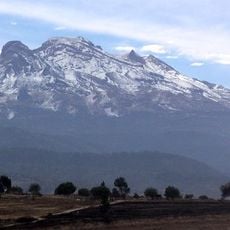
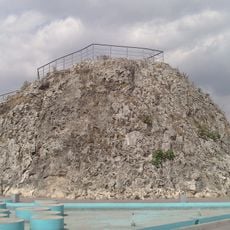
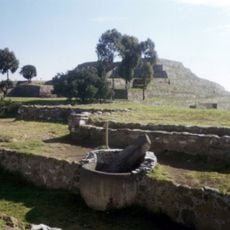
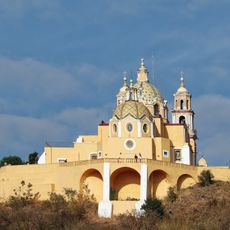
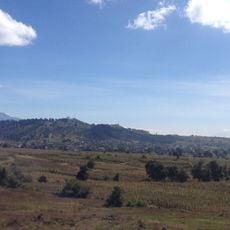
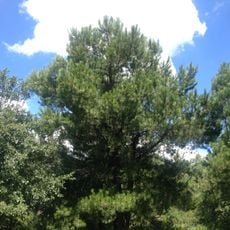
Teotón is a hill on the eastern slopes of the Popocatépetl volcano, in the municipality of San Nicolás de los Ranchos, Puebla, whose summit holds a Mesoamerican pyramidal base that is not visible as such today. A short climb leads to a stairway and a small sanctuary at the top, near which stand a microwave antenna and a geodetic marker. The Atlanepantla river and its deep ravine border the hill to the northwest-southeast.
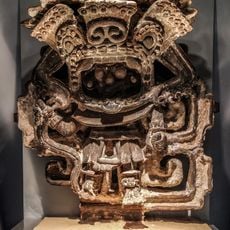
The hill itself formed from the Mayorazgo debris avalanche, when the older Pies cone of the Iztaccíhuatl collapsed about 36,000 years ago. In pre-Hispanic times the Teotón area was used to venerate the "Gran Dios", asked for abundant rains; a pyramidal base still lies in the hill, unrecognised as such today.
The name Teotón comes from Nahuatl for "idol". In pre-Hispanic times the hill was used to venerate the "Great God", asked for abundant rains. This tradition survives in the syncretic Fiesta del Cerro, held every June at the start of the rainy season.
The hilltop is reachable on foot, though some paths are steep and require sturdy hiking shoes. It is better to arrive early in the morning to avoid heat and explore the ruins with better visibility.
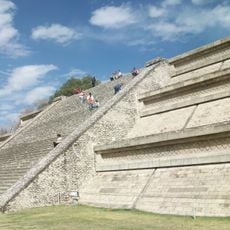
Some researchers propose that a straight line drawn from Teotón to the Great Pyramid of Cholula passes directly over the crater of the Tecajete hill. A bolder hypothesis makes Teotón the axis mundi, the vertex of a huge parallelogram formed with Cholula, Popocatépetl, the Apatlaco hill and the Montero hill in Coronango.
The community of curious travelers
AroundUs brings together thousands of curated places, local tips, and hidden gems, enriched daily by 94,230 contributors worldwide.