Grey Goat Temple, Taoist temple in Chengdu, China
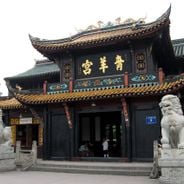
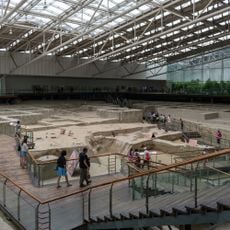
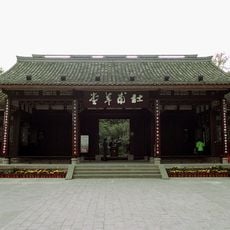
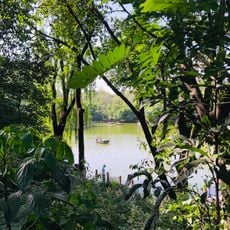
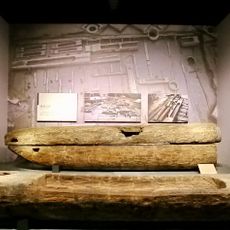
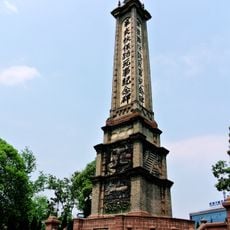
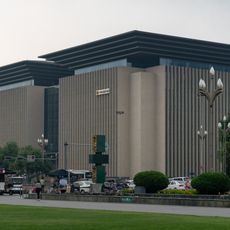
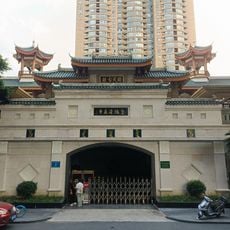
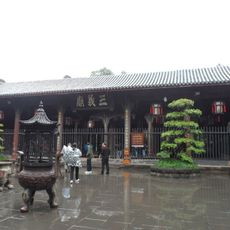
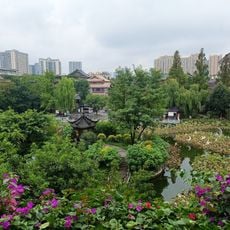
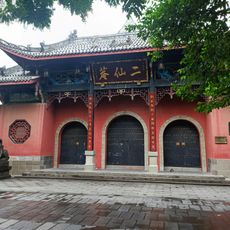
Qingyang Gong, the Grey Goat Temple, stands at No. 9, Second West Section of the First Ring Road in Chengdu's Qingyang District, beside the Jin River. Its rebuilt Qing-era halls include the octagonal Bagua Pavilion, about 20 metres tall with gilded dragons and a figure of Laozi on an ox, the Sanqing Hall, the Doumu Hall, the Lingzu Hall, the Qiankun Hall and the Tangwang Hall on a hill. An old ceramic kiln also survives on the grounds.
Founded in 491 BC as Qingyang Si, a market, the temple was renamed Xuanzhong Guan in the early Tang. In 881 Emperor Xizong took refuge here during Huang Chao's rebellion, then funded its expansion and gave it the name Qingyang Gong. Ming-era warfare destroyed the Tang buildings; the present halls were rebuilt between 1667 and 1671, under Kangxi.
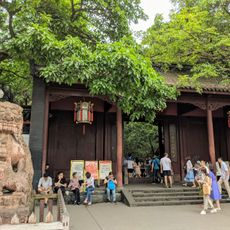
The name Qingyang, "Green Goat," comes from the legend of a boy sent by the Green Emperor who appeared as a goat at this spot. The district of Qingyang is named after the temple. Visitors rub the bronze goats' heads and bellies to cure headaches and stomachaches, which has polished the metal.
The temple stands at No. 9, Second West Section of the First Ring Road, beside the Jinjiang River, in Qingyang District. The Bagua Pavilion rises about 20 metres, and the Tang Emperor Hall sits on a hill within the grounds, so allow time for stairs and uneven paving. The old ceramic kiln on the site is easy to miss.
The single-horned bronze goat before Sanqing Hall was donated in 1723 by Zhang Penghe, a grand secretary of the Qing court; the two-horned one came from a Chengdu believer, Zhang Ke, in 1829. Worshippers rub its belly and head to cure stomach and head aches, which is why the bronze shines.
The community of curious travelers
AroundUs brings together thousands of curated places, local tips, and hidden gems, enriched daily by 93,518 contributors worldwide.