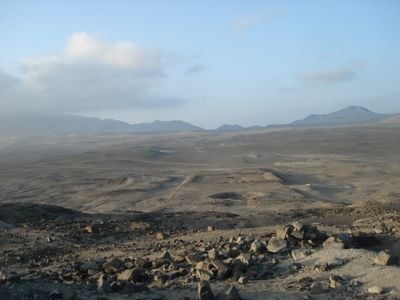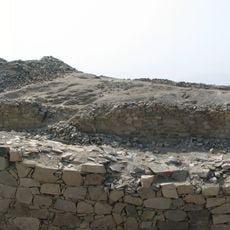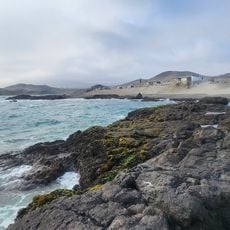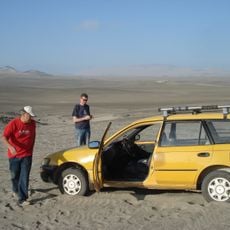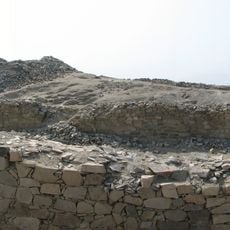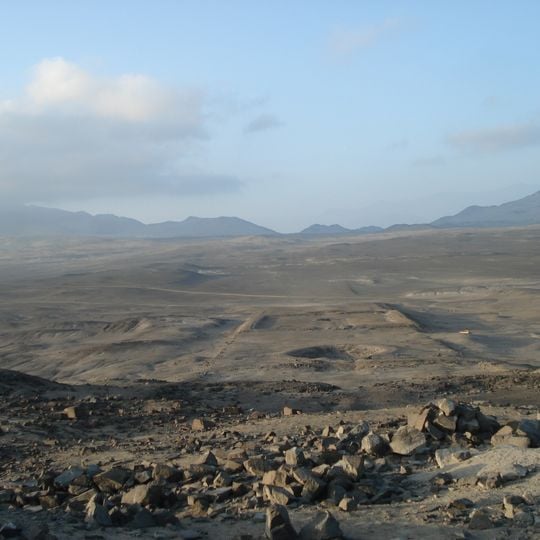
Las Haldas, Archaeological site near Pacific coast in Casma District, Peru.
Las Haldas is an archaeological site on Peru's Pacific coast with stone structures spreading across roughly 40 hectares, featuring a U-shaped central area, large mounds, elevated plazas, and residential zones. The layout of these structures shows careful urban planning with distinct areas for different activities.
Discovered in 1955 by Swiss archaeologist Frédéric André Engel, Las Haldas was occupied from roughly 1925 to 1410 BCE, spanning the Late Archaic and Formative periods. Most monumental construction took place in two phases, the first beginning around 2000 BCE and the second around 1400 BCE, when the site reached its apex. After 1000 BCE it was gradually abandoned as irrigation agriculture gained importance.
The inhabitants maintained trade relationships with inland communities, exchanging marine products for agricultural goods from the Casma River valley settlements. These connections show how the center functioned as a meeting point between coast and highlands.
Access is by road from Lima on the Panamericana Norte to kilometre 345, near the fishing cove of La Gramita in Casma district. The site lies on arid desert terrain between 30 and 60 metres above sea level, with no vegetation and almost no shade, so carry water and sun protection. A visitor circuit was inaugurated on 26 April 2019.
The settlement demonstrates how early cultures flourished without agricultural foundations, relying entirely on marine resources. This development challenges the common assumption that all ancient civilizations depended on farming.
The community of curious travelers
AroundUs brings together thousands of curated places, local tips, and hidden gems, enriched daily by 92,657 contributors worldwide.