Chankillo, Archaeological site in Casma, Peru.
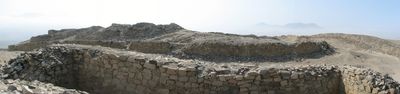
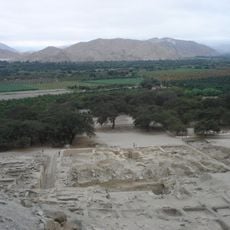
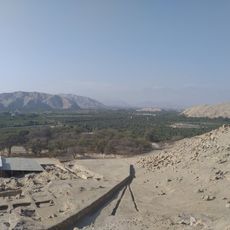
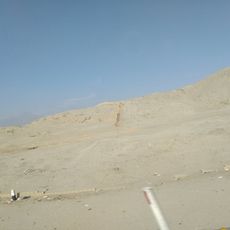
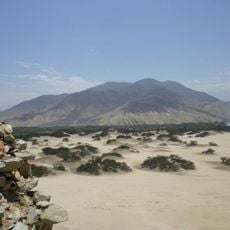
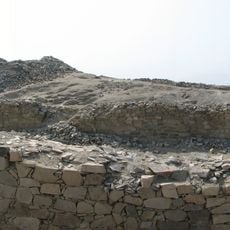
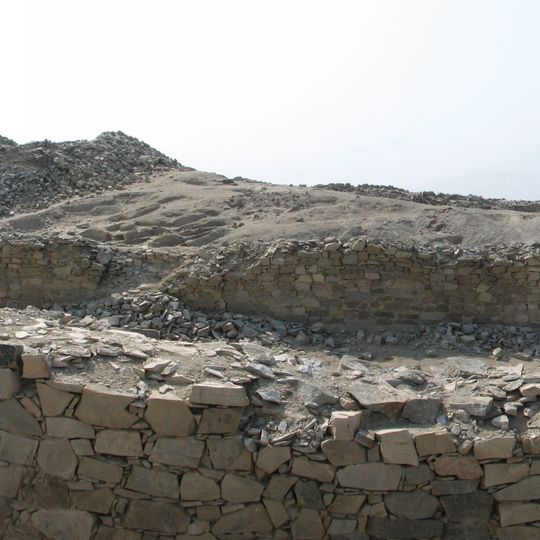
Chankillo is an ancient monumental complex in the Casma-Sechin basin of Peru's coastal desert, covering about four square kilometres. It comprises the hilltop Chankillo fort, residential and gathering areas, and the Thirteen Towers, built of flat, roughly shaped stones set in courses on the ridge of a low hill running near north to south. The towers form a toothed horizon with narrow gaps at regular intervals, and ruined masonry walls of gray, tan and brown stone stand among fallen rubble.
The Casma/Sechin culture built Chankillo in the third century BC, according to most research; a Chinese-language source dates the Thirteen Towers to the fourth century BC. The towers were known to travellers for 200 years, but their astronomical function was only established in 2007 by Iván Ghezzi and Clive Ruggles. UNESCO listed the complex as a World Heritage Site in July 2021.
The towers were built by the Casma/Sechin culture, the society that also raised the hilltop fort and the residential areas of Chankillo. The name Chankillo is used for the whole complex, while the thirteen towers form a toothed horizon of narrow gaps along a low ridge. Visitors can still walk the ridge and see how the towers line up with the sun's rising and setting points.
The best time to visit is the dry season from April to October when weather is stable and clear. Bring water, sun protection, and sturdy shoes since the ground is uneven and the sun is strong.
The towers were known to travellers for about 200 years, but their astronomical purpose was only established in 2007 by Iván Ghezzi and Clive Ruggles. From the two observation points east and west of the ridge, the 300 m line of towers matches the sun's rising and setting positions over the year, though not all towers are visible at once.
The community of curious travelers
AroundUs brings together thousands of curated places, local tips, and hidden gems, enriched daily by 92,667 contributors worldwide.