Tell al-'Ubaid, Archaeological site in Dhi Qar Governorate, Iraq.
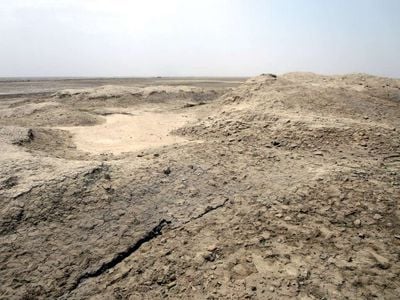
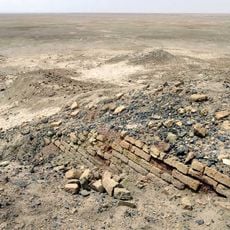
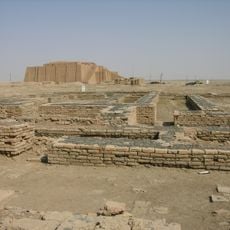
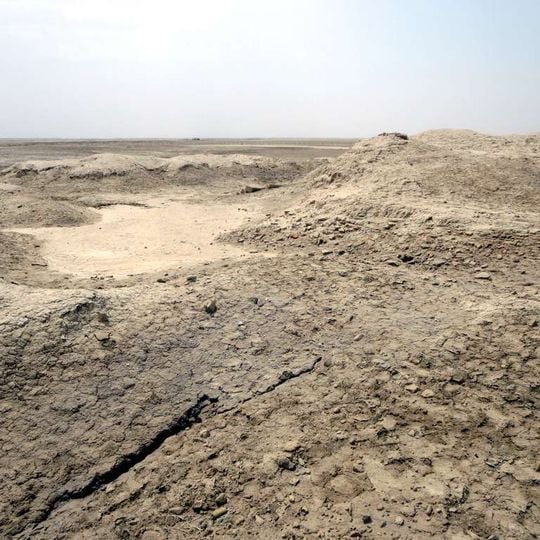
Tell al-'Ubaid is an oblong tell about 500 m north to south and 300 m east to west, rising roughly 2 m above the plain in Dhi Qar Governorate. Its surface is bare, cracked earth with loose stones and a shallow eroded channel; a fan of Ubaid pottery shards and lithics spreads to the south and southwest. The Ninḫursaĝ temple outcrop, 50 m long and 7 m high, sits on the northern edge.
Tell al-'Ubaid is the type site of the Ubaid period, a Chalcolithic culture of southern Mesopotamia. Henry Hall of the British Museum first excavated there in 1919, working on the temple of Ninhursag; C. L. Woolley followed in 1923–1924, and Seton Lloyd and Pinhas Delougaz in 1937. Foundation tablets name A'annepada, son of Mesannepada of Ur's First Dynasty, as temple builder, and Shulgi of Ur III later rebuilt on the same spot.
The site's ancient name is unknown; Nutur has been proposed from a year-name of Shulgi, ruler of the Ur III empire (c. 2094–2046 BC), recording that Ninhursag of Nutur was brought into her temple. The mound gave its name to the Ubaid period, whose pottery was largely wheel-made and painted with broad black bands forming geometric, plant and animal motifs.
The site lies about seven kilometers west of Ur and 17 kilometers north of Eridu, reached by road through open desert; there is no on-site shelter, shade or facilities. The oblong mound rises only about two meters above the plain, so the temple area on its northern edge and the low hillock 60 meters to the south-southeast are easy to walk between. Bring water and sun protection, and plan around midday heat.
Tell al-'Ubaid gives its name to the Ubaid period, the Chalcolithic era for which it is the type site. Its Ubaid pottery was largely wheel-made and painted with broad black bands forming geometric, plant and animal motifs. A. M. T. Moore found Ubaid kilns with numerous wasters about 100 metres south of the temple in 1990.
The community of curious travelers
AroundUs brings together thousands of curated places, local tips, and hidden gems, enriched daily by 92,588 contributors worldwide.