See the monuments around you in AROpen chests in the app
Around Us is built for your phone — point your camera at the streets and discover the monuments and places around you in augmented reality.Around Us is built for your phone — chests unlock when you walk, explore and capture nearby places.
Architecture does not have to follow straight lines and right angles. This collection presents buildings that stand out through their form: domes, spirals, tilted facades or organic structures that recall animals or plants. From Gaudí's mosaic covered works in Barcelona to the stacked concrete cubes of Habitat 67 in Montreal or the conical trulli of Alberobello, these structures demonstrate alternative approaches to construction.
Some emerged from technical necessity, such as the temporary cardboard cathedral in Christchurch after the 2011 earthquake. Others are artistic statements: the Guggenheim Museum in Bilbao with its titanium plates, the Dancing House in Prague or the cubist houses in Rotterdam. In Đà Lạt, the Crazy House transforms tree trunks and caves into habitable spaces, while the Atomium in Brussels represents a magnified iron crystal.
These structures attract visitors but also raise questions about function and livability. The Longaberger Basket Building in Ohio takes the form of a seven story basket. The Lotus Temple in New Delhi uses concrete shells to form 27 petals. The Aldar headquarters in Abu Dhabi resembles a circular coin. These buildings expand the definition of what architecture can be.
Architecture does not have to follow straight lines and right angles. This collection presents buildings that stand out through their form: domes, spirals, tilted facades or organic structures that recall animals or plants. From Gaudí's mosaic covered works in Barcelona to the stacked concrete cubes of Habitat 67 in Montreal or the conical trulli of Alberobello, these structures demonstrate alternative approaches to construction.
Some emerged from technical necessity, such as the temporary cardboard cathedral in Christchurch after the 2011 earthquake. Others are artistic statements: the Guggenheim Museum in Bilbao with its titanium plates, the Dancing House in Prague or the cubist houses in Rotterdam. In Đà Lạt, the Crazy House transforms tree trunks and caves into habitable spaces, while the Atomium in Brussels represents a magnified iron crystal.
These structures attract visitors but also raise questions about function and livability. The Longaberger Basket Building in Ohio takes the form of a seven story basket. The Lotus Temple in New Delhi uses concrete shells to form 27 petals. The Aldar headquarters in Abu Dhabi resembles a circular coin. These buildings expand the definition of what architecture can be.
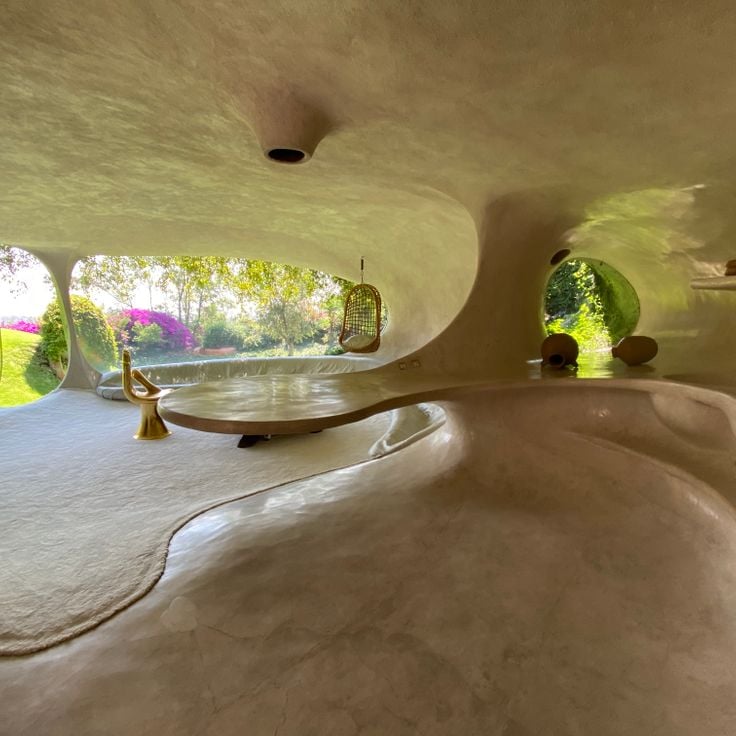
This residential building in Naucalpan de Juárez follows the spiral geometry of a sea shell, demonstrating an organic approach to form. The Nautilus House uses curved lines and flowing transitions between spaces, with concrete and colored glass forming the exterior structure. The architecture avoids right angles and straight walls, creating interior spaces that recall natural caves. Entrances and windows integrate into the organic form, while the staircase follows the internal spiral. The building belongs to those structures that treat living space as a sculptural object and demonstrates how far residential architecture can depart from conventional building forms.
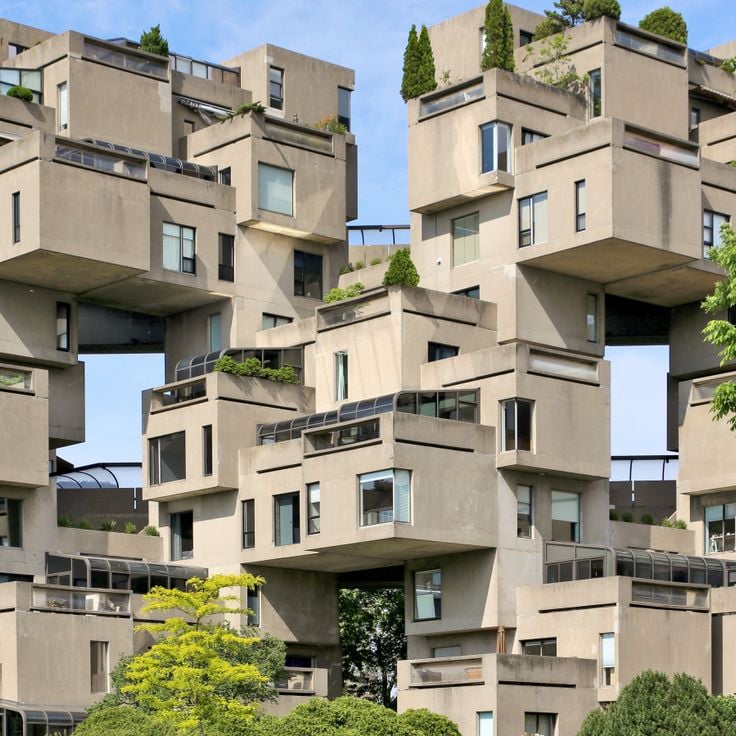
This residential complex designed for the 1967 World's Fair comprises 354 identical concrete modules forming 146 residences across twelve stories. Architect Moshe Safdie developed a modular construction method where each unit includes a private terrace, giving residents outdoor space despite the high density. The stacked arrangement created an alternative to conventional high-rise buildings and demonstrated new possibilities for urban living. Habitat 67 stands along the Saint Lawrence River and continues to function as an inhabited structure.
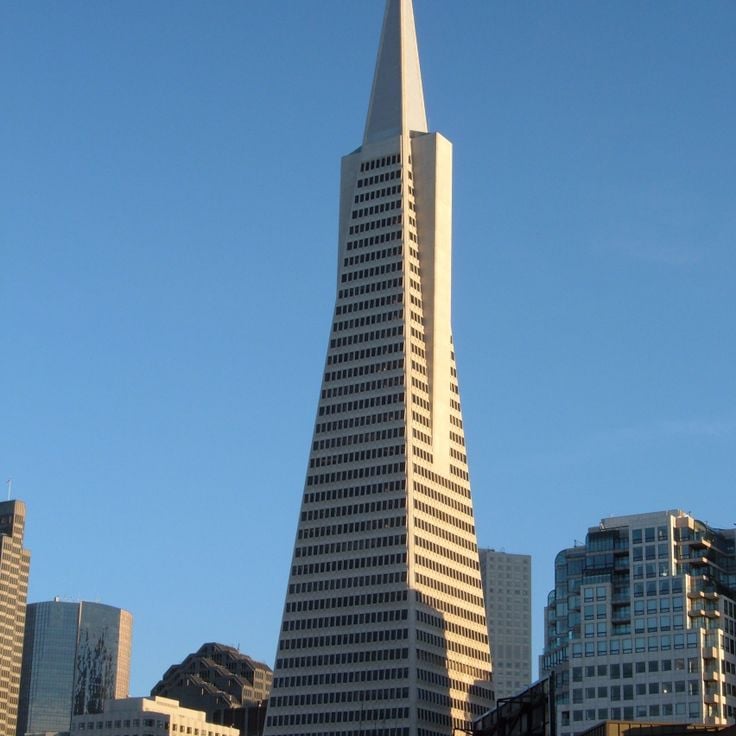
The Transamerica Pyramid has defined San Francisco's skyline since its completion in 1972. This 850-foot office tower uses its pyramidal form to meet structural requirements in a seismically active zone. The reinforced concrete frame supports a glass facade, while the tapering shape provides added stability during earthquakes. The building rises 48 stories and served for decades as headquarters for the Transamerica Corporation. Today it houses various office tenants and stands as an example of functional high-rise architecture from the early 1970s.
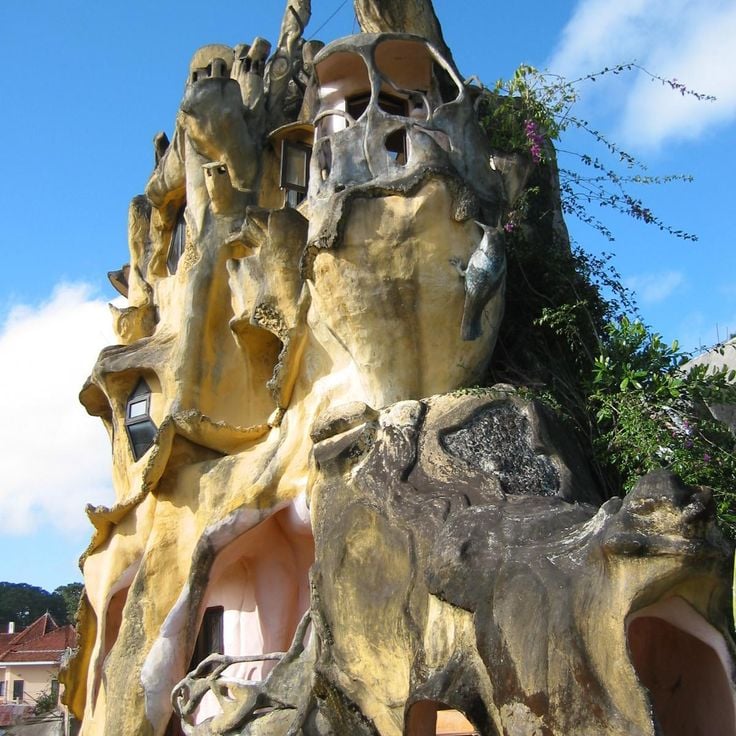
This hotel in Đà Lạt takes the form of an organic treehouse with curving walls, tunnels and bridges. Vietnamese architect Dang Viet Nga designed the building as an inhabitable sculpture where natural forms merge with functional spaces. Guest rooms fit within the flowing structure while passages and staircases wind through the multilevel complex. The design abandons right angles and straight lines in favor of continuous curved architecture that recalls grown organisms. Visitors can explore the interwoven levels and experience the unconventional spatial arrangements throughout the property.
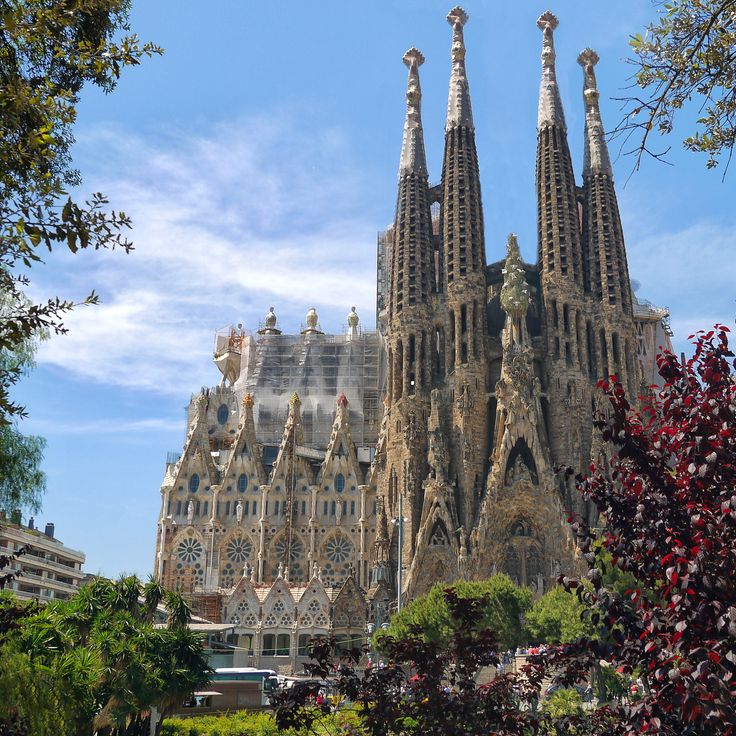
The Sagrada Familia is a Roman Catholic basilica with multiple tall towers and complex geometric forms that has been under construction since 1882, initiated under the direction of Antoni Gaudí. This structure combines Gothic architecture with organic elements and demonstrates Gaudí's characteristic use of natural forms in the design of the facades and interior spaces. The basilica features three main facades that each represent different aspects of Christ's life, and an interior with inclined columns that mimic a forest canopy. The ongoing construction makes the Sagrada Familia one of the longest architectural projects in the world.
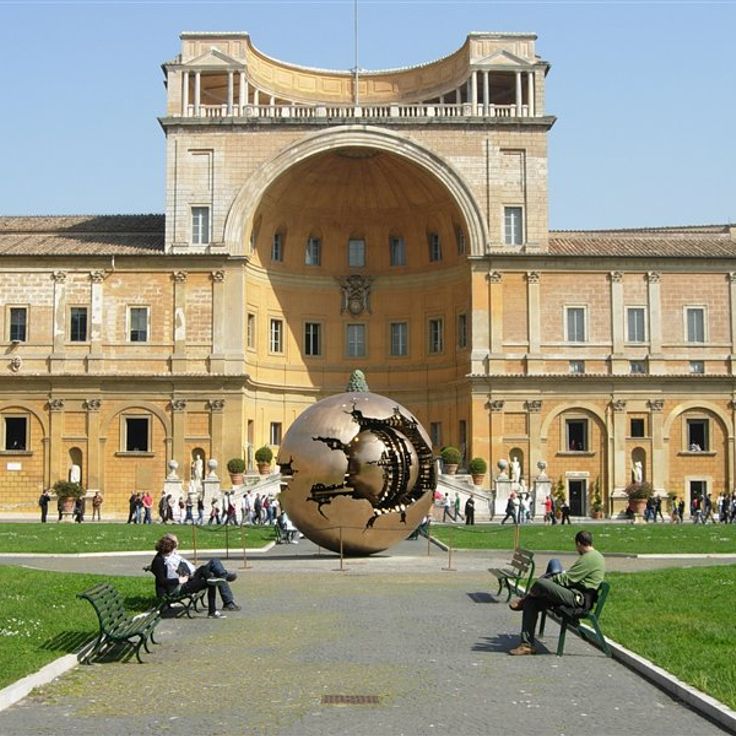
This bronze sculpture by Arnaldo Pomodoro stands in the courtyard of the Vatican Museums and features an outer sphere with a fractured surface that reveals a complex inner sphere. The work, approximately 13 feet (4 meters) tall and dating from the 1990s, belongs to a series of similar sculptures the Italian artist created for locations worldwide. The mechanical gears and geometric patterns visible inside contrast with the smooth outer shell and demonstrate Pomodoro's distinctive approach to form and surface.
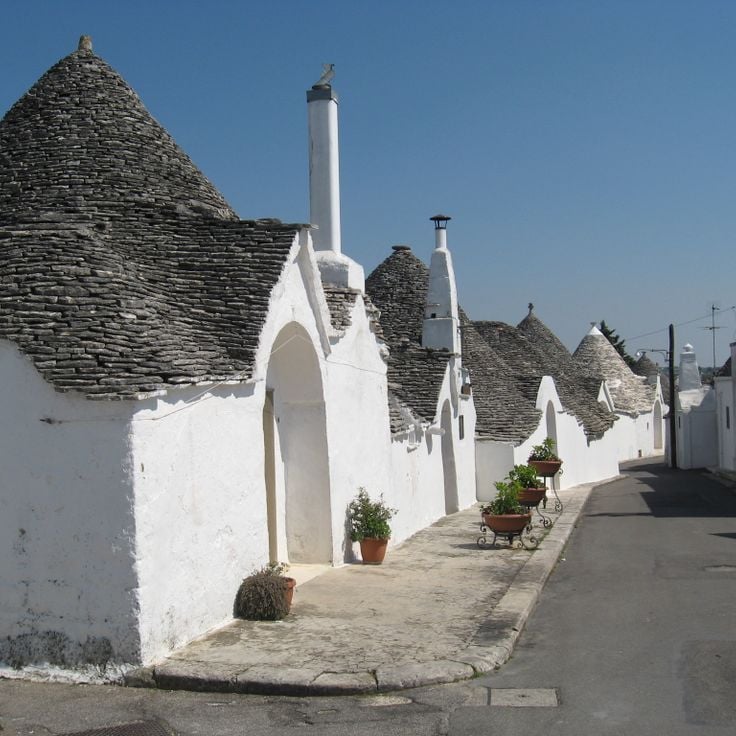
These traditional limestone structures from the 14th century define Alberobello's architecture with their conical roofs and dry stone construction. The trulli were built without mortar, with roof stones that could be removed when needed. This construction method allowed residents to quickly dismantle the buildings to avoid taxes on permanent structures. Today more than 1,500 of these buildings stand in the town, which is recognized as a UNESCO World Heritage site and represents a notable example of prehistoric building techniques that survived into modern times.
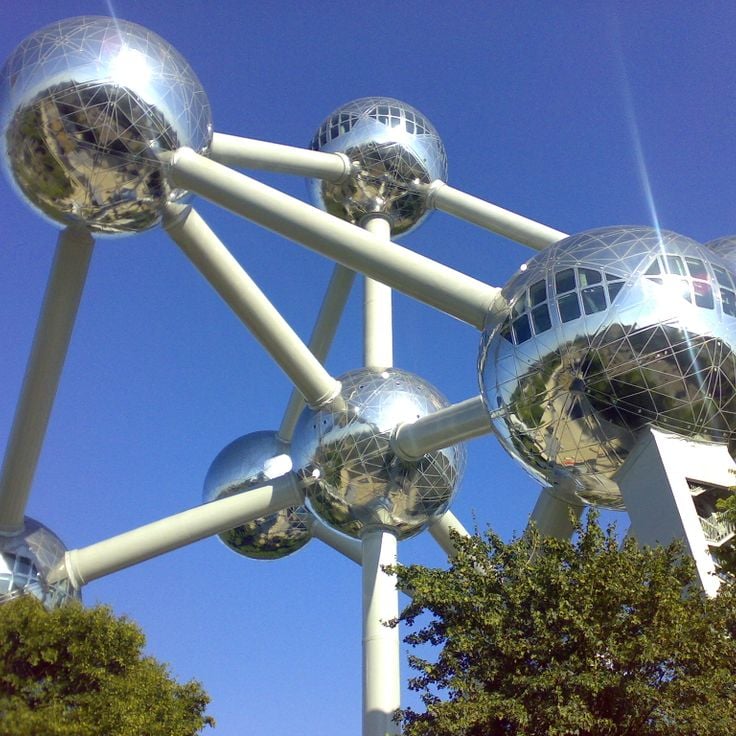
This Brussels landmark from 1958 consists of nine connected spheres linked by twenty tubes, representing an iron crystal cell magnified 165 billion times. The Atomium was designed for the World's Fair and symbolizes the atomic age and postwar scientific progress. The structure rises 335 feet (102 meters) and contains exhibition spaces in the upper spheres, accessible via escalators and an elevator. From the top sphere, visitors can take in views across the Belgian capital.
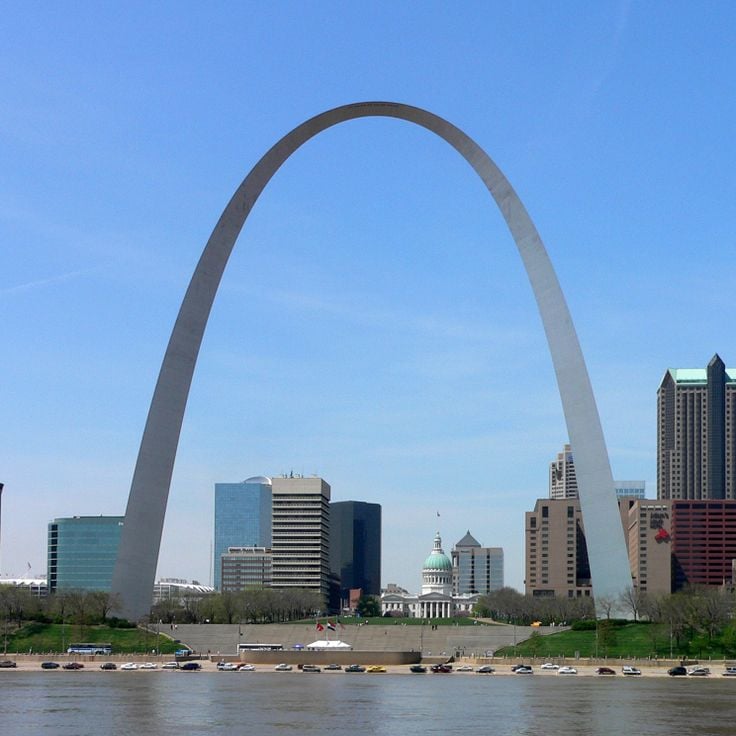
This steel arch marks the historic starting point of 19th-century American westward expansion. The 630-foot (192-meter) stainless steel structure was completed in 1965 and stands on the west bank of the Mississippi River. A tram system carries visitors to the observation deck at the apex, providing views across the city and the river. Architect Eero Saarinen designed the parabolic form, which required three years of precise engineering work to construct. The Gateway Arch anchors a national park commemorating the Louisiana Purchase and the pioneer routes heading west.
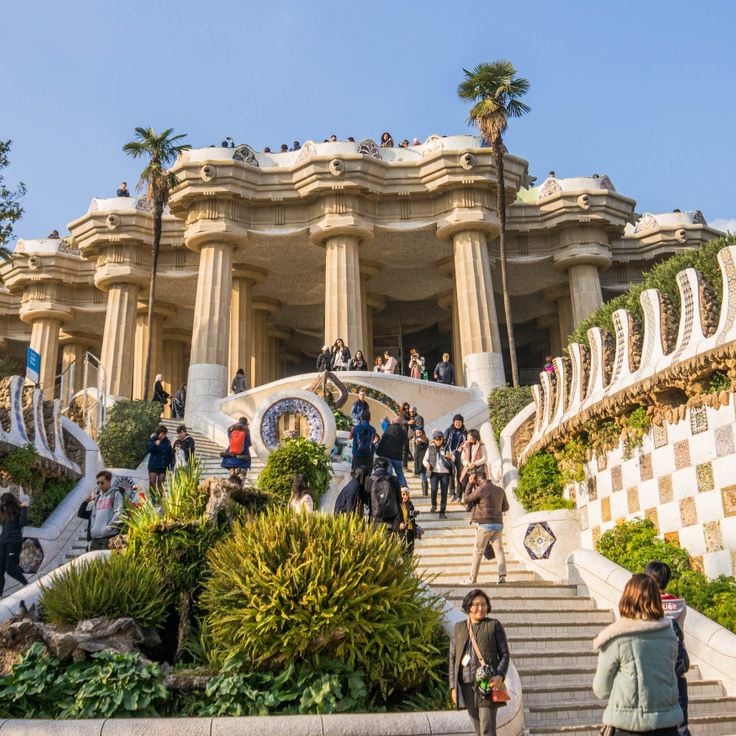
This public park extends across 42 acres (17 hectares) and presents the characteristic work of Antoni Gaudí through colored mosaic surfaces, serpentine stone colonnades and organically shaped benches. Originally conceived as a residential development project between 1900 and 1914, the site demonstrates architectural elements that combine natural forms with structural innovation. The design includes the undulating bench on the main terrace, covered with broken ceramic fragments, and incorporates the natural topography of the hillside with constructed elements that reflect Gaudí's approach to spatial organization.
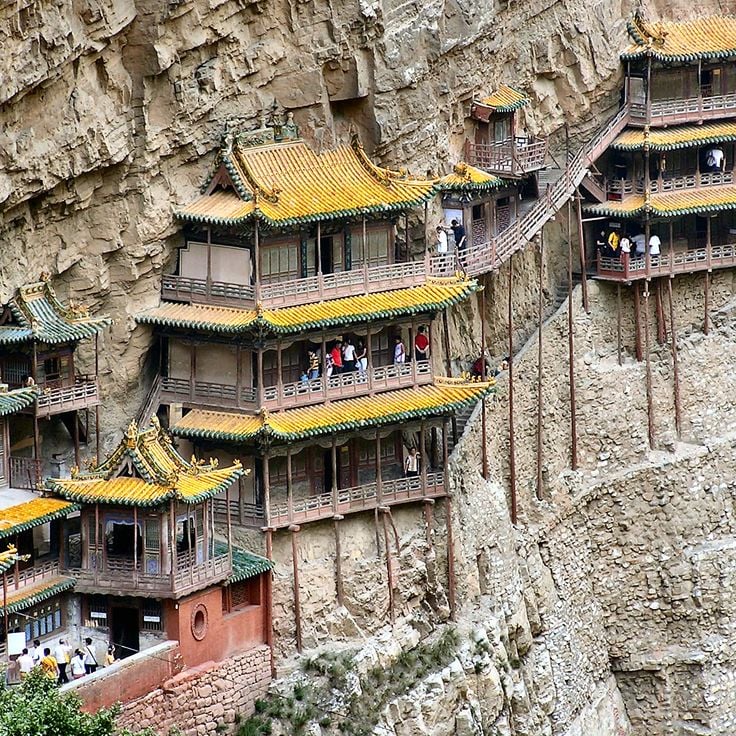
This structure dates to the 5th century and sits on a vertical cliff face 246 feet (75 meters) above the valley floor. The construction rests on wooden crossbeams anchored deep into the rock that support a series of pavilions combining Buddhist, Taoist and Confucian elements. The architects used the natural overhang of the cliff as protection against weathering. The technique demonstrates advanced understanding of statics and timber construction from the Wei Dynasty, where load and thrust are distributed through a system of interlocking beams.
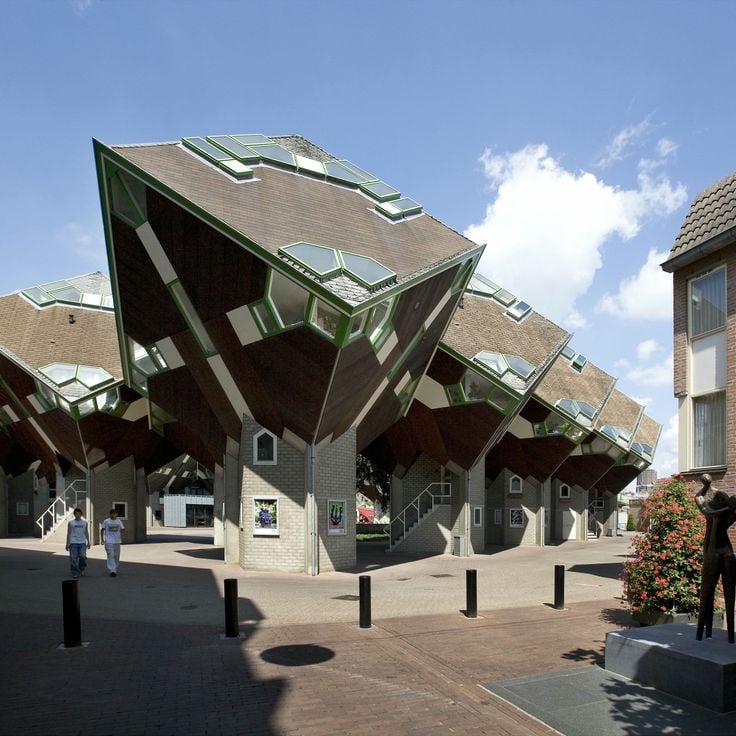
These residential buildings from the 1980s were designed by Dutch architect Piet Blom, who experimented with an unconventional geometric solution. Each structure rests on a hexagonal base and tilts at a 45-degree angle, making the upper floors appear as three-dimensional cubes. The design was intended to represent a forest of artificial trees, with each unit forming its own trunk. The living concept distributed functions across three levels: the lower area contains the entrance zone and kitchen, the middle floor holds living and sleeping spaces, while the top level serves as a pyramid-shaped room with windows facing all directions.
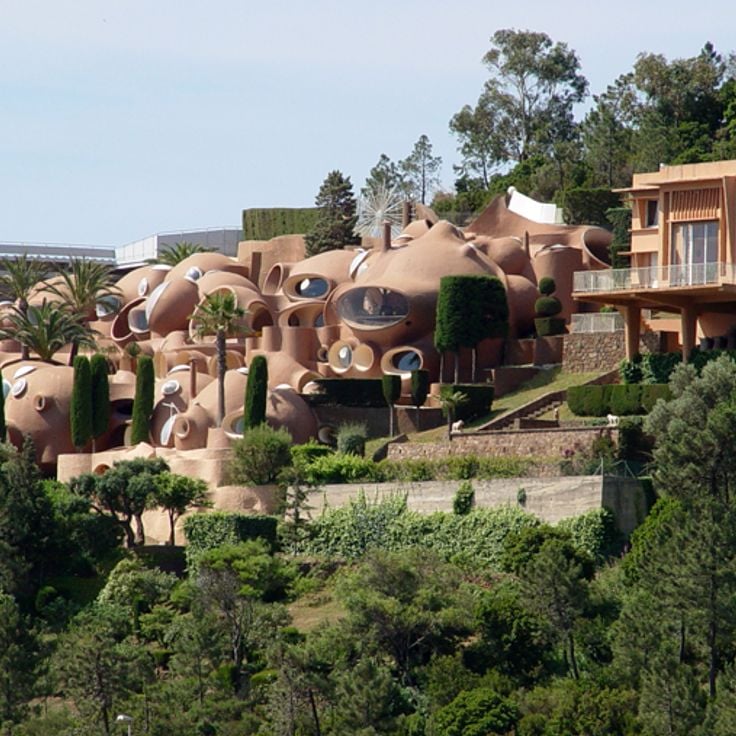
This private residence along the Mediterranean coast was designed by Hungarian architect Antti Lovag and consists of interconnected spherical forms that cascade down a hillside above the shoreline. The structure combines more than 28 circular rooms of varying sizes with panoramic windows that open to views of the sea and surrounding terrain. The organic shapes follow Lovag's concept of habitology, which rejects rectangular spaces in favor of flowing, cave-like structures. An amphitheater-style outdoor area provides seating for approximately 500 people and hosts cultural events. Terracotta tones dominate the facades, while interiors are marked by sculptural furniture and built-in elements.
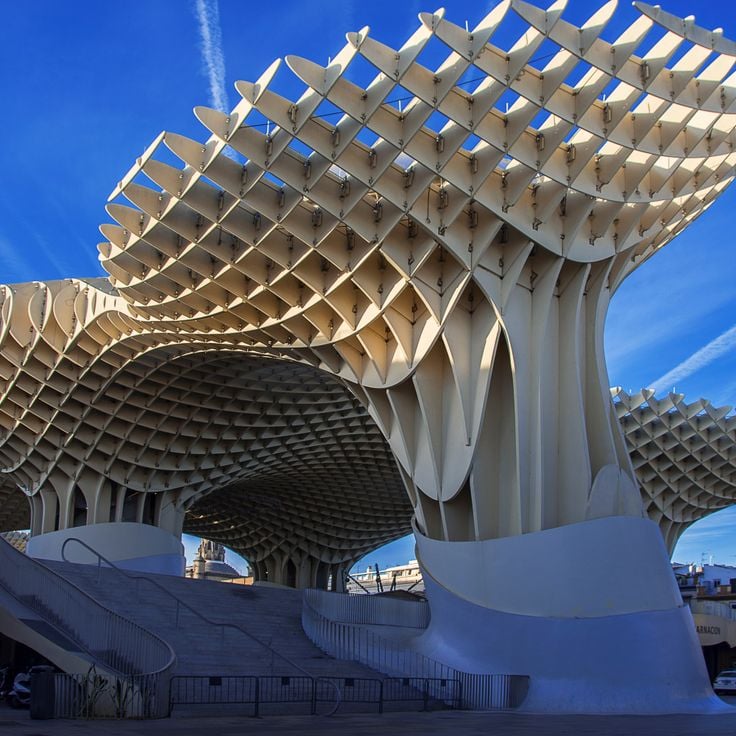
This modern timber structure spans 150 meters in length and has covered a market on Plaza de la Encarnación since 2011. The Metropol Parasol combines structural innovation with organic forms and offers not only the ground-level market but also a rooftop walkway where visitors can view the old town from above. The undulating structure made of laminated timber and polyurethane ranks among the largest wooden buildings worldwide and has fundamentally transformed the urban appearance of this historic square. Archaeological remains from Roman and Moorish periods are displayed in the lower levels.
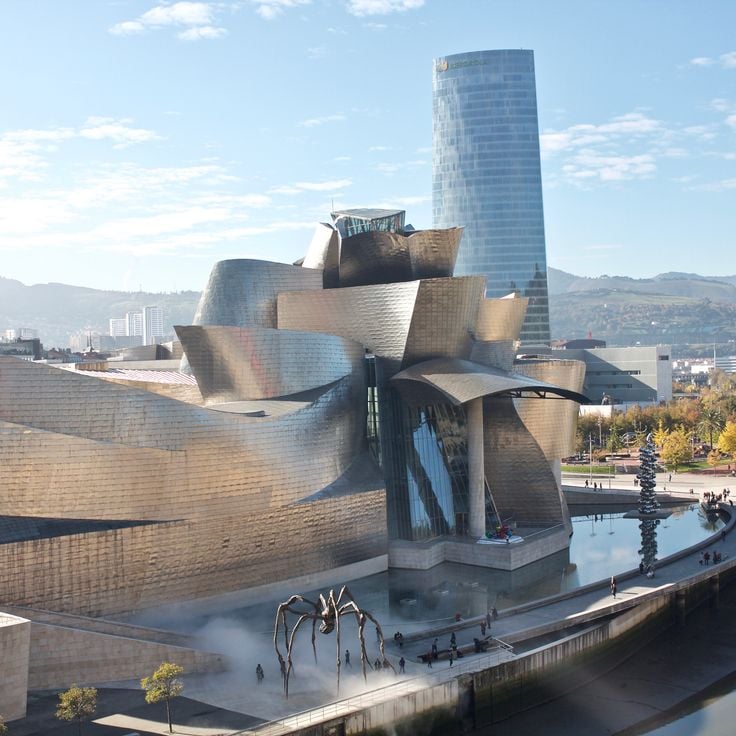
The Guggenheim Museum Bilbao stands as a powerful example of the unconventional architecture presented in this collection. Its titanium panels catch the light differently depending on the time of day, creating an ever-changing appearance along the Nervión River. Inside, 19 galleries spread across three floors hold contemporary and modern art. The flowing curves of the structure reshape how visitors move through exhibition spaces and experience the art within.
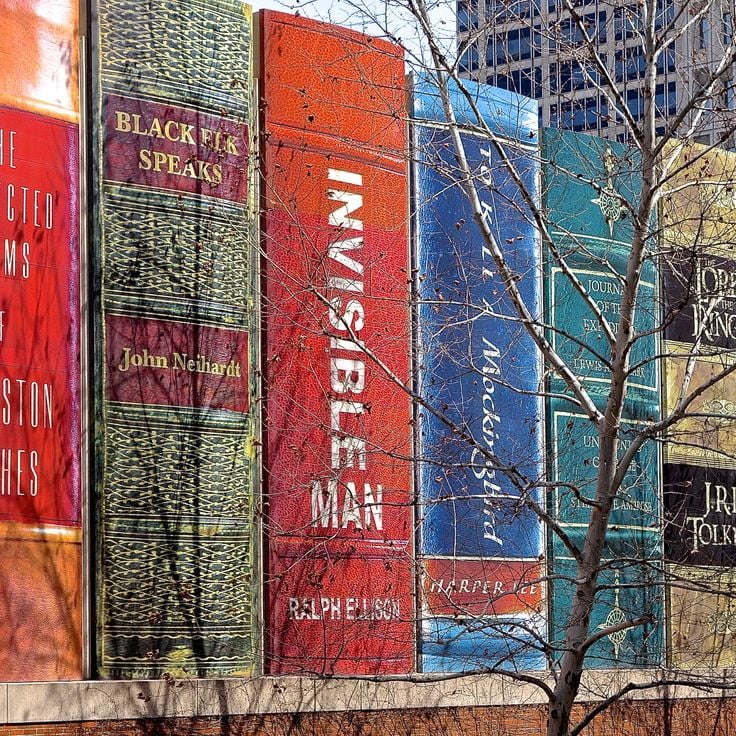
The south wall of this parking structure displays 22 book spines measuring 25 feet (7.5 meters) in height, with titles selected by local residents. The installation transforms functional infrastructure into public art, combining practical urban planning with cultural expression. Each spine represents works meaningful to the community, making the building a recognizable landmark in the downtown area. The structure demonstrates how everyday architecture can communicate civic values through creative design.
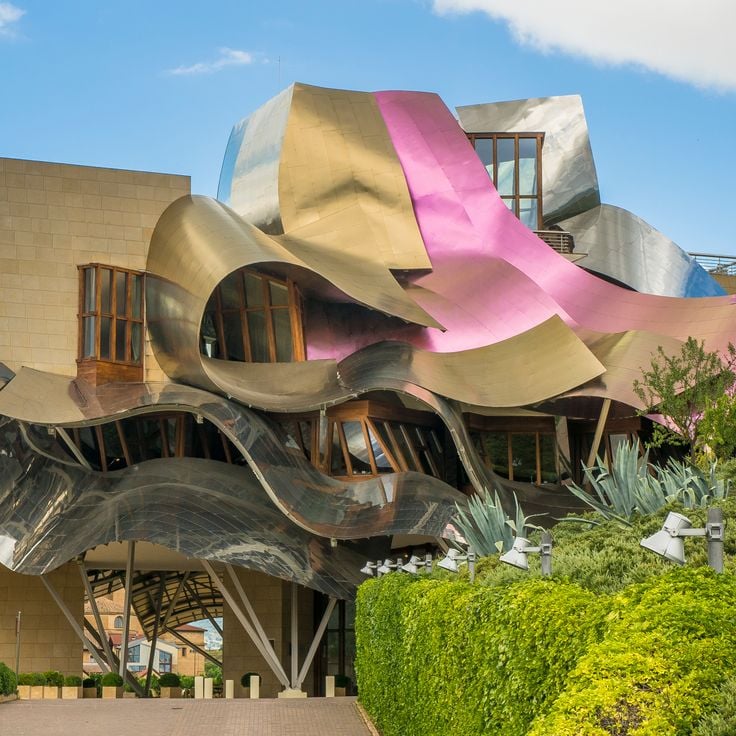
This hotel opened in 2006 and uses 60 tons of titanium for its exterior cladding in pink, gold and silver. The building stands in the heart of the Rioja wine region and combines technical precision with sculptural form. The undulating titanium panels reflect light and create shifting visual effects throughout the day. The design integrates with the surrounding vineyards while serving as a distinct landmark in the landscape.
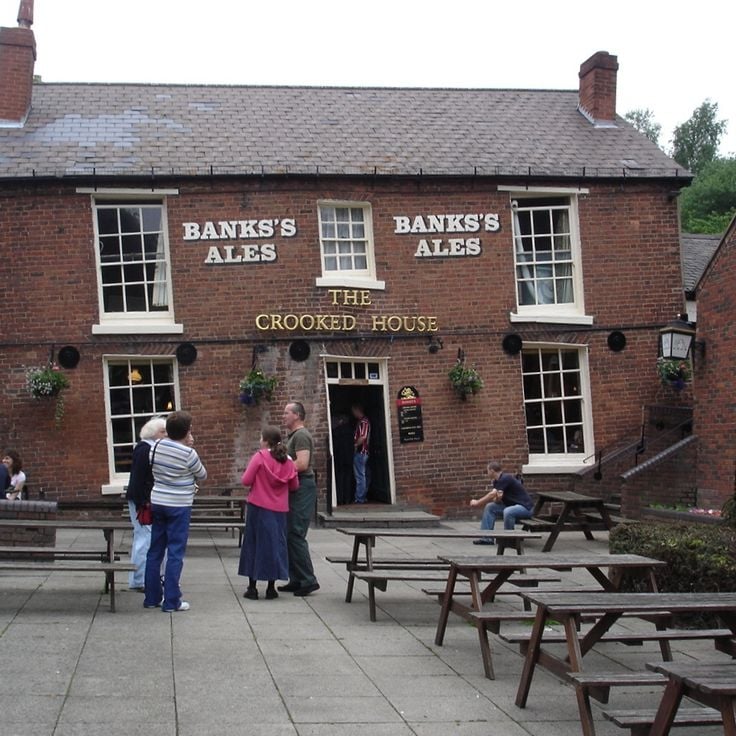
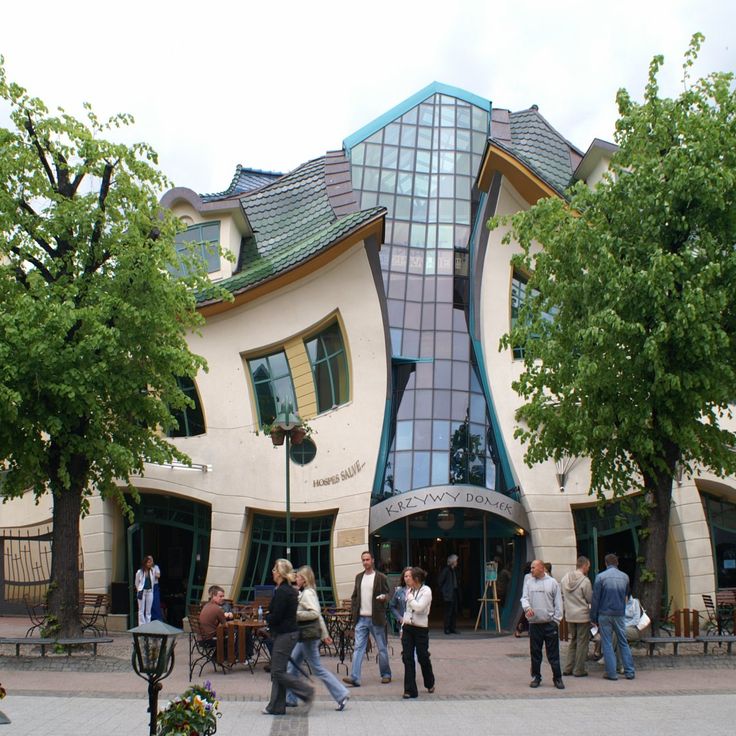
The Krzywy Domek is a commercial building designed by Szotyńscy & Zaleski in 2004, featuring a wave-like facade inspired by Jan Szancer's illustrations. The structure's curved lines and distorted windows create an optical illusion resembling melted glass. The building houses retail shops, restaurants and office spaces in central Sopot. Its asymmetric architecture contrasts with the surrounding traditional buildings, demonstrating how commercial structures can integrate unconventional design principles.
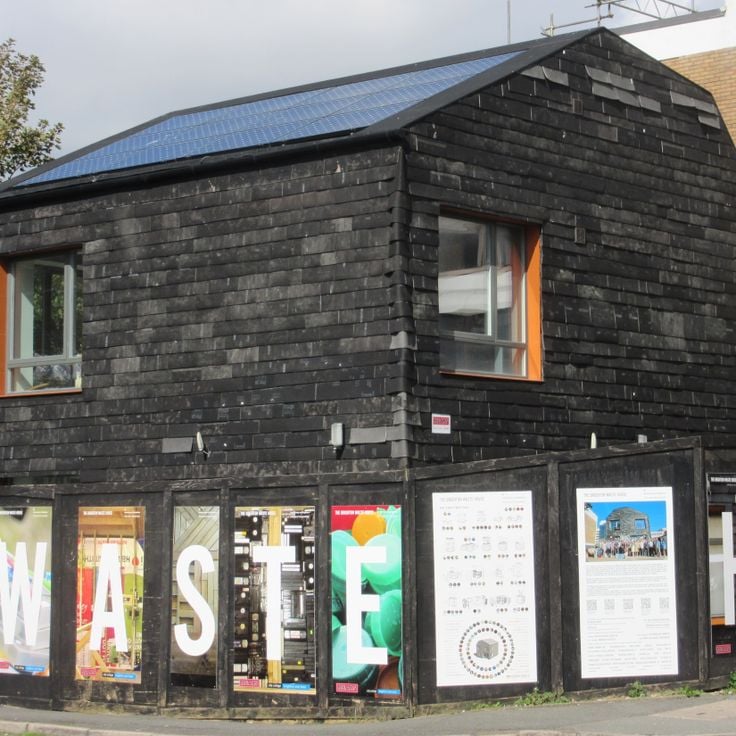
This university building in Brighton was constructed as a research project in sustainable building practices, demonstrating the reuse of everyday consumer items as construction materials. The structure incorporates approximately 20,000 toothbrushes, 2,000 carpet tiles and 4,000 DVD cases into its framework. The building illustrates practical applications of recycling principles in architecture and examines how consumer waste can be transformed into functional building components. The structure serves as an experimental model for resource-conscious construction methods.
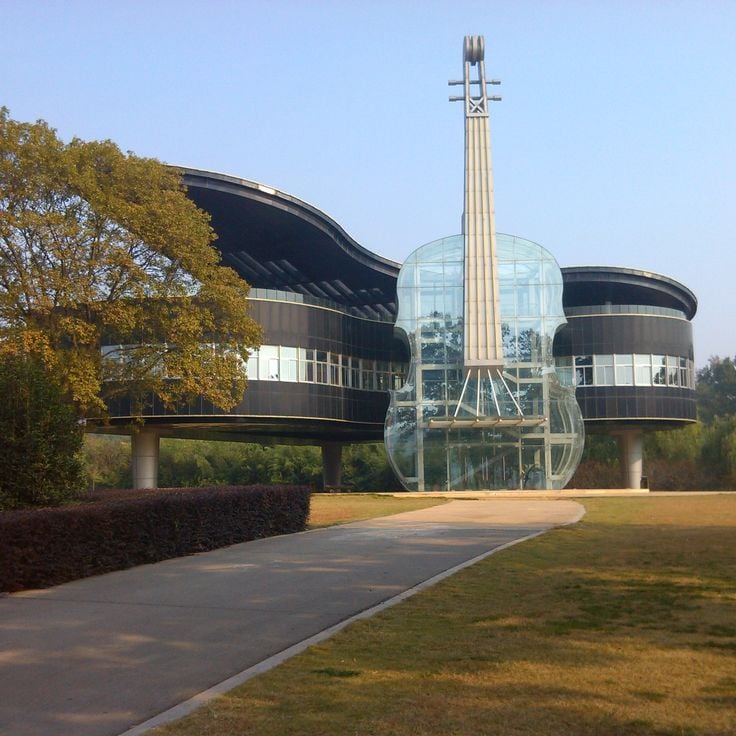
The Piano House in Huainan takes the form of a concert grand piano constructed from black glass and steel, while a transparent violin serves as the entrance structure. The building functions as a music center and demonstrates how functional architecture can translate musicality into three-dimensional form. This structure combines technical innovation with artistic expression and shows the possibilities of unconventional architectural design in contemporary Chinese architecture.
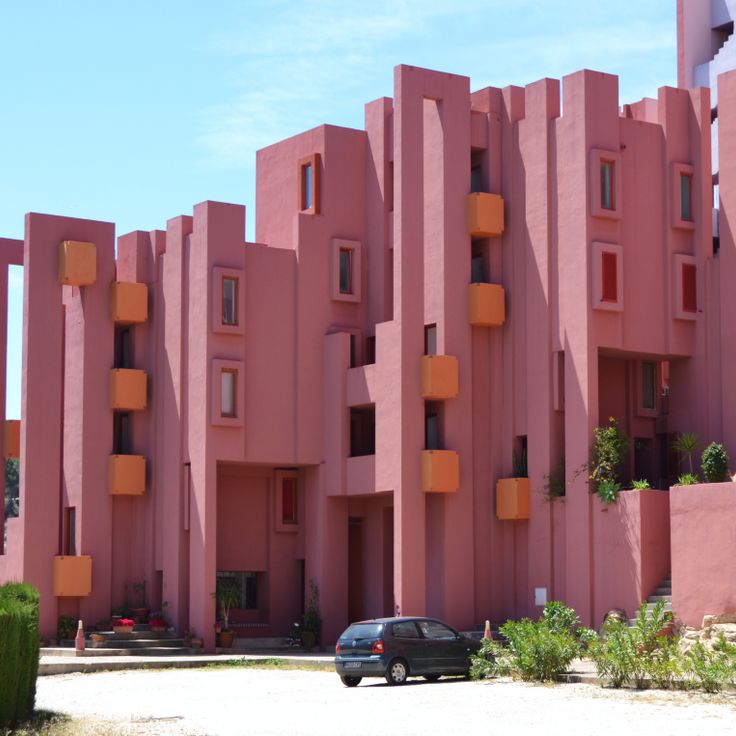
La Muralla Roja is a residential complex in Calpe designed by architect Ricardo Bofill in 1973 that pushes the boundaries of conventional building forms. The structure combines cubic volumes with interlocking staircases and courtyards inspired by North African kasbah architecture. Its red facade contrasts with blue and violet accents in the interior spaces, demonstrating Bofill's experimental approach to merging geometric precision with Mediterranean building traditions. As part of this collection, La Muralla Roja shows how technical innovation and artistic expression can merge in residential architecture.
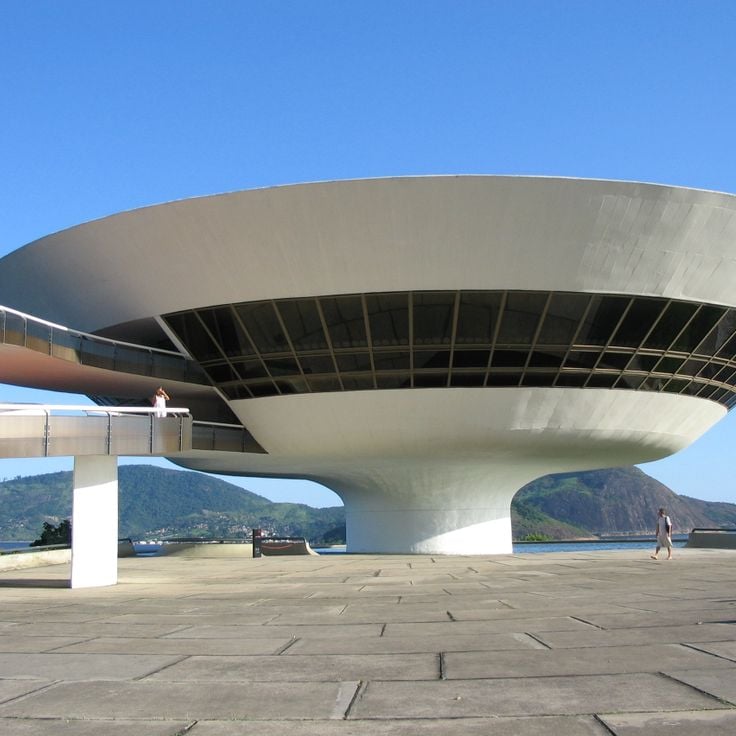
The Museu de Arte Contemporânea de Niterói rises from a cliff above Guanabara Bay, redefining modern Brazilian architecture. Designed by Oscar Niemeyer, this six story structure combines a circular base with a prominent dome resembling a spacecraft or flower. Completed in 1996, the building rests on a single central support column and extends outward via a 52 foot (16 meter) wide ramp. The curved lines and red walkway contrast with white concrete, creating a sculptural form that demonstrates Niemeyer's interest in organic shapes.
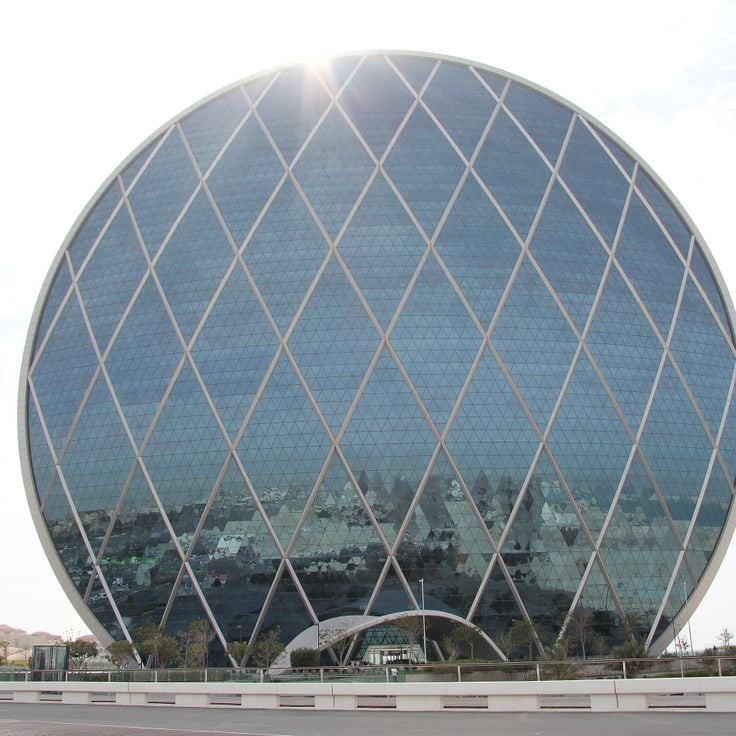
The Aldar headquarters is a 360-foot office tower in Abu Dhabi completed in 2010. The building takes a complete circular form, wrapped in a continuous glass facade. The structure combines the technical requirements of an office building with a geometric shape that departs from conventional high-rise design. The circular structure required specialized structural solutions and custom facade engineering to realize the round geometry across its full height.
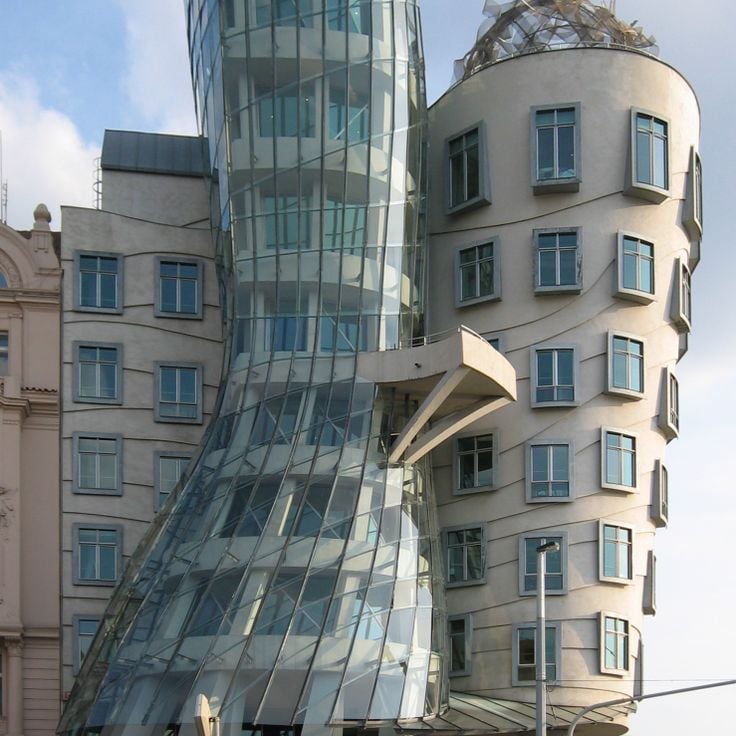
This 1996 building in central Prague consists of two towers with curved glass facades and asymmetrically placed windows. The Dancing House was designed by architects Vlado Milunić and Frank Gehry and departs from the historical architectural styles of the surrounding area. The construction uses reinforced concrete and prefabricated elements to achieve the curved lines. The building stands on the Vltava riverbank and houses offices, a restaurant and a gallery. The architectural form with its two distinct towers suggests a dancing couple, which gave the structure its name.
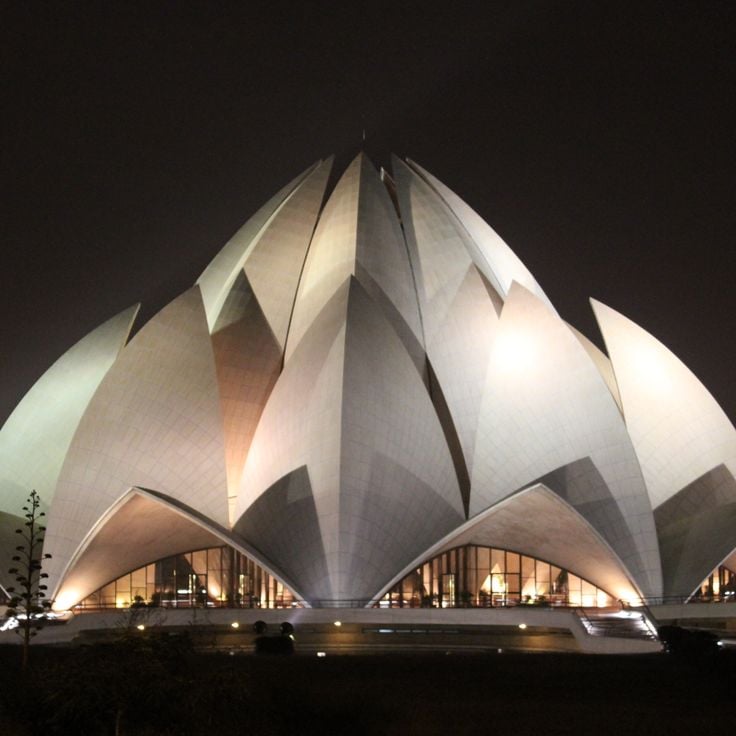
The Lotus Temple demonstrates architectural innovation through its unusual construction of 27 freestanding marble petals reaching a height of 112 feet (34 meters). This Bahai house of worship, built between 1980 and 1986, eliminates load-bearing interior walls and instead employs a complex structural system of nine interconnected petal clusters. The design shows how religious architecture can translate organic forms into technically demanding buildings while creating an open prayer hall that accommodates up to 2,500 visitors.
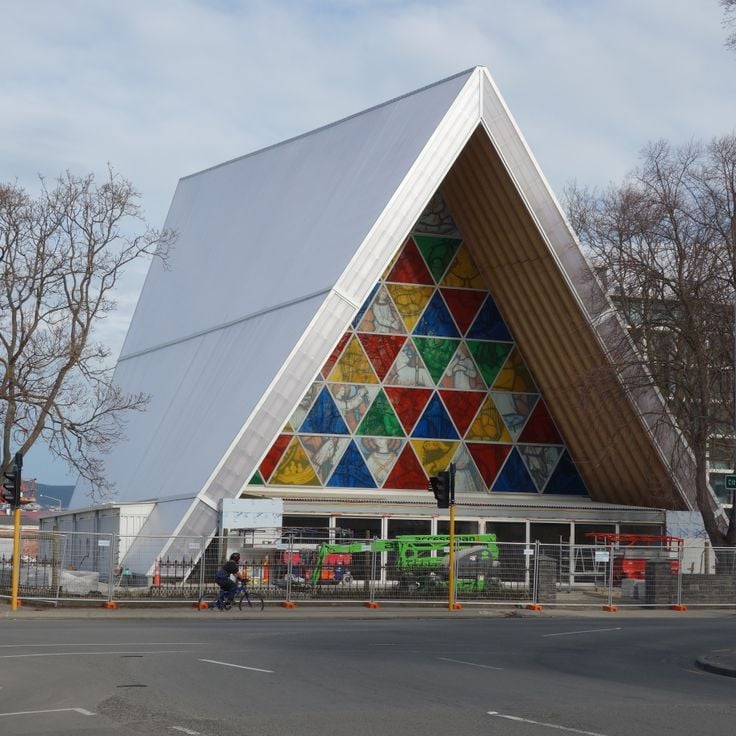
This cathedral was built in 2013 as a temporary replacement for the Anglican church damaged in the earthquake. Japanese architect Shigeru Ban designed the structure using 86 paper tubes, each weighing 1,300 pounds (600 kilograms) and rising 79 feet (24 meters) high. The building demonstrates how temporary religious spaces can be created with recyclable materials. The construction combines structural stability with environmental considerations and continues to serve as a place of worship.
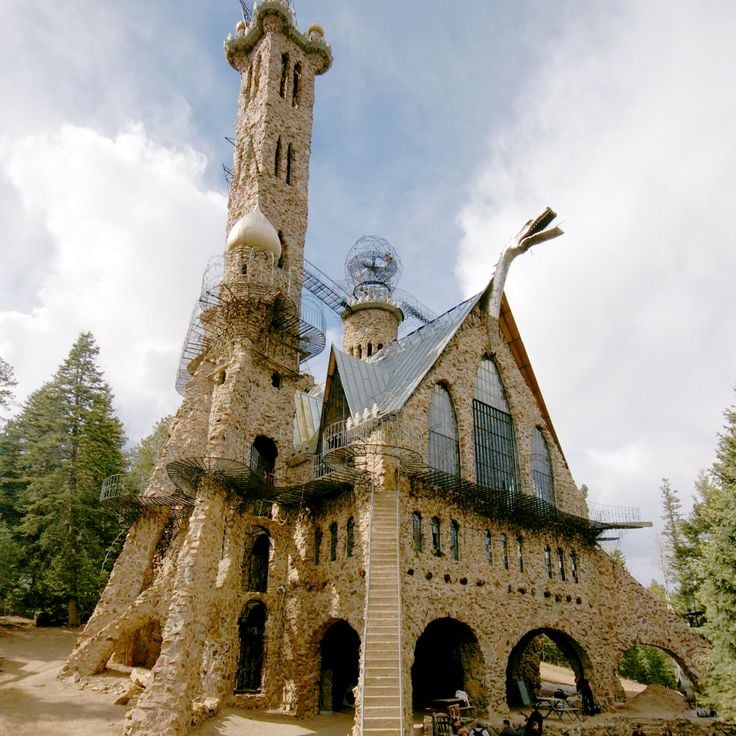
Bishop Castle in Colorado represents over four decades of architectural work by a single builder. Constructed between 1969 and 2010 without formal plans or blueprints, this stone and metal structure emerged through an intuitive building process. The castle includes multiple towers connected by bridges, demonstrating how architectural complexity can develop through continuous construction without conventional planning. Each element was developed during the building process itself, creating a structure that documents one man's sustained vision and technical problem-solving across 41 years of work.
This metal art installation takes the form of a residential house rotated 90 degrees, challenging conventional notions of architectural orientation. The Maison Tordue forms part of the Columbus public art collection, demonstrating how artistic intervention can redefine public space. The structure combines industrial materials with conceptual design, inviting visitors to reconsider the relationship between function and form. The work exists within a city recognized for its substantial architectural holdings.
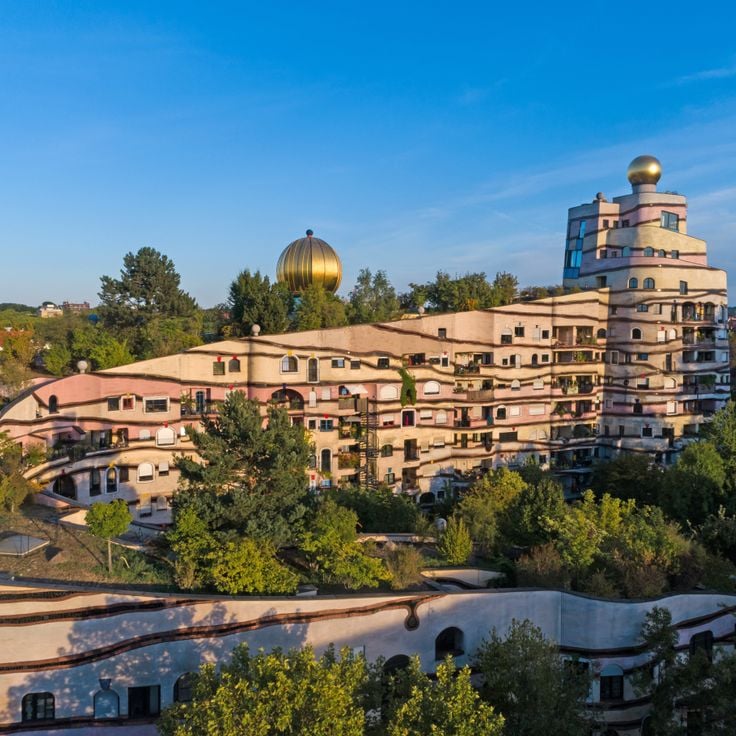
This residential structure in Darmstadt follows a spiral floor plan and contains 105 apartments across multiple levels. The facade displays a sequence of varying colors, while trees have been planted on the rooftop surface. Completed in 2000 after a two-year construction period, the Spirale Forêt combines serial housing concepts with design elements inspired by organic forms. The building represents experimental approaches in German residential architecture during the late 1990s, integrating environmental components into an unconventional geometric framework.
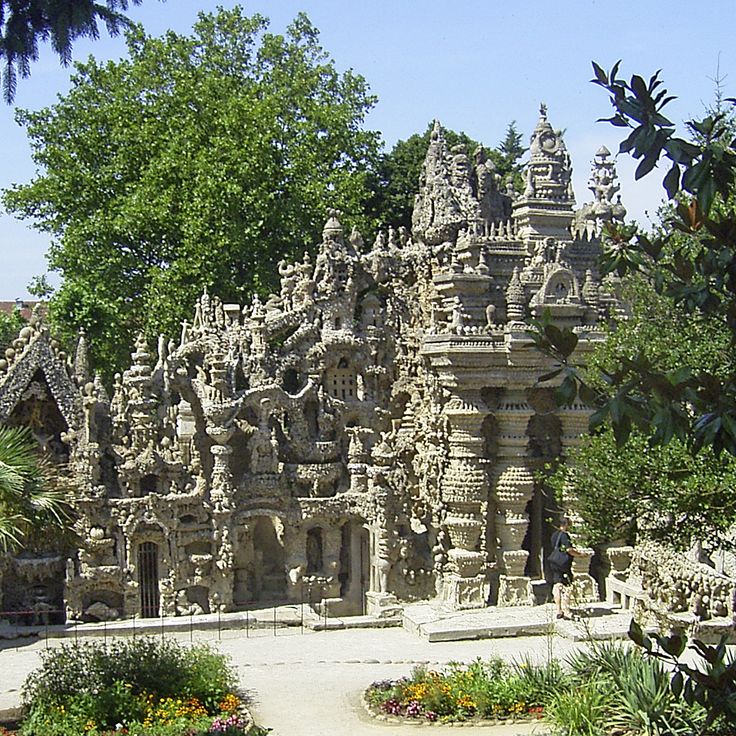
This palace in Hauterives is the life's work of Ferdinand Cheval, a rural mail carrier who collected stones along his postal route from 1879 to 1912 to construct this unusual structure. Cheval worked for 33 years without architectural training, creating a complex building that combines elements from various cultures and historical periods. The facades display a mix of mythological figures, exotic animals and geometric patterns, all crafted from fieldstones and lime. The structure was recognized as a historic monument by André Malraux in 1969 and stands as a notable example of outsider art in architecture.
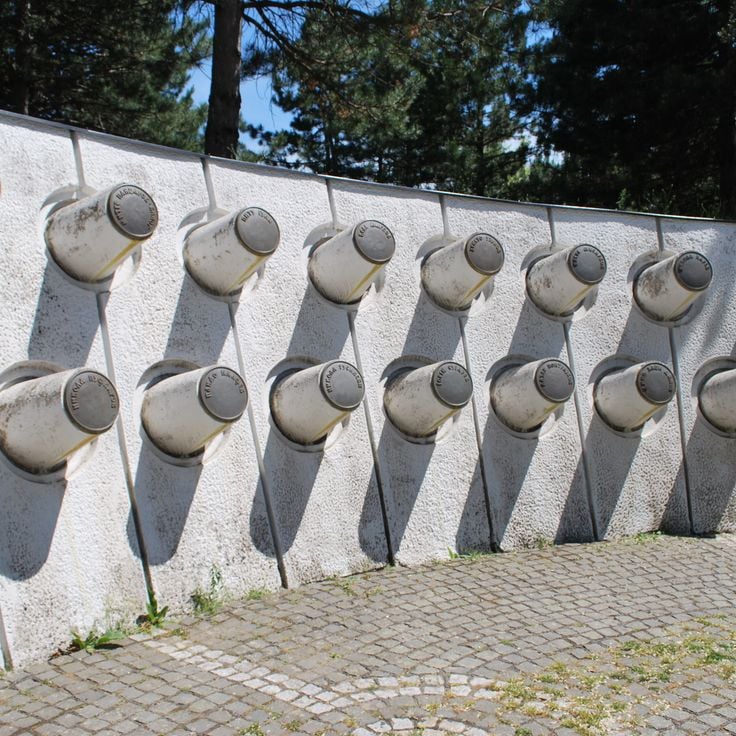
This abstract monument near Kruševo commemorates participants of the 1903 Ilinden Uprising and fighters from the Second World War. Makedonium was designed in 1974 by Jordanian architect Bogdan Bogdanović and consists of circular concrete structures resembling a stylized flower or sun. The geometric forms and open spaces create a monumental presence on the site. The structure belongs to a series of monuments from the former Yugoslavia and demonstrates the architectural language of that era. Visitors can explore the interior spaces and take in views across the surrounding mountain landscape.
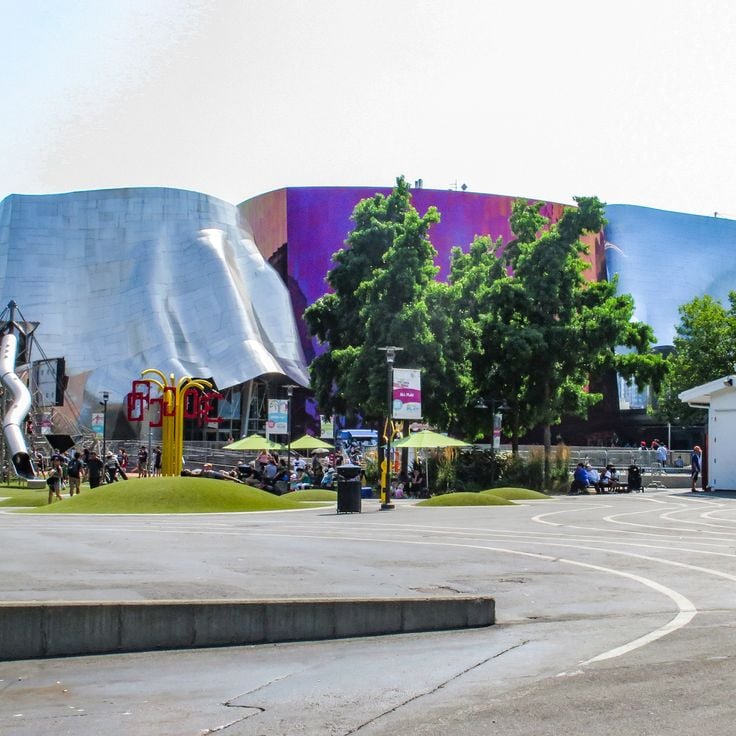
This Seattle museum presents contemporary culture within a wave-like metal structure designed by Frank Gehry. The exhibitions cover American music history, science fiction artifacts and interactive displays on pop culture. The building itself demonstrates deconstructivist architecture through its curved aluminum and stainless steel facades that flow across multiple levels. Visitors find collections on guitar innovation, horror films and video games, along with rotating special exhibitions addressing current cultural phenomena.
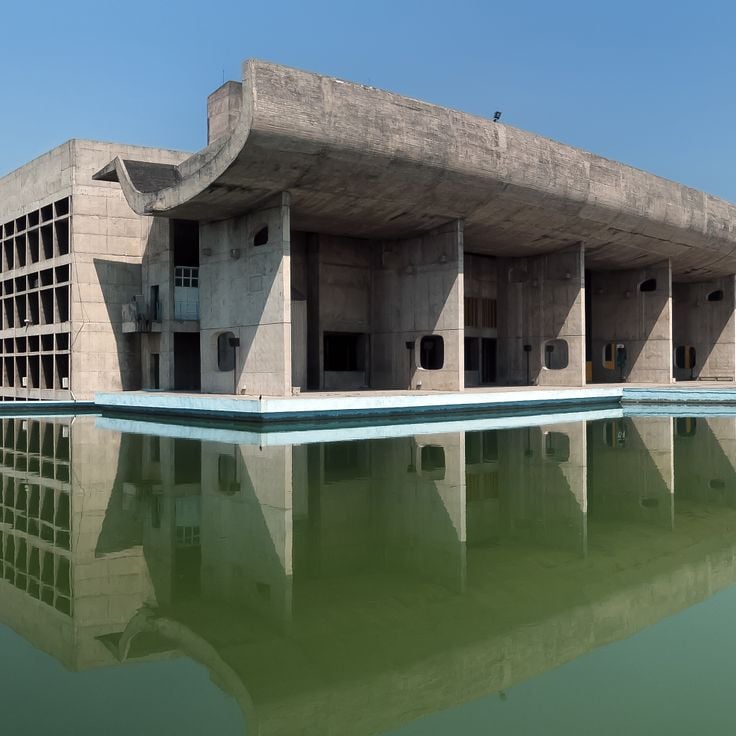
The Capitol Complex of Chandigarh was built between 1951 and 1965 to designs by Le Corbusier and serves as the government center of Punjab state. The complex includes the Assembly, the Secretariat and the High Court, three concrete structures that embody Le Corbusier's modernist principles. The architect developed his theories on natural ventilation, sun protection and monumental form in a tropical climate through these buildings. The geometric shapes and raw concrete surfaces reflect Le Corbusier's vision of rational, functional architecture for independent India. This UNESCO World Heritage site covers 247 acres (100 hectares) and demonstrates how modernist principles were applied to institutional buildings in South Asia.
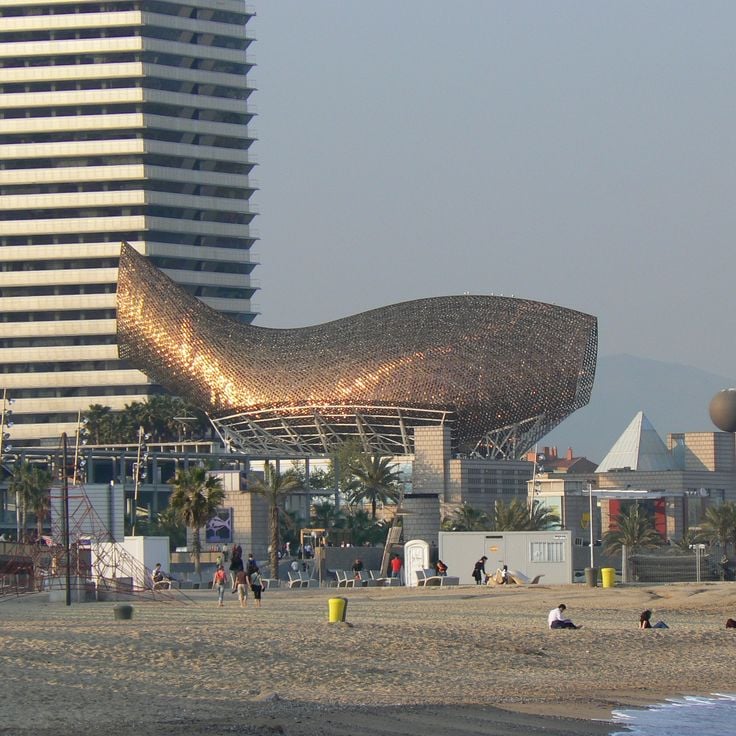
This 170-foot (52-meter) metal sculpture stands in Barcelona's Olympic Harbor, representing a fish with gleaming stainless steel scales. El Peix was created for the 1992 Olympic Games, combining maritime symbolism with contemporary steel construction. The structure ranks among the largest fish sculptures in the world and demonstrates how public art can redefine urban waterfront areas. The work fits into the tradition of architectural forms that merge technical innovation with artistic expression.
The Nakagin Capsule Tower was completed in 1972 and consists of 140 interchangeable residential capsules attached to a central core. Located in the Ginza district, this building embodies the principles of Metabolist architecture, a movement that viewed structures as adaptable organisms. Each capsule measures roughly 107 square feet (10 square meters) and was originally designed as a mobile dwelling unit, though the interchangeability concept was never implemented. The tower represents an attempt to address Tokyo's space constraints through prefabricated modular construction.
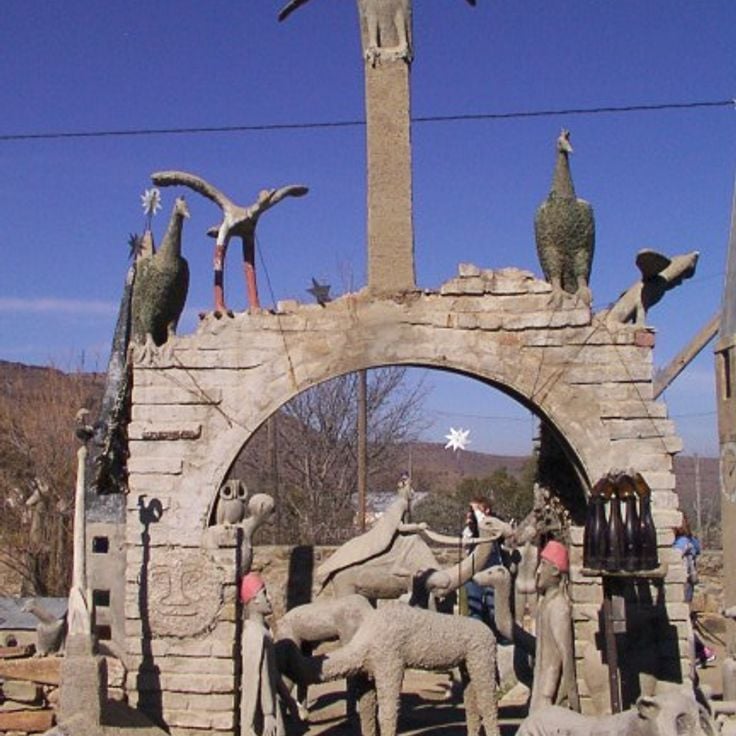
This museum inside a modest house preserves more than 300 concrete sculptures Helen Martins created between 1945 and 1976. The figures depict animals, biblical scenes and religious motifs that fill the walls and garden. Martins used ground glass, mirrors and bright colors to realize a personal vision that developed outside conventional artistic movements. The collection documents three decades of work by a woman who transformed her home into a three-dimensional artwork that challenges traditional boundaries between domestic space and creative expression.
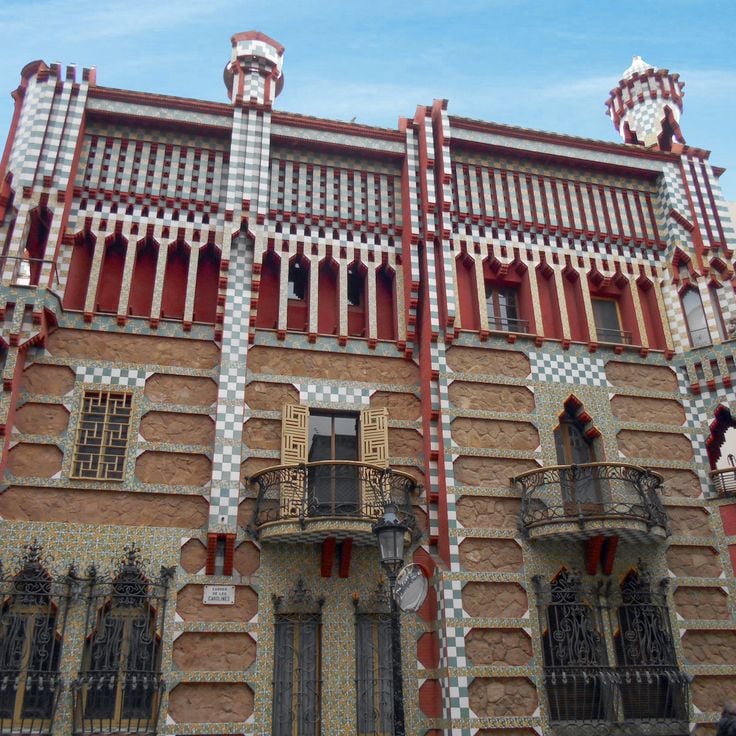
Casa Vicens was Antoni Gaudí's first major project and marked the start of his long career in Barcelona. Completed in 1885, this residential building combines Moorish elements with Catalan building traditions and already displays Gaudí's characteristic use of ceramic tiles in bright colors. The facade presents geometric patterns in green and white tiles, while the interior spaces feature elaborate stucco work and hand-painted ceilings. The building originally served as a summer house for industrialist Manuel Vicens and opened to the public as a museum in 2017. The architecture connects Oriental inspiration with European construction methods of the late 19th century.
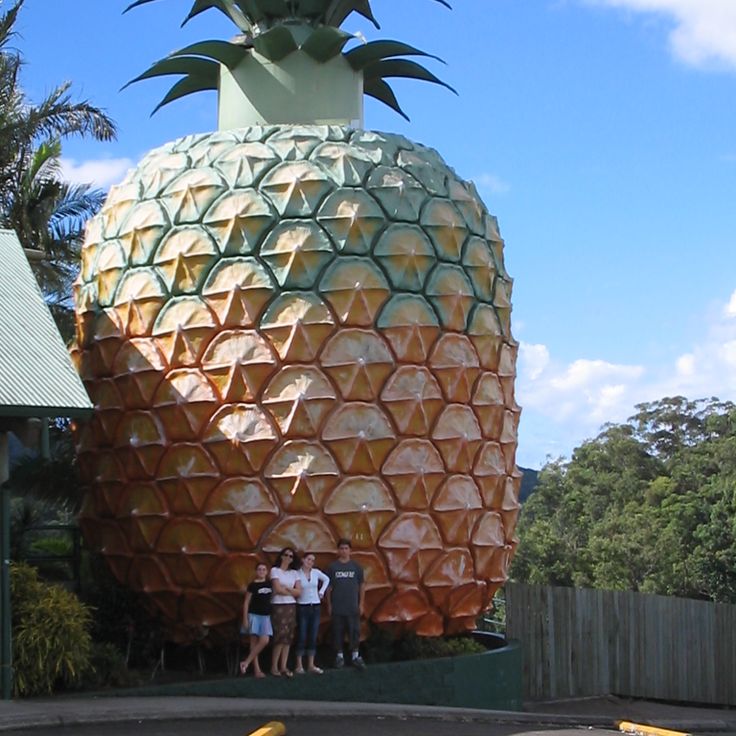
This fiberglass and steel structure was built in 1971 and serves as an example of Australian roadside advertising architecture. The Big Pineapple stands 55 feet (16.7 meters) tall and was originally created as a tourist attraction for a pineapple plantation. The form references the region's agricultural tradition and demonstrates how commercial architecture transformed regional products into built structures. Visitors can access exhibitions about pineapple production inside. The site documents a trend toward monumental product advertising that emerged during the second half of the twentieth century.
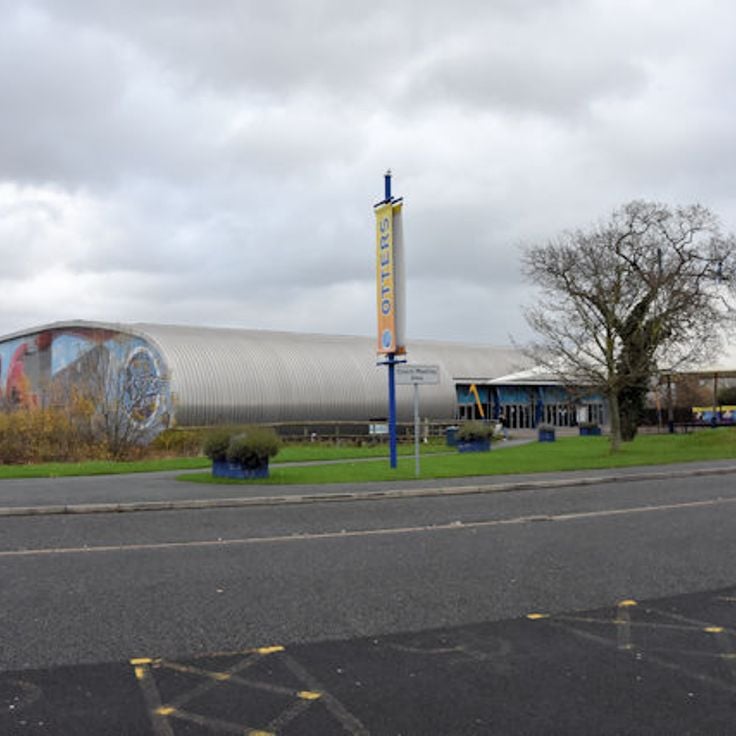
The Blue Planet in Copenhagen takes the form of a water vortex and houses 53 aquariums within an aluminum-clad building. The facility combines technical functionality with an architectural form inspired by the movement of water. The spiral arms extend from the central entrance area and organize the various installations along a circulation route. The design aligns with the collection's concept through its unconventional structure, which departs from traditional aquarium buildings. The aluminum cladding reflects light and reinforces the visual connection to the aquatic theme of the building. The architecture serves both to present marine habitats and as a standalone expression of contemporary construction.
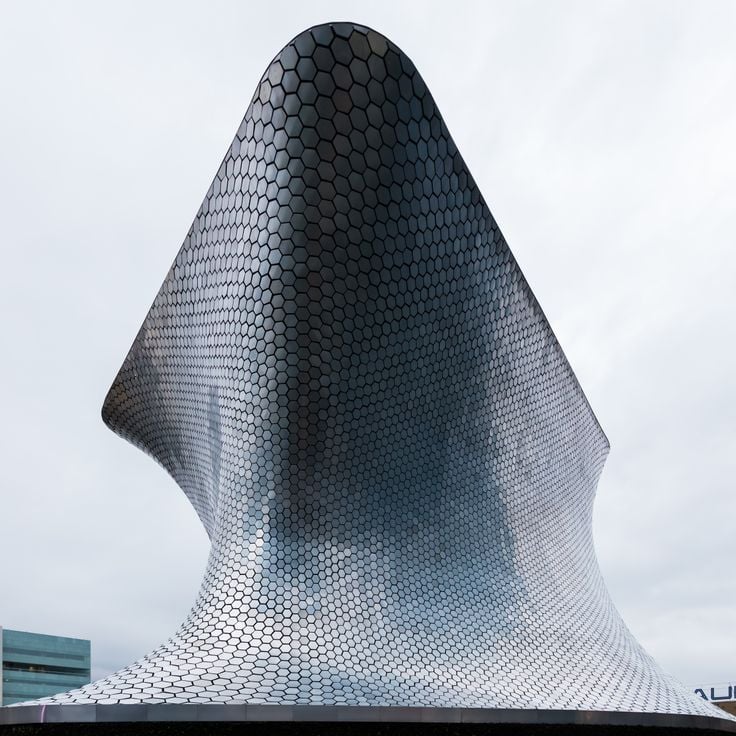
The Museo Soumaya is a six-story museum housed in an asymmetrical metal facade that contains approximately 66,000 works of art. The building's exterior consists of roughly 16,000 hexagonal aluminum plates that give the structure its distinctive reflective surface. The collection spans multiple periods and cultures, from pre-Columbian art to European masterworks. The unconventional architecture makes this museum a prominent feature of Mexico City's urban landscape.
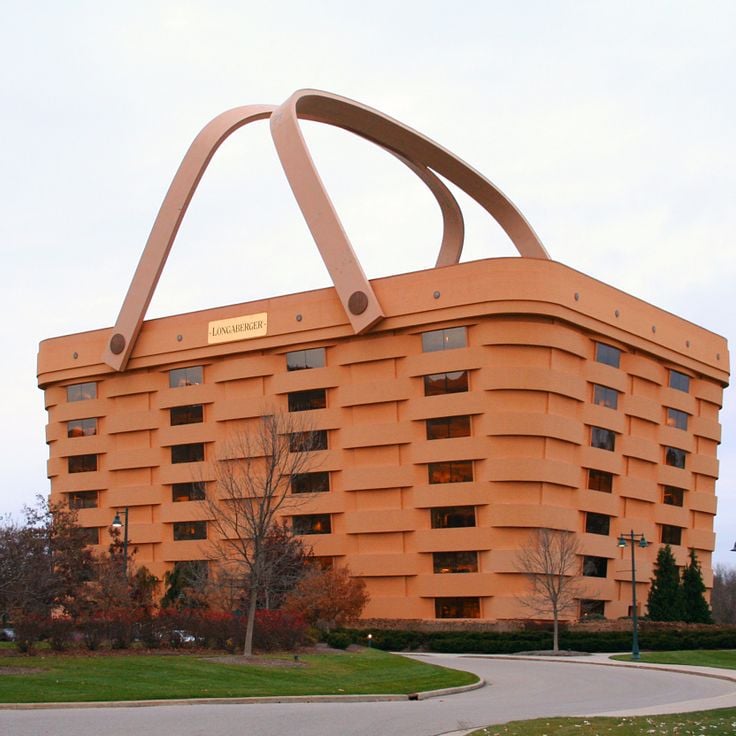
This office building in Newark served as corporate headquarters for the Longaberger Company from 1997 to 2016. The structure replicates one of the manufacturer's handwoven baskets at monumental scale, measuring 276 feet (84 meters) in length and 192 feet (59 meters) in width. The seven-story construction weighs approximately 8000 tons and features two basket handles fashioned from aluminum and copper, each weighing 68 tons. The facade consists of reinforced concrete with heating elements installed in the handles to prevent ice formation. Following the company's bankruptcy, the building was sold and now serves different purposes.
This art museum in Graz opened in 2003 and stands out for its organic shape that resembles a bubble or an alien organism. The blue shimmering shell consists of acrylic panels stretched over a steel structure. The building contrasts with the historic architecture of the old town and houses contemporary art exhibitions. The bionic form dispenses with right angles and creates flexible interior spaces that adapt to different exhibition concepts. The museum's outer skin can be animated with integrated lights.
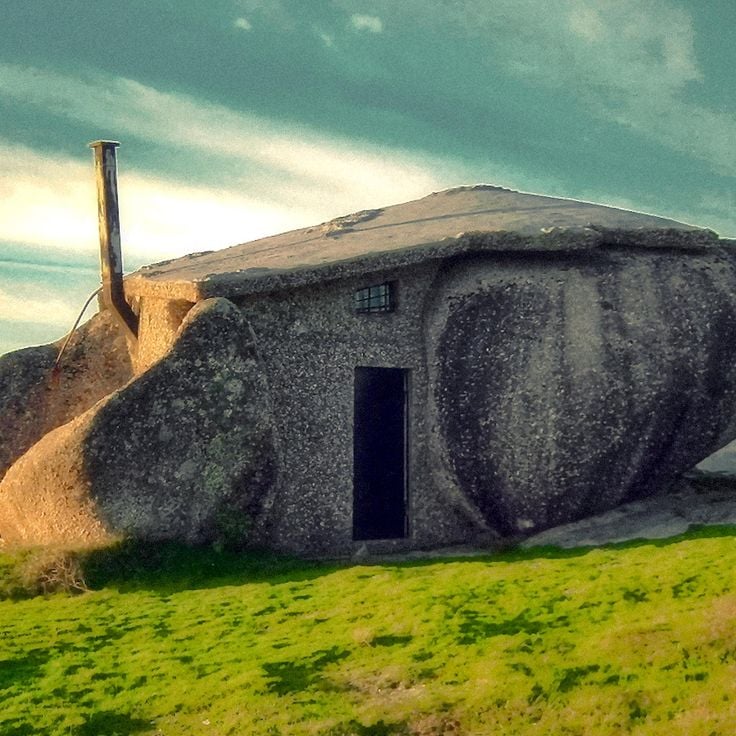
Casa do Penedo is a residence in the Fafe mountains built between four large granite boulders. Constructed in the 1970s, the structure integrates the natural rock formations as load-bearing elements and walls. The building contains two levels of living space that adapt to the irregular surfaces of the stones. Windows and doors fit directly into the granite, while the roof bridges the gaps between the boulders. This house demonstrates a construction approach where existing geological features determine architectural form and create functional spaces within the constraints imposed by natural elements.
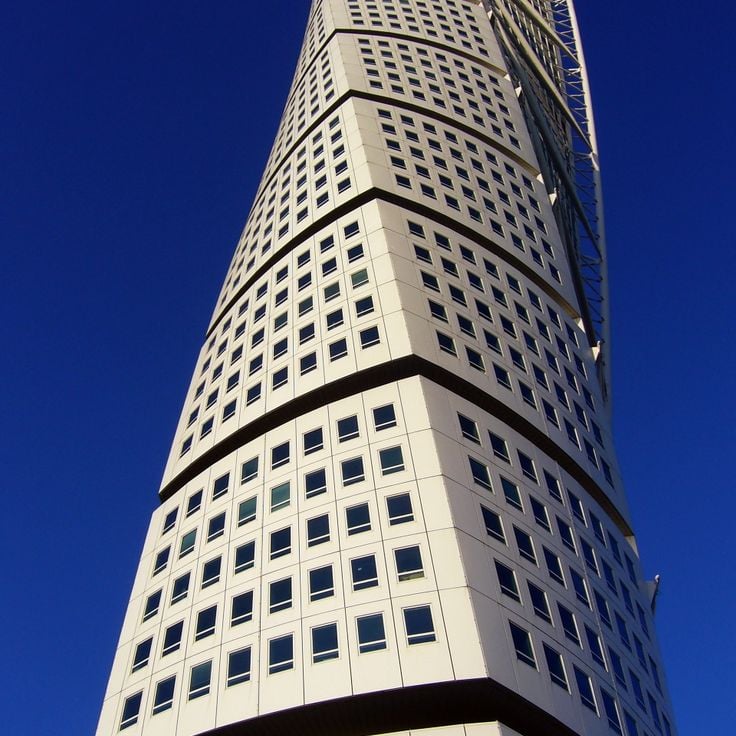
The Turning Torso is a 623-foot residential tower in Malmö that rotates 90 degrees across nine segments. Spanish architect Santiago Calatrava designed the building based on the concept of a twisting human torso, with 54 floors housing 147 apartments. The construction uses a central concrete core reinforced by an external steel skeleton to maintain structural integrity throughout the rotation. Completed in 2005, the building marks the Västra Hamnen harbor district and represents Malmö's urban transformation from an industrial city to a modern center. Visitors can view the building from the outside; access to residential areas is restricted to residents.
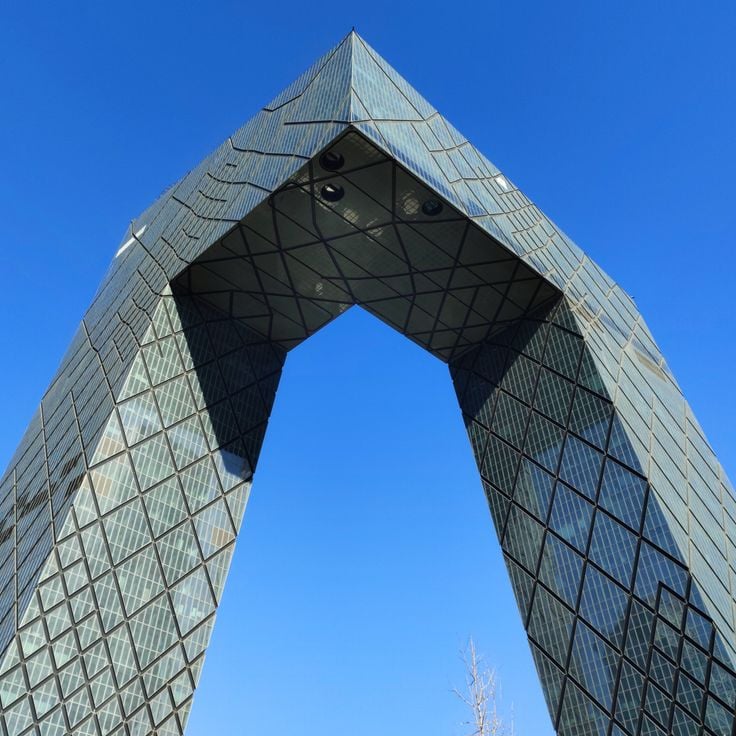
The CCTV Headquarters in Beijing consists of two leaning towers connected at the top by a horizontal section, forming an unusual closed loop. Standing 768 feet (234 meters) tall and completed in 2012, the structure breaks from the vertical tradition of skyscrapers by creating a continuous path through the building. The outward-leaning walls create an angular appearance while the exterior diagonal lattice system provides both structural support and visual texture. The building houses television studios, offices and production facilities for China's state broadcaster, demonstrating how engineering can enable radically different geometry in high-rise architecture.
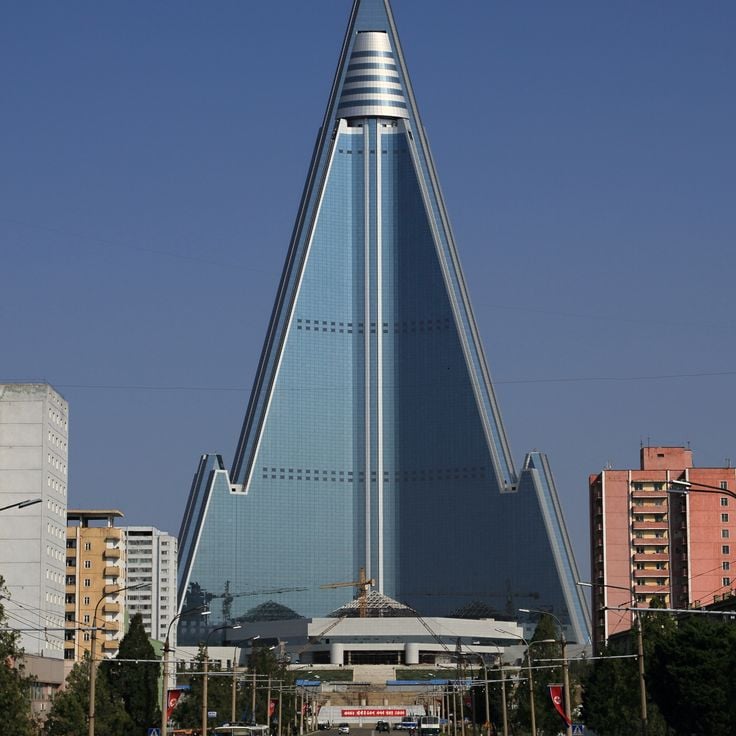
The Ryugyong Hotel rises in pyramidal form over Pyongyang and stands among the tallest structures in the country at 1083 feet (330 meters). Construction started in 1987, halted several times and received its glass exterior of triangular facade panels only from 2008 onward. The three building wings taper upward and meet at a common point. The plan calls for 1400 rooms, many of which remain unfinished today. The structure dominates the city skyline from a distance and serves as an example of large scale architectural projects that remained incomplete for decades due to political and economic factors before exterior facade work was completed.
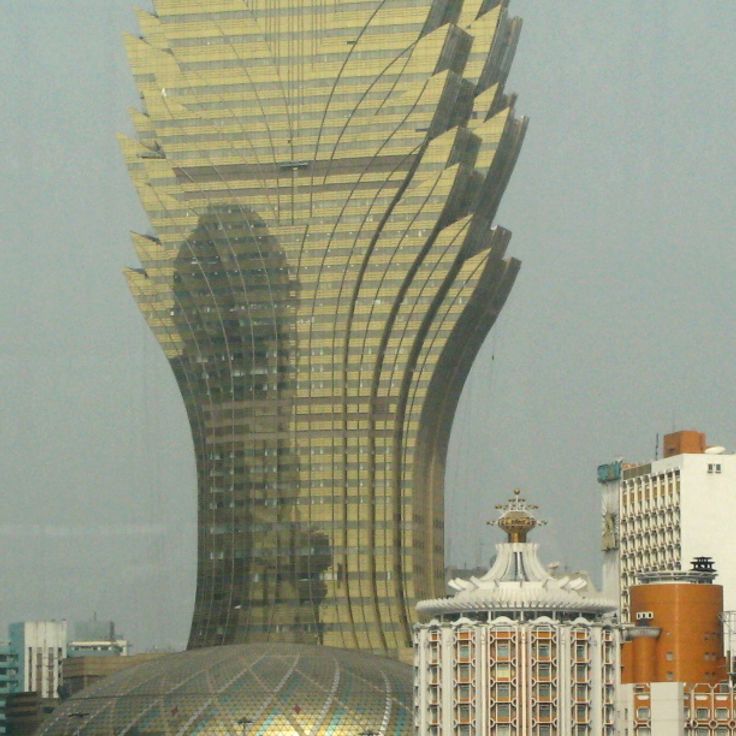
The Grand Lisboa rises 258 meters (846 feet) in the Sé district of Macau, combining casino operations with architecture that deliberately departs from conventional high-rise forms. The lotus-shaped structure consists of a cylindrical base and an upward-flaring crown whose exterior facade is fitted with thousands of LED lights. This illumination transforms the building at night into a widely visible presence. The design by Dennis Lau and Ng Chun Man interprets the lotus flower as a regional symbol and demonstrates how gambling facilities can achieve urban dominance through unconventional geometry.
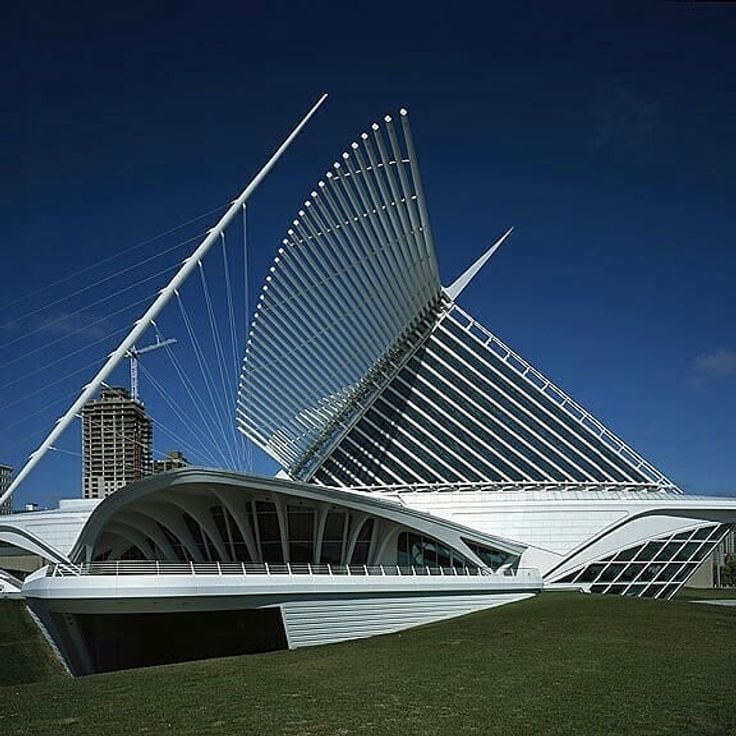
The Quadracci Pavilion, designed by Santiago Calatrava, serves as the main entrance to the Milwaukee Art Museum. Completed in 2001, the addition demonstrates Calatrava's signature structural elements: a movable sunscreen system featuring 66 steel fins that open and close, and a glass-enclosed hall supported by exposed steel ribs. The building's roof rises 90 feet (28 meters) above ground. The wingspan measures 217 feet (66 meters). This structure shows how engineering requirements and functional needs can be translated into unconventional architectural form.
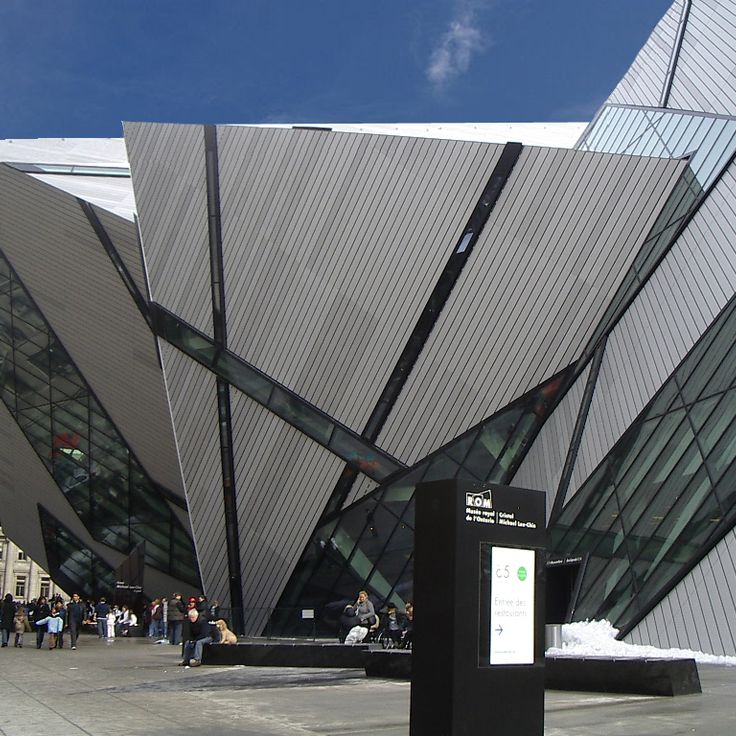
The Royal Ontario Museum displays collections of natural history, world culture and archaeology within a building that joins traditional stone architecture with a modern crystalline addition. The 2007 Micheal Lee-Chin Crystal extension consists of five interlocking prismatic forms clad in aluminum and glass that project over Bloor Street. The addition's sharp angles and slanted walls break from the symmetrical facade of the original 1914 building, creating interior spaces with tilted ceilings and triangular galleries. This architectural contrast underscores the museum's role as one of North America's largest cultural institutions, holding more than six million objects in its collections.
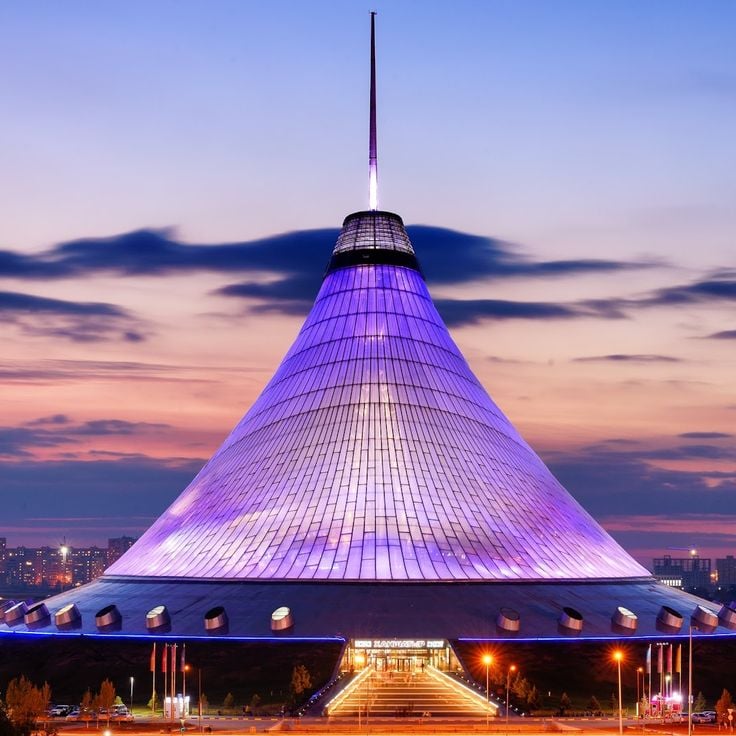
The Khan Shatyr Entertainment Center in Astana, designed by Norman Foster, stands as a 150-meter-tall transparent tent structure clad in ETFE cushions. This building merges modern engineering with the traditional form of the nomadic yurt, creating a climate-controlled interior that houses retail stores, entertainment venues and an indoor beach. The structure demonstrates how unconventional shapes can meet practical requirements in a continental climate with extreme temperature variations. As part of this collection, Khan Shatyr shows that tensile structures can define permanent urban spaces beyond temporary applications.
The Heydar Aliyev Center in Baku demonstrates how organic forms can be realized in contemporary construction. Opened in 2012, the structure abandons right angles in favor of flowing curves and undulating surfaces that span 610,000 square feet. The exterior of white fiberglass-reinforced concrete forms a continuous wave-like envelope with no visible transitions between walls, roof and ground surfaces. Inside, the center houses exhibition galleries, a 1,000-seat auditorium and a museum dedicated to Azerbaijani history. The construction required advanced engineering solutions to achieve the complex geometry, including custom-fabricated steel framing and specially formed cladding panels. The building serves both as a performance venue and as an architectural example of how computer-aided design technologies enable curved forms that were previously impossible to construct.
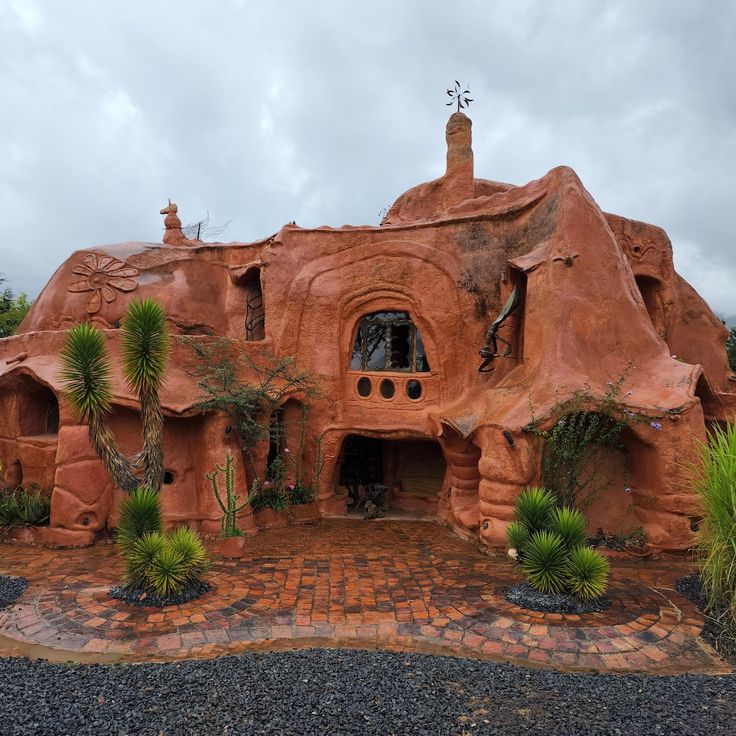
Casa Terracota is a terracotta house in Villa de Leyva built by architect Octavio Mendoza Morales over 14 years between 1999 and 2012. The two-story building is made entirely of hand-molded clay, with no wood or steel used in its construction. Windows, doorframes, stairs and furniture are fashioned from the same material, forming organic shapes with curved walls and vaulted ceilings. Mendoza designed the house as an experiment in sustainable architecture using local resources. The structure includes several rooms connected by arched passageways and an interior courtyard. Visitors can tour the rooms and observe the clay construction technique. The building demonstrates an alternative approach to residential architecture through the exclusive use of fired clay as a building material.
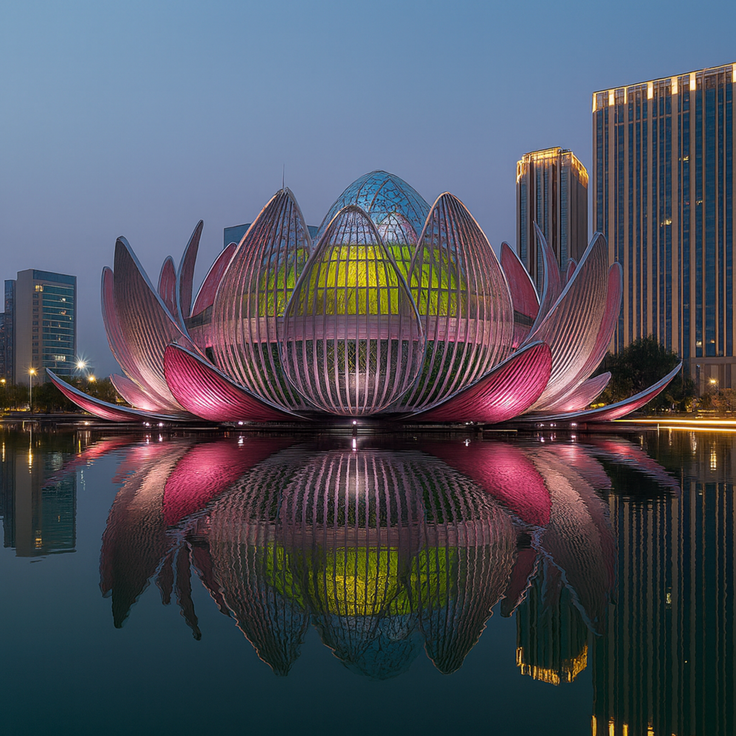
This civic building in Wujin near Changzhou takes the form of a lotus leaf rising above the surface of a lake. The glass and steel structure was completed in 2009 and serves as the seat of the Wujin District administration. The facade consists of curved glass panels that reflect light during the day and are illuminated from within at night. The three stacked layers of the outer shell create a multidimensional profile. The building stands on an artificial island in the lake and is accessible via pedestrian bridges. The construction demonstrates how organic forms can be translated into functional administrative buildings, contributing to this collection that documents alternative approaches to conventional architecture.
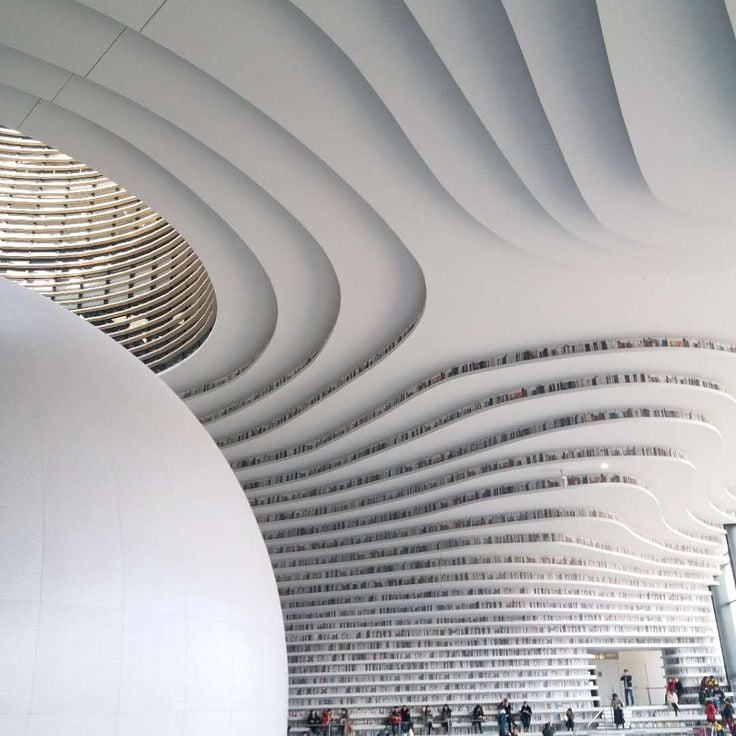
This public library in Tianjin's Binhai New Area opened in 2017 and features an undulating atrium with curved white shelving that extends from floor to ceiling. The shelves double as staircases and seating areas, creating a flowing interior that avoids traditional rectangular spaces. The central section houses a spherical auditorium structure surrounded by the terraced shelving. The library holds a collection of approximately 1.2 million books and serves as a cultural center for the newly developed coastal district northeast of Beijing.
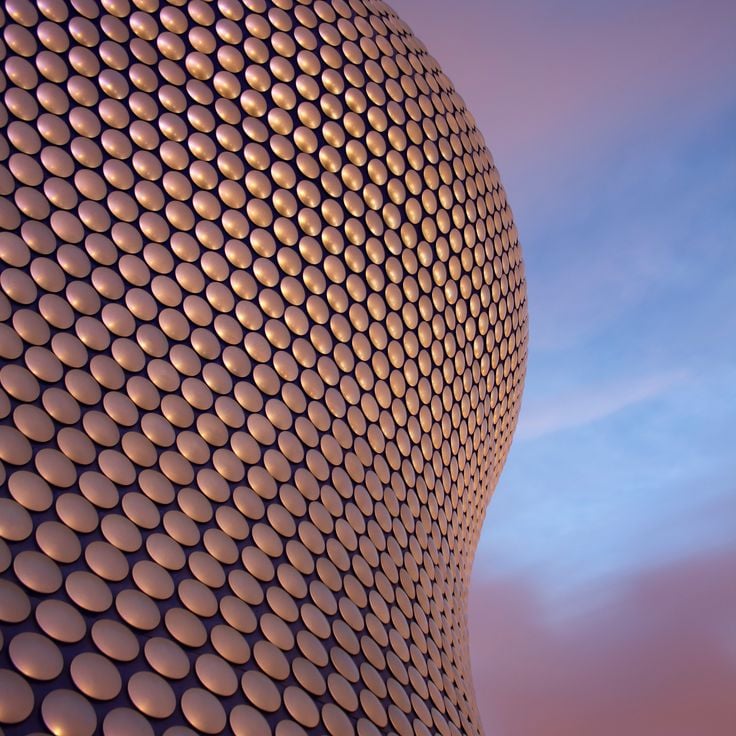
This department store in central Birmingham opened in 2003 and presents a marked contrast to the surrounding Victorian architecture. The facade consists of 15,000 aluminum discs distributed across a blue surface, giving the building its distinctive appearance. The organic form avoids right angles and instead follows curved lines. The four-story structure spans 323,000 square feet (30,000 square meters) of retail space and combines commercial use with experimental design, making it an example of structures that depart from conventional architectural approaches.
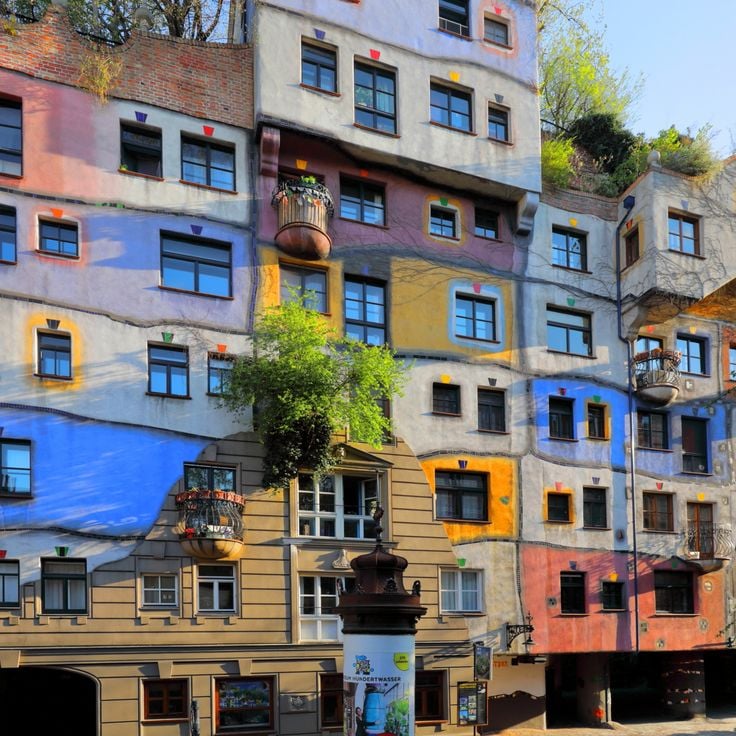
This residential building in Vienna's Landstrasse district was constructed between 1983 and 1985 following designs by artist Friedensreich Hundertwasser. The building features uneven floors, undulating walls and brightly glazed ceramic tiles covering the facade. It contains 52 apartments and four commercial units on the ground floor. Approximately 250 trees and shrubs grow on balconies, terraces and in the courtyard, realizing Hundertwasser's concept of integrating vegetation into urban architecture. The City of Vienna commissioned the transformation of a 1950s social housing block. The Hundertwasserhaus remains a functioning residential building managed by Vienna's municipal housing authority. Across the street, the Hundertwasser Village contains shops and a museum displaying his works.
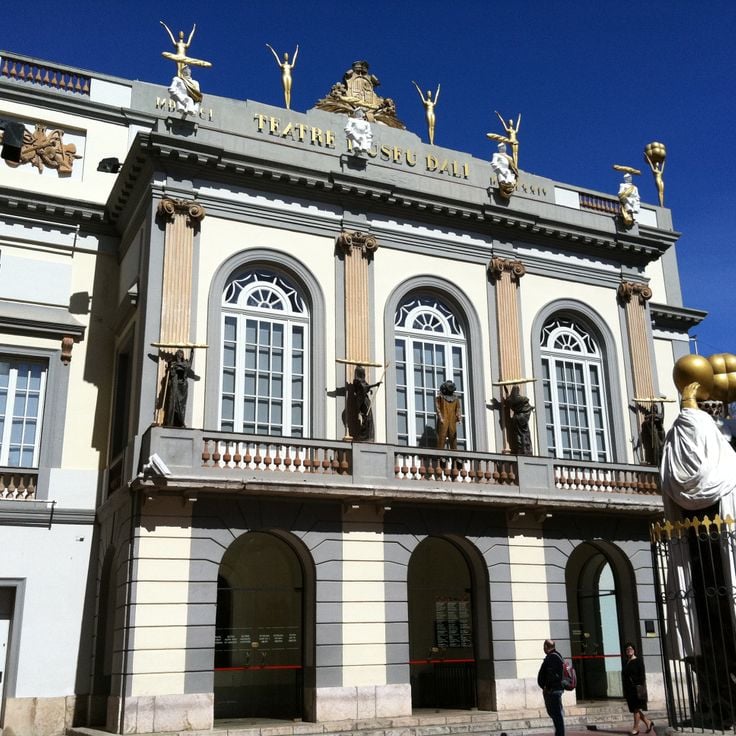
This museum in Figueres opened in 1974 on the ruins of a former municipal theater and now houses the largest collection of Salvador Dalí's works. The artist himself designed the facade with its red exterior walls, golden bread loaf sculptures along the roofline and geodesic dome over the former stage area. The collection includes paintings from all periods of his career, sculptures, furniture and installations. In the Torre Galatea, which adjoins the museum, Dalí lived his final years and is buried there. The rooms display surrealist elements such as the Mae West Room, where furniture forms a face, and the Palace of the Wind with optical illusions.
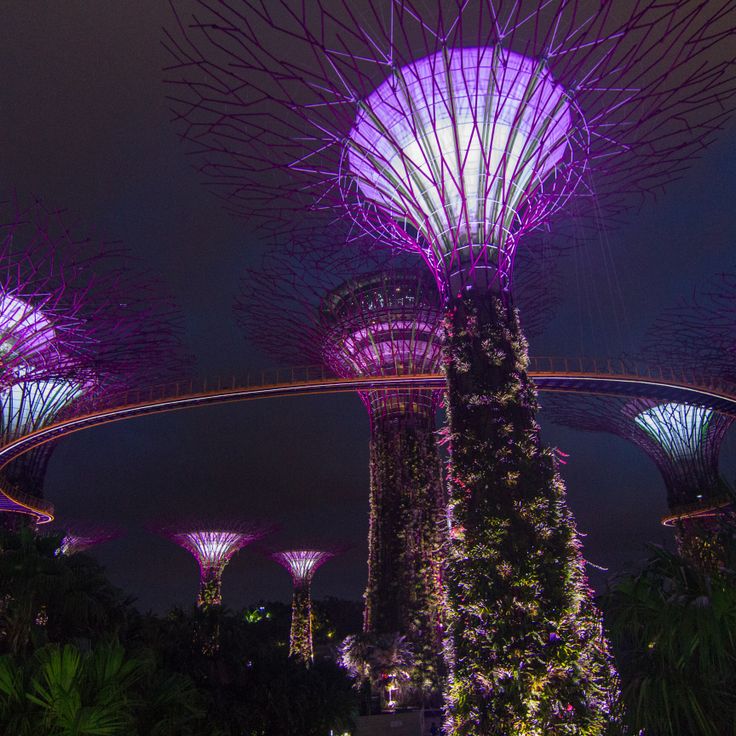
These artificial trees at Gardens by the Bay reach heights of 82 to 164 feet (25 to 50 meters) and function as vertical gardens housing more than 162,000 plants. The Supertrees collect rainwater, generate solar power and serve as ventilation ducts for nearby conservatories. A suspended walkway at 72 feet (22 meters) connects two of the largest structures, allowing visitors to walk among the canopy. The steel frameworks are covered with climbing plants, ferns and bromeliads that grow without soil in vertical planting systems. In the evening, the structures become part of a light and sound show that merges technology with botany, demonstrating the possibilities of urban green space in densely built cities.
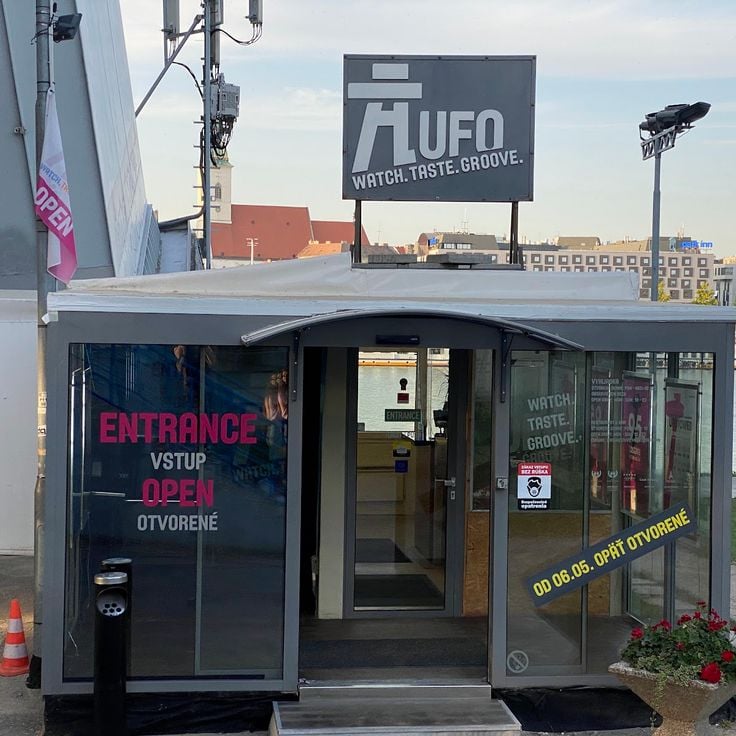
This restaurant, resembling a flying object, sits 280 feet (85 meters) above the Danube on the SNP Bridge pylon in Bratislava. Completed in 1972, the structure demonstrates the architectural experimentation of the socialist era, with its suspended reinforced concrete platform and glazed exterior walls. The circular structure houses a dining room and observation deck, providing views across the Slovak capital and the Danube basin. The UFO illustrates this collection's focus on unconventional forms, where technical requirements (in this case, spanning a river) result in unusual architectural solutions.
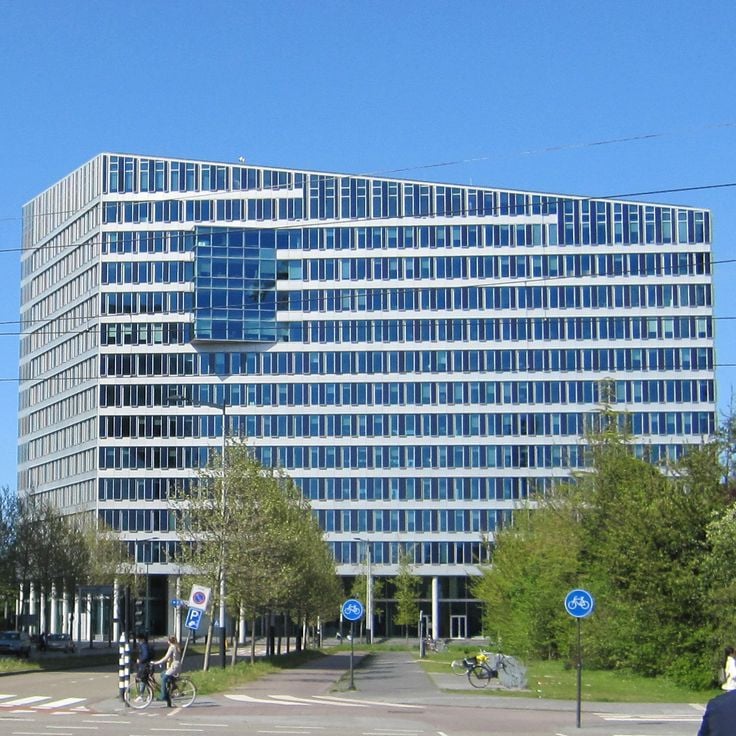
The Edge building in Amsterdam's Zuidas business district was completed in 2014 and ranks among the most sustainable office buildings globally. The 15-story structure uses over 28,000 sensors to control lighting, temperature and space utilization. Solar panels on the roof and south facade generate more energy than the building consumes. A central atrium connects floors with natural light while smart workstations adapt to individual user preferences. The glass exterior with precise orientation minimizes heat loss and maximizes natural illumination. This technical approach demonstrates modern possibilities for energy efficiency in large-scale construction.
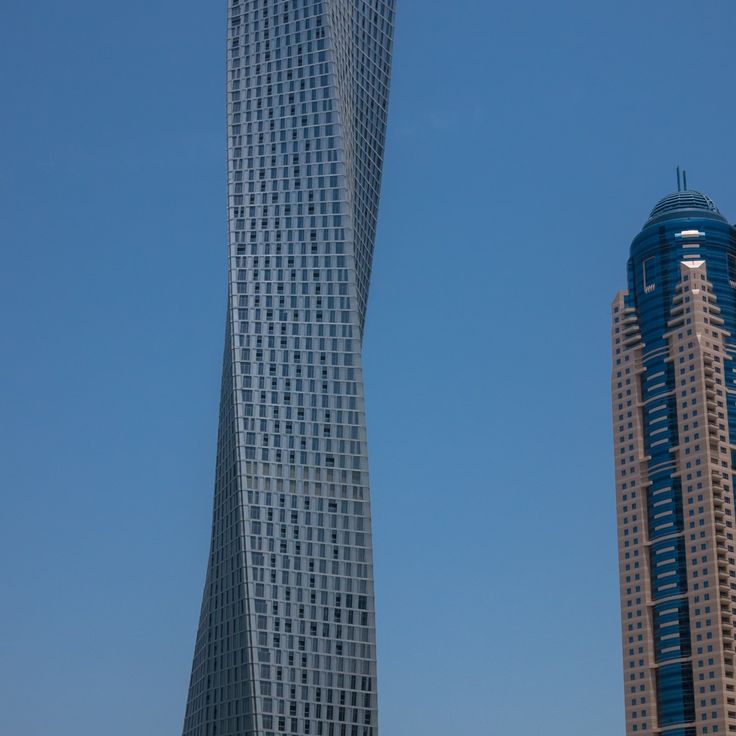
The Cayan Tower twists 90 degrees over its 1,017-foot (310-meter) height, forming a helix in the Dubai Marina district. Each of the 75 floors rotates 1.2 degrees from the one below, creating the twist. This construction method reduces wind loads on the building while changing the appearance of the facade depending on viewing angle. Completed in 2013, the residential tower contains 495 apartments and demonstrates how torsion can be applied as a structural principle in high-rise architecture.
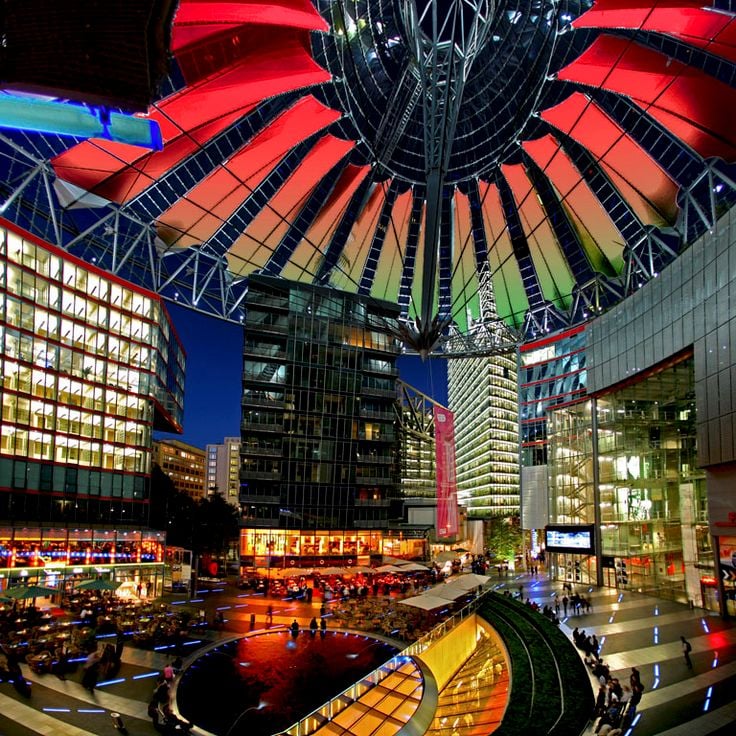
This complex of seven buildings at Potsdamer Platz combines cinemas, shops, restaurants and offices beneath a glass-covered forum. The Sony Center was built between 1996 and 2000 on a site divided for decades by the Berlin Wall. The central structure is an elliptical roof of steel and glass that stretches like a tent canopy over the public plaza. The roof consists of segmented panels radiating from a central ring. The complex was designed by Helmut Jahn and serves as a symbol of urban renewal following reunification. At night the roof is illuminated from within, casting the glass structure in shifting colors. The forum provides 43,000 square feet (4,000 square meters) of space for events and public gatherings.
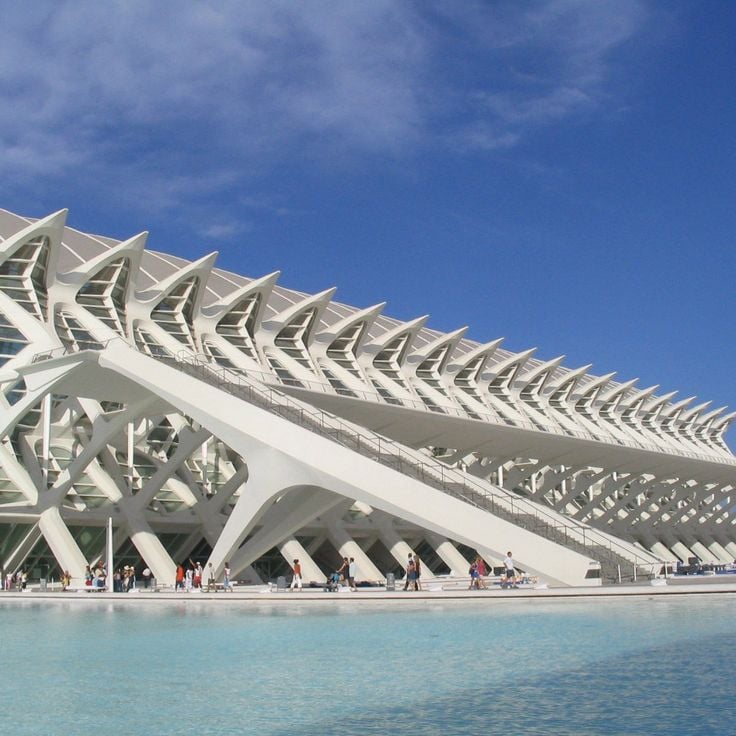
The Príncipe Felipe Science Museum in Valencia's Ciudad de las Artes y las Ciencias features a vaulted skeletal structure of concrete and glass that extends 792 feet (241 meters). Spanish architect Santiago Calatrava designed the building, completed in 2000, with cantilevered ribs that suggest a skeleton or whale body. Interactive exhibits cover science and technology across three levels totaling 280,000 square feet (26,000 square meters). The asymmetrical exterior shell is reflected in surrounding water features that reinforce the architectural profile. The museum forms part of a larger complex that includes several buildings with organic forms built during the 1990s and 2000s.
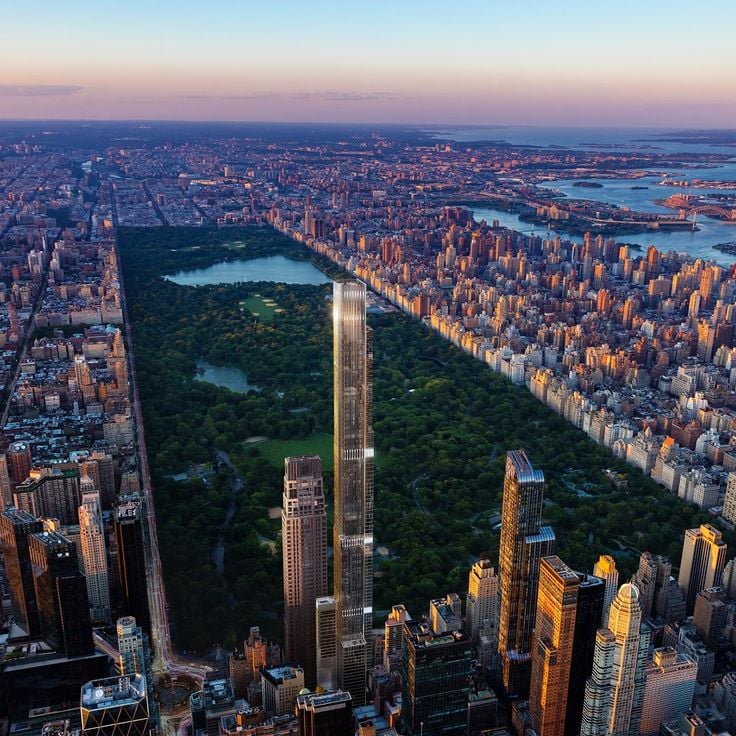
Central Park Tower is an ultra-tall residential tower on the southern edge of Central Park in Manhattan. Standing at 98 stories and reaching 1,549 feet (472 meters), it is the world's tallest residential building and was completed in 2020. The slender tower with its glass facades presents a vertical form that departs from the city's traditional rectangular block construction. The building contains luxury residences on its upper floors and the Nordstrom department store in the lower levels. Its narrow footprint and extreme height required engineering solutions for wind loads and structural stability that differ from conventional residential construction.
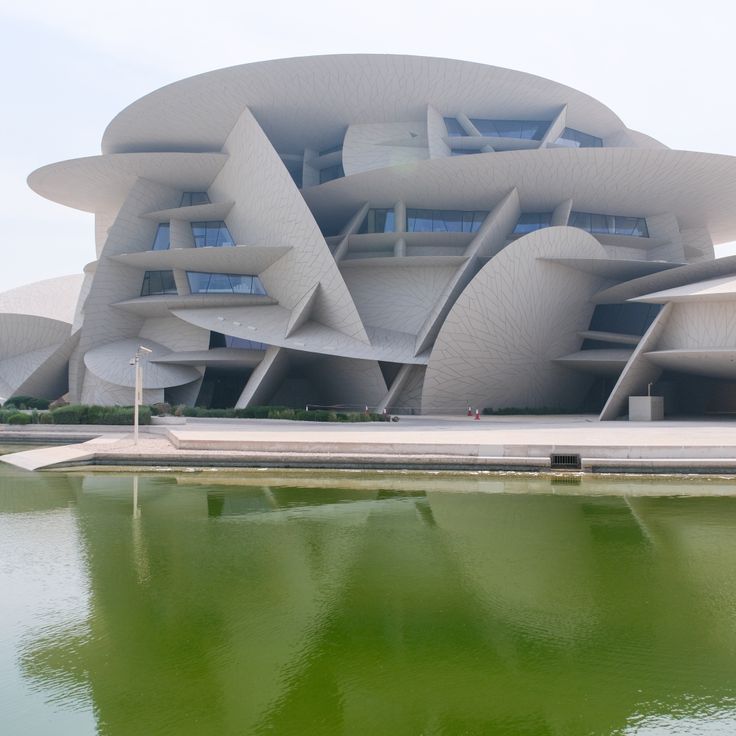
This museum opened in Doha in 2019, developing an architectural language of interlocking discs inspired by desert rose crystals. French architect Jean Nouvel designed a structure using 539 curved concrete panels that intersect at various angles, creating a series of galleries that document Qatar's history from geological formation to the present. The facade extends roughly 1,150 feet (350 meters) with discs reaching up to 260 feet (80 meters) in diameter. Construction required specialized engineering to fabricate and stabilize the curved forms. Interior spaces include 11 permanent galleries across approximately 86,000 square feet (8,000 square meters). The building adds an example of contemporary geometry to the collection's experimental structures.
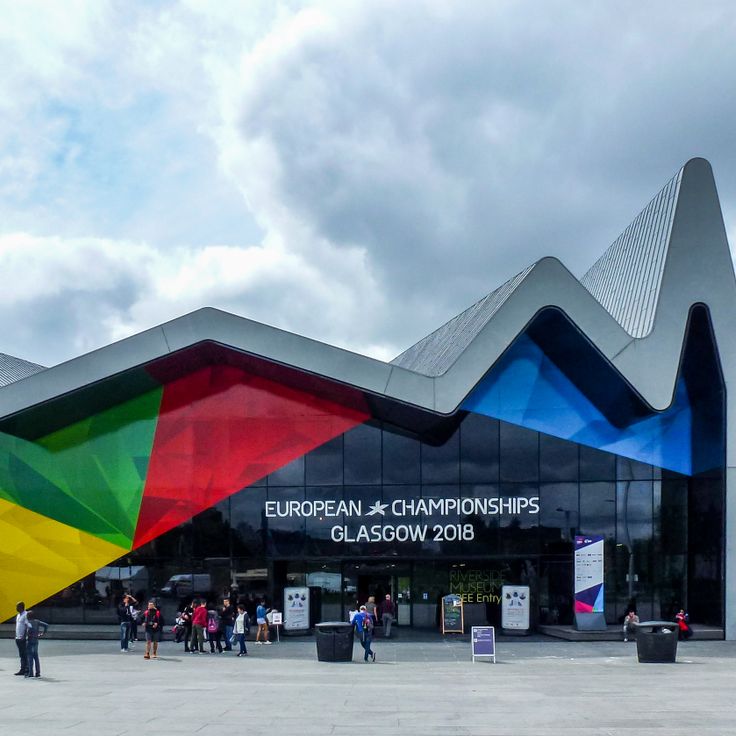
This transportation museum in Glasgow Harbour brings together over 3,000 objects beneath a corrugated zinc-and-steel roof that folds in sharp angles. The interlocking façades and tapered form call to mind ship hulls and shipyard structures that once lined the River Clyde waterfront. Inside, seven exhibition zones present trams, locomotives, motorcycles and historic vehicles documenting 200 years of industrial history. A restored cargo ship is moored at the quay for onboard tours. Opened in 2011, the building has revitalized the harborfront district.
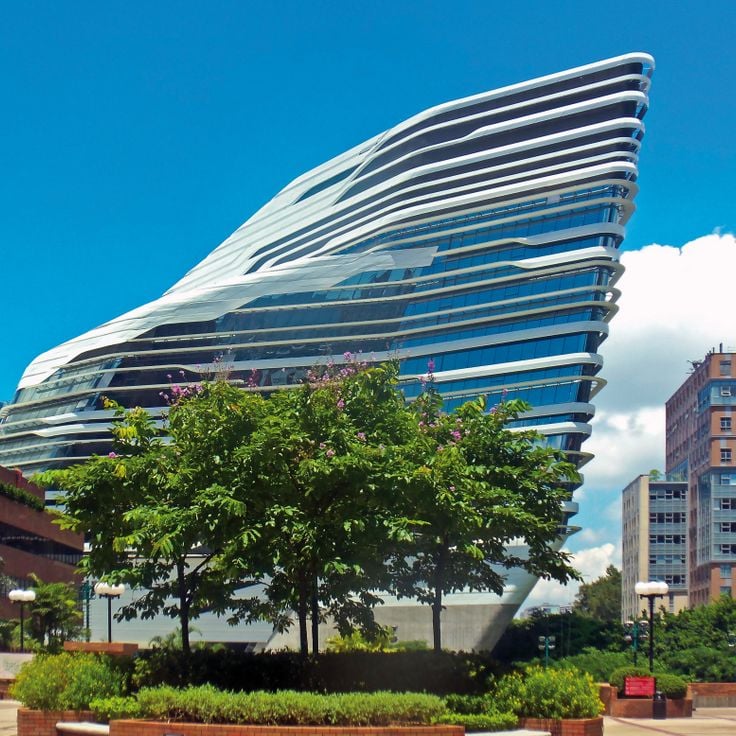
The Jockey Club Innovation Tower has served as home to the School of Design at Hong Kong Polytechnic University in Hung Hom since 2014. Designed by Zaha Hadid, the building displays her signature approach with flowing lines and interlocking volumes of concrete and glass. The facade departs from orthogonal grids, creating a sculptural silhouette that stands apart from surrounding campus structures. Inside, sloped floors and open staircases connect levels and encourage interaction among students and faculty. This structure demonstrates how architectural design can shape educational spaces without adhering to conventional building forms.
This residential building in Naucalpan de Juárez follows the spiral geometry of a sea shell, demonstrating an organic approach to form. The Nautilus House uses curved lines and flowing transitions between spaces, with concrete and colored glass forming the exterior structure. The architecture avoids right angles and straight walls, creating interior spaces that recall natural caves. Entrances and windows integrate into the organic form, while the staircase follows the internal spiral. The building belongs to those structures that treat living space as a sculptural object and demonstrates how far residential architecture can depart from conventional building forms.
This residential complex designed for the 1967 World's Fair comprises 354 identical concrete modules forming 146 residences across twelve stories. Architect Moshe Safdie developed a modular construction method where each unit includes a private terrace, giving residents outdoor space despite the high density. The stacked arrangement created an alternative to conventional high-rise buildings and demonstrated new possibilities for urban living. Habitat 67 stands along the Saint Lawrence River and continues to function as an inhabited structure.
The Transamerica Pyramid has defined San Francisco's skyline since its completion in 1972. This 850-foot office tower uses its pyramidal form to meet structural requirements in a seismically active zone. The reinforced concrete frame supports a glass facade, while the tapering shape provides added stability during earthquakes. The building rises 48 stories and served for decades as headquarters for the Transamerica Corporation. Today it houses various office tenants and stands as an example of functional high-rise architecture from the early 1970s.
This hotel in Đà Lạt takes the form of an organic treehouse with curving walls, tunnels and bridges. Vietnamese architect Dang Viet Nga designed the building as an inhabitable sculpture where natural forms merge with functional spaces. Guest rooms fit within the flowing structure while passages and staircases wind through the multilevel complex. The design abandons right angles and straight lines in favor of continuous curved architecture that recalls grown organisms. Visitors can explore the interwoven levels and experience the unconventional spatial arrangements throughout the property.
The Sagrada Familia is a Roman Catholic basilica with multiple tall towers and complex geometric forms that has been under construction since 1882, initiated under the direction of Antoni Gaudí. This structure combines Gothic architecture with organic elements and demonstrates Gaudí's characteristic use of natural forms in the design of the facades and interior spaces. The basilica features three main facades that each represent different aspects of Christ's life, and an interior with inclined columns that mimic a forest canopy. The ongoing construction makes the Sagrada Familia one of the longest architectural projects in the world.
This bronze sculpture by Arnaldo Pomodoro stands in the courtyard of the Vatican Museums and features an outer sphere with a fractured surface that reveals a complex inner sphere. The work, approximately 13 feet (4 meters) tall and dating from the 1990s, belongs to a series of similar sculptures the Italian artist created for locations worldwide. The mechanical gears and geometric patterns visible inside contrast with the smooth outer shell and demonstrate Pomodoro's distinctive approach to form and surface.
These traditional limestone structures from the 14th century define Alberobello's architecture with their conical roofs and dry stone construction. The trulli were built without mortar, with roof stones that could be removed when needed. This construction method allowed residents to quickly dismantle the buildings to avoid taxes on permanent structures. Today more than 1,500 of these buildings stand in the town, which is recognized as a UNESCO World Heritage site and represents a notable example of prehistoric building techniques that survived into modern times.
This Brussels landmark from 1958 consists of nine connected spheres linked by twenty tubes, representing an iron crystal cell magnified 165 billion times. The Atomium was designed for the World's Fair and symbolizes the atomic age and postwar scientific progress. The structure rises 335 feet (102 meters) and contains exhibition spaces in the upper spheres, accessible via escalators and an elevator. From the top sphere, visitors can take in views across the Belgian capital.
This steel arch marks the historic starting point of 19th-century American westward expansion. The 630-foot (192-meter) stainless steel structure was completed in 1965 and stands on the west bank of the Mississippi River. A tram system carries visitors to the observation deck at the apex, providing views across the city and the river. Architect Eero Saarinen designed the parabolic form, which required three years of precise engineering work to construct. The Gateway Arch anchors a national park commemorating the Louisiana Purchase and the pioneer routes heading west.
This public park extends across 42 acres (17 hectares) and presents the characteristic work of Antoni Gaudí through colored mosaic surfaces, serpentine stone colonnades and organically shaped benches. Originally conceived as a residential development project between 1900 and 1914, the site demonstrates architectural elements that combine natural forms with structural innovation. The design includes the undulating bench on the main terrace, covered with broken ceramic fragments, and incorporates the natural topography of the hillside with constructed elements that reflect Gaudí's approach to spatial organization.
This structure dates to the 5th century and sits on a vertical cliff face 246 feet (75 meters) above the valley floor. The construction rests on wooden crossbeams anchored deep into the rock that support a series of pavilions combining Buddhist, Taoist and Confucian elements. The architects used the natural overhang of the cliff as protection against weathering. The technique demonstrates advanced understanding of statics and timber construction from the Wei Dynasty, where load and thrust are distributed through a system of interlocking beams.
These residential buildings from the 1980s were designed by Dutch architect Piet Blom, who experimented with an unconventional geometric solution. Each structure rests on a hexagonal base and tilts at a 45-degree angle, making the upper floors appear as three-dimensional cubes. The design was intended to represent a forest of artificial trees, with each unit forming its own trunk. The living concept distributed functions across three levels: the lower area contains the entrance zone and kitchen, the middle floor holds living and sleeping spaces, while the top level serves as a pyramid-shaped room with windows facing all directions.
This private residence along the Mediterranean coast was designed by Hungarian architect Antti Lovag and consists of interconnected spherical forms that cascade down a hillside above the shoreline. The structure combines more than 28 circular rooms of varying sizes with panoramic windows that open to views of the sea and surrounding terrain. The organic shapes follow Lovag's concept of habitology, which rejects rectangular spaces in favor of flowing, cave-like structures. An amphitheater-style outdoor area provides seating for approximately 500 people and hosts cultural events. Terracotta tones dominate the facades, while interiors are marked by sculptural furniture and built-in elements.
This modern timber structure spans 150 meters in length and has covered a market on Plaza de la Encarnación since 2011. The Metropol Parasol combines structural innovation with organic forms and offers not only the ground-level market but also a rooftop walkway where visitors can view the old town from above. The undulating structure made of laminated timber and polyurethane ranks among the largest wooden buildings worldwide and has fundamentally transformed the urban appearance of this historic square. Archaeological remains from Roman and Moorish periods are displayed in the lower levels.
The Guggenheim Museum Bilbao stands as a powerful example of the unconventional architecture presented in this collection. Its titanium panels catch the light differently depending on the time of day, creating an ever-changing appearance along the Nervión River. Inside, 19 galleries spread across three floors hold contemporary and modern art. The flowing curves of the structure reshape how visitors move through exhibition spaces and experience the art within.
The south wall of this parking structure displays 22 book spines measuring 25 feet (7.5 meters) in height, with titles selected by local residents. The installation transforms functional infrastructure into public art, combining practical urban planning with cultural expression. Each spine represents works meaningful to the community, making the building a recognizable landmark in the downtown area. The structure demonstrates how everyday architecture can communicate civic values through creative design.
This hotel opened in 2006 and uses 60 tons of titanium for its exterior cladding in pink, gold and silver. The building stands in the heart of the Rioja wine region and combines technical precision with sculptural form. The undulating titanium panels reflect light and create shifting visual effects throughout the day. The design integrates with the surrounding vineyards while serving as a distinct landmark in the landscape.
The Krzywy Domek is a commercial building designed by Szotyńscy & Zaleski in 2004, featuring a wave-like facade inspired by Jan Szancer's illustrations. The structure's curved lines and distorted windows create an optical illusion resembling melted glass. The building houses retail shops, restaurants and office spaces in central Sopot. Its asymmetric architecture contrasts with the surrounding traditional buildings, demonstrating how commercial structures can integrate unconventional design principles.
This university building in Brighton was constructed as a research project in sustainable building practices, demonstrating the reuse of everyday consumer items as construction materials. The structure incorporates approximately 20,000 toothbrushes, 2,000 carpet tiles and 4,000 DVD cases into its framework. The building illustrates practical applications of recycling principles in architecture and examines how consumer waste can be transformed into functional building components. The structure serves as an experimental model for resource-conscious construction methods.
The Piano House in Huainan takes the form of a concert grand piano constructed from black glass and steel, while a transparent violin serves as the entrance structure. The building functions as a music center and demonstrates how functional architecture can translate musicality into three-dimensional form. This structure combines technical innovation with artistic expression and shows the possibilities of unconventional architectural design in contemporary Chinese architecture.
La Muralla Roja is a residential complex in Calpe designed by architect Ricardo Bofill in 1973 that pushes the boundaries of conventional building forms. The structure combines cubic volumes with interlocking staircases and courtyards inspired by North African kasbah architecture. Its red facade contrasts with blue and violet accents in the interior spaces, demonstrating Bofill's experimental approach to merging geometric precision with Mediterranean building traditions. As part of this collection, La Muralla Roja shows how technical innovation and artistic expression can merge in residential architecture.
The Museu de Arte Contemporânea de Niterói rises from a cliff above Guanabara Bay, redefining modern Brazilian architecture. Designed by Oscar Niemeyer, this six story structure combines a circular base with a prominent dome resembling a spacecraft or flower. Completed in 1996, the building rests on a single central support column and extends outward via a 52 foot (16 meter) wide ramp. The curved lines and red walkway contrast with white concrete, creating a sculptural form that demonstrates Niemeyer's interest in organic shapes.
The Aldar headquarters is a 360-foot office tower in Abu Dhabi completed in 2010. The building takes a complete circular form, wrapped in a continuous glass facade. The structure combines the technical requirements of an office building with a geometric shape that departs from conventional high-rise design. The circular structure required specialized structural solutions and custom facade engineering to realize the round geometry across its full height.
This 1996 building in central Prague consists of two towers with curved glass facades and asymmetrically placed windows. The Dancing House was designed by architects Vlado Milunić and Frank Gehry and departs from the historical architectural styles of the surrounding area. The construction uses reinforced concrete and prefabricated elements to achieve the curved lines. The building stands on the Vltava riverbank and houses offices, a restaurant and a gallery. The architectural form with its two distinct towers suggests a dancing couple, which gave the structure its name.
The Lotus Temple demonstrates architectural innovation through its unusual construction of 27 freestanding marble petals reaching a height of 112 feet (34 meters). This Bahai house of worship, built between 1980 and 1986, eliminates load-bearing interior walls and instead employs a complex structural system of nine interconnected petal clusters. The design shows how religious architecture can translate organic forms into technically demanding buildings while creating an open prayer hall that accommodates up to 2,500 visitors.
This cathedral was built in 2013 as a temporary replacement for the Anglican church damaged in the earthquake. Japanese architect Shigeru Ban designed the structure using 86 paper tubes, each weighing 1,300 pounds (600 kilograms) and rising 79 feet (24 meters) high. The building demonstrates how temporary religious spaces can be created with recyclable materials. The construction combines structural stability with environmental considerations and continues to serve as a place of worship.
Bishop Castle in Colorado represents over four decades of architectural work by a single builder. Constructed between 1969 and 2010 without formal plans or blueprints, this stone and metal structure emerged through an intuitive building process. The castle includes multiple towers connected by bridges, demonstrating how architectural complexity can develop through continuous construction without conventional planning. Each element was developed during the building process itself, creating a structure that documents one man's sustained vision and technical problem-solving across 41 years of work.
This metal art installation takes the form of a residential house rotated 90 degrees, challenging conventional notions of architectural orientation. The Maison Tordue forms part of the Columbus public art collection, demonstrating how artistic intervention can redefine public space. The structure combines industrial materials with conceptual design, inviting visitors to reconsider the relationship between function and form. The work exists within a city recognized for its substantial architectural holdings.
This residential structure in Darmstadt follows a spiral floor plan and contains 105 apartments across multiple levels. The facade displays a sequence of varying colors, while trees have been planted on the rooftop surface. Completed in 2000 after a two-year construction period, the Spirale Forêt combines serial housing concepts with design elements inspired by organic forms. The building represents experimental approaches in German residential architecture during the late 1990s, integrating environmental components into an unconventional geometric framework.
This palace in Hauterives is the life's work of Ferdinand Cheval, a rural mail carrier who collected stones along his postal route from 1879 to 1912 to construct this unusual structure. Cheval worked for 33 years without architectural training, creating a complex building that combines elements from various cultures and historical periods. The facades display a mix of mythological figures, exotic animals and geometric patterns, all crafted from fieldstones and lime. The structure was recognized as a historic monument by André Malraux in 1969 and stands as a notable example of outsider art in architecture.
This abstract monument near Kruševo commemorates participants of the 1903 Ilinden Uprising and fighters from the Second World War. Makedonium was designed in 1974 by Jordanian architect Bogdan Bogdanović and consists of circular concrete structures resembling a stylized flower or sun. The geometric forms and open spaces create a monumental presence on the site. The structure belongs to a series of monuments from the former Yugoslavia and demonstrates the architectural language of that era. Visitors can explore the interior spaces and take in views across the surrounding mountain landscape.
This Seattle museum presents contemporary culture within a wave-like metal structure designed by Frank Gehry. The exhibitions cover American music history, science fiction artifacts and interactive displays on pop culture. The building itself demonstrates deconstructivist architecture through its curved aluminum and stainless steel facades that flow across multiple levels. Visitors find collections on guitar innovation, horror films and video games, along with rotating special exhibitions addressing current cultural phenomena.
The Capitol Complex of Chandigarh was built between 1951 and 1965 to designs by Le Corbusier and serves as the government center of Punjab state. The complex includes the Assembly, the Secretariat and the High Court, three concrete structures that embody Le Corbusier's modernist principles. The architect developed his theories on natural ventilation, sun protection and monumental form in a tropical climate through these buildings. The geometric shapes and raw concrete surfaces reflect Le Corbusier's vision of rational, functional architecture for independent India. This UNESCO World Heritage site covers 247 acres (100 hectares) and demonstrates how modernist principles were applied to institutional buildings in South Asia.
This 170-foot (52-meter) metal sculpture stands in Barcelona's Olympic Harbor, representing a fish with gleaming stainless steel scales. El Peix was created for the 1992 Olympic Games, combining maritime symbolism with contemporary steel construction. The structure ranks among the largest fish sculptures in the world and demonstrates how public art can redefine urban waterfront areas. The work fits into the tradition of architectural forms that merge technical innovation with artistic expression.
The Nakagin Capsule Tower was completed in 1972 and consists of 140 interchangeable residential capsules attached to a central core. Located in the Ginza district, this building embodies the principles of Metabolist architecture, a movement that viewed structures as adaptable organisms. Each capsule measures roughly 107 square feet (10 square meters) and was originally designed as a mobile dwelling unit, though the interchangeability concept was never implemented. The tower represents an attempt to address Tokyo's space constraints through prefabricated modular construction.
This museum inside a modest house preserves more than 300 concrete sculptures Helen Martins created between 1945 and 1976. The figures depict animals, biblical scenes and religious motifs that fill the walls and garden. Martins used ground glass, mirrors and bright colors to realize a personal vision that developed outside conventional artistic movements. The collection documents three decades of work by a woman who transformed her home into a three-dimensional artwork that challenges traditional boundaries between domestic space and creative expression.
Casa Vicens was Antoni Gaudí's first major project and marked the start of his long career in Barcelona. Completed in 1885, this residential building combines Moorish elements with Catalan building traditions and already displays Gaudí's characteristic use of ceramic tiles in bright colors. The facade presents geometric patterns in green and white tiles, while the interior spaces feature elaborate stucco work and hand-painted ceilings. The building originally served as a summer house for industrialist Manuel Vicens and opened to the public as a museum in 2017. The architecture connects Oriental inspiration with European construction methods of the late 19th century.
This fiberglass and steel structure was built in 1971 and serves as an example of Australian roadside advertising architecture. The Big Pineapple stands 55 feet (16.7 meters) tall and was originally created as a tourist attraction for a pineapple plantation. The form references the region's agricultural tradition and demonstrates how commercial architecture transformed regional products into built structures. Visitors can access exhibitions about pineapple production inside. The site documents a trend toward monumental product advertising that emerged during the second half of the twentieth century.
The Blue Planet in Copenhagen takes the form of a water vortex and houses 53 aquariums within an aluminum-clad building. The facility combines technical functionality with an architectural form inspired by the movement of water. The spiral arms extend from the central entrance area and organize the various installations along a circulation route. The design aligns with the collection's concept through its unconventional structure, which departs from traditional aquarium buildings. The aluminum cladding reflects light and reinforces the visual connection to the aquatic theme of the building. The architecture serves both to present marine habitats and as a standalone expression of contemporary construction.
The Museo Soumaya is a six-story museum housed in an asymmetrical metal facade that contains approximately 66,000 works of art. The building's exterior consists of roughly 16,000 hexagonal aluminum plates that give the structure its distinctive reflective surface. The collection spans multiple periods and cultures, from pre-Columbian art to European masterworks. The unconventional architecture makes this museum a prominent feature of Mexico City's urban landscape.
This office building in Newark served as corporate headquarters for the Longaberger Company from 1997 to 2016. The structure replicates one of the manufacturer's handwoven baskets at monumental scale, measuring 276 feet (84 meters) in length and 192 feet (59 meters) in width. The seven-story construction weighs approximately 8000 tons and features two basket handles fashioned from aluminum and copper, each weighing 68 tons. The facade consists of reinforced concrete with heating elements installed in the handles to prevent ice formation. Following the company's bankruptcy, the building was sold and now serves different purposes.
This art museum in Graz opened in 2003 and stands out for its organic shape that resembles a bubble or an alien organism. The blue shimmering shell consists of acrylic panels stretched over a steel structure. The building contrasts with the historic architecture of the old town and houses contemporary art exhibitions. The bionic form dispenses with right angles and creates flexible interior spaces that adapt to different exhibition concepts. The museum's outer skin can be animated with integrated lights.
Casa do Penedo is a residence in the Fafe mountains built between four large granite boulders. Constructed in the 1970s, the structure integrates the natural rock formations as load-bearing elements and walls. The building contains two levels of living space that adapt to the irregular surfaces of the stones. Windows and doors fit directly into the granite, while the roof bridges the gaps between the boulders. This house demonstrates a construction approach where existing geological features determine architectural form and create functional spaces within the constraints imposed by natural elements.
The Turning Torso is a 623-foot residential tower in Malmö that rotates 90 degrees across nine segments. Spanish architect Santiago Calatrava designed the building based on the concept of a twisting human torso, with 54 floors housing 147 apartments. The construction uses a central concrete core reinforced by an external steel skeleton to maintain structural integrity throughout the rotation. Completed in 2005, the building marks the Västra Hamnen harbor district and represents Malmö's urban transformation from an industrial city to a modern center. Visitors can view the building from the outside; access to residential areas is restricted to residents.
The CCTV Headquarters in Beijing consists of two leaning towers connected at the top by a horizontal section, forming an unusual closed loop. Standing 768 feet (234 meters) tall and completed in 2012, the structure breaks from the vertical tradition of skyscrapers by creating a continuous path through the building. The outward-leaning walls create an angular appearance while the exterior diagonal lattice system provides both structural support and visual texture. The building houses television studios, offices and production facilities for China's state broadcaster, demonstrating how engineering can enable radically different geometry in high-rise architecture.
The Ryugyong Hotel rises in pyramidal form over Pyongyang and stands among the tallest structures in the country at 1083 feet (330 meters). Construction started in 1987, halted several times and received its glass exterior of triangular facade panels only from 2008 onward. The three building wings taper upward and meet at a common point. The plan calls for 1400 rooms, many of which remain unfinished today. The structure dominates the city skyline from a distance and serves as an example of large scale architectural projects that remained incomplete for decades due to political and economic factors before exterior facade work was completed.
The Grand Lisboa rises 258 meters (846 feet) in the Sé district of Macau, combining casino operations with architecture that deliberately departs from conventional high-rise forms. The lotus-shaped structure consists of a cylindrical base and an upward-flaring crown whose exterior facade is fitted with thousands of LED lights. This illumination transforms the building at night into a widely visible presence. The design by Dennis Lau and Ng Chun Man interprets the lotus flower as a regional symbol and demonstrates how gambling facilities can achieve urban dominance through unconventional geometry.
The Quadracci Pavilion, designed by Santiago Calatrava, serves as the main entrance to the Milwaukee Art Museum. Completed in 2001, the addition demonstrates Calatrava's signature structural elements: a movable sunscreen system featuring 66 steel fins that open and close, and a glass-enclosed hall supported by exposed steel ribs. The building's roof rises 90 feet (28 meters) above ground. The wingspan measures 217 feet (66 meters). This structure shows how engineering requirements and functional needs can be translated into unconventional architectural form.
The Royal Ontario Museum displays collections of natural history, world culture and archaeology within a building that joins traditional stone architecture with a modern crystalline addition. The 2007 Micheal Lee-Chin Crystal extension consists of five interlocking prismatic forms clad in aluminum and glass that project over Bloor Street. The addition's sharp angles and slanted walls break from the symmetrical facade of the original 1914 building, creating interior spaces with tilted ceilings and triangular galleries. This architectural contrast underscores the museum's role as one of North America's largest cultural institutions, holding more than six million objects in its collections.
The Khan Shatyr Entertainment Center in Astana, designed by Norman Foster, stands as a 150-meter-tall transparent tent structure clad in ETFE cushions. This building merges modern engineering with the traditional form of the nomadic yurt, creating a climate-controlled interior that houses retail stores, entertainment venues and an indoor beach. The structure demonstrates how unconventional shapes can meet practical requirements in a continental climate with extreme temperature variations. As part of this collection, Khan Shatyr shows that tensile structures can define permanent urban spaces beyond temporary applications.
The Heydar Aliyev Center in Baku demonstrates how organic forms can be realized in contemporary construction. Opened in 2012, the structure abandons right angles in favor of flowing curves and undulating surfaces that span 610,000 square feet. The exterior of white fiberglass-reinforced concrete forms a continuous wave-like envelope with no visible transitions between walls, roof and ground surfaces. Inside, the center houses exhibition galleries, a 1,000-seat auditorium and a museum dedicated to Azerbaijani history. The construction required advanced engineering solutions to achieve the complex geometry, including custom-fabricated steel framing and specially formed cladding panels. The building serves both as a performance venue and as an architectural example of how computer-aided design technologies enable curved forms that were previously impossible to construct.
Casa Terracota is a terracotta house in Villa de Leyva built by architect Octavio Mendoza Morales over 14 years between 1999 and 2012. The two-story building is made entirely of hand-molded clay, with no wood or steel used in its construction. Windows, doorframes, stairs and furniture are fashioned from the same material, forming organic shapes with curved walls and vaulted ceilings. Mendoza designed the house as an experiment in sustainable architecture using local resources. The structure includes several rooms connected by arched passageways and an interior courtyard. Visitors can tour the rooms and observe the clay construction technique. The building demonstrates an alternative approach to residential architecture through the exclusive use of fired clay as a building material.
This civic building in Wujin near Changzhou takes the form of a lotus leaf rising above the surface of a lake. The glass and steel structure was completed in 2009 and serves as the seat of the Wujin District administration. The facade consists of curved glass panels that reflect light during the day and are illuminated from within at night. The three stacked layers of the outer shell create a multidimensional profile. The building stands on an artificial island in the lake and is accessible via pedestrian bridges. The construction demonstrates how organic forms can be translated into functional administrative buildings, contributing to this collection that documents alternative approaches to conventional architecture.
This public library in Tianjin's Binhai New Area opened in 2017 and features an undulating atrium with curved white shelving that extends from floor to ceiling. The shelves double as staircases and seating areas, creating a flowing interior that avoids traditional rectangular spaces. The central section houses a spherical auditorium structure surrounded by the terraced shelving. The library holds a collection of approximately 1.2 million books and serves as a cultural center for the newly developed coastal district northeast of Beijing.
This department store in central Birmingham opened in 2003 and presents a marked contrast to the surrounding Victorian architecture. The facade consists of 15,000 aluminum discs distributed across a blue surface, giving the building its distinctive appearance. The organic form avoids right angles and instead follows curved lines. The four-story structure spans 323,000 square feet (30,000 square meters) of retail space and combines commercial use with experimental design, making it an example of structures that depart from conventional architectural approaches.
This residential building in Vienna's Landstrasse district was constructed between 1983 and 1985 following designs by artist Friedensreich Hundertwasser. The building features uneven floors, undulating walls and brightly glazed ceramic tiles covering the facade. It contains 52 apartments and four commercial units on the ground floor. Approximately 250 trees and shrubs grow on balconies, terraces and in the courtyard, realizing Hundertwasser's concept of integrating vegetation into urban architecture. The City of Vienna commissioned the transformation of a 1950s social housing block. The Hundertwasserhaus remains a functioning residential building managed by Vienna's municipal housing authority. Across the street, the Hundertwasser Village contains shops and a museum displaying his works.
This museum in Figueres opened in 1974 on the ruins of a former municipal theater and now houses the largest collection of Salvador Dalí's works. The artist himself designed the facade with its red exterior walls, golden bread loaf sculptures along the roofline and geodesic dome over the former stage area. The collection includes paintings from all periods of his career, sculptures, furniture and installations. In the Torre Galatea, which adjoins the museum, Dalí lived his final years and is buried there. The rooms display surrealist elements such as the Mae West Room, where furniture forms a face, and the Palace of the Wind with optical illusions.
These artificial trees at Gardens by the Bay reach heights of 82 to 164 feet (25 to 50 meters) and function as vertical gardens housing more than 162,000 plants. The Supertrees collect rainwater, generate solar power and serve as ventilation ducts for nearby conservatories. A suspended walkway at 72 feet (22 meters) connects two of the largest structures, allowing visitors to walk among the canopy. The steel frameworks are covered with climbing plants, ferns and bromeliads that grow without soil in vertical planting systems. In the evening, the structures become part of a light and sound show that merges technology with botany, demonstrating the possibilities of urban green space in densely built cities.
This restaurant, resembling a flying object, sits 280 feet (85 meters) above the Danube on the SNP Bridge pylon in Bratislava. Completed in 1972, the structure demonstrates the architectural experimentation of the socialist era, with its suspended reinforced concrete platform and glazed exterior walls. The circular structure houses a dining room and observation deck, providing views across the Slovak capital and the Danube basin. The UFO illustrates this collection's focus on unconventional forms, where technical requirements (in this case, spanning a river) result in unusual architectural solutions.
The Edge building in Amsterdam's Zuidas business district was completed in 2014 and ranks among the most sustainable office buildings globally. The 15-story structure uses over 28,000 sensors to control lighting, temperature and space utilization. Solar panels on the roof and south facade generate more energy than the building consumes. A central atrium connects floors with natural light while smart workstations adapt to individual user preferences. The glass exterior with precise orientation minimizes heat loss and maximizes natural illumination. This technical approach demonstrates modern possibilities for energy efficiency in large-scale construction.
The Cayan Tower twists 90 degrees over its 1,017-foot (310-meter) height, forming a helix in the Dubai Marina district. Each of the 75 floors rotates 1.2 degrees from the one below, creating the twist. This construction method reduces wind loads on the building while changing the appearance of the facade depending on viewing angle. Completed in 2013, the residential tower contains 495 apartments and demonstrates how torsion can be applied as a structural principle in high-rise architecture.
This complex of seven buildings at Potsdamer Platz combines cinemas, shops, restaurants and offices beneath a glass-covered forum. The Sony Center was built between 1996 and 2000 on a site divided for decades by the Berlin Wall. The central structure is an elliptical roof of steel and glass that stretches like a tent canopy over the public plaza. The roof consists of segmented panels radiating from a central ring. The complex was designed by Helmut Jahn and serves as a symbol of urban renewal following reunification. At night the roof is illuminated from within, casting the glass structure in shifting colors. The forum provides 43,000 square feet (4,000 square meters) of space for events and public gatherings.
The Príncipe Felipe Science Museum in Valencia's Ciudad de las Artes y las Ciencias features a vaulted skeletal structure of concrete and glass that extends 792 feet (241 meters). Spanish architect Santiago Calatrava designed the building, completed in 2000, with cantilevered ribs that suggest a skeleton or whale body. Interactive exhibits cover science and technology across three levels totaling 280,000 square feet (26,000 square meters). The asymmetrical exterior shell is reflected in surrounding water features that reinforce the architectural profile. The museum forms part of a larger complex that includes several buildings with organic forms built during the 1990s and 2000s.
Central Park Tower is an ultra-tall residential tower on the southern edge of Central Park in Manhattan. Standing at 98 stories and reaching 1,549 feet (472 meters), it is the world's tallest residential building and was completed in 2020. The slender tower with its glass facades presents a vertical form that departs from the city's traditional rectangular block construction. The building contains luxury residences on its upper floors and the Nordstrom department store in the lower levels. Its narrow footprint and extreme height required engineering solutions for wind loads and structural stability that differ from conventional residential construction.
This museum opened in Doha in 2019, developing an architectural language of interlocking discs inspired by desert rose crystals. French architect Jean Nouvel designed a structure using 539 curved concrete panels that intersect at various angles, creating a series of galleries that document Qatar's history from geological formation to the present. The facade extends roughly 1,150 feet (350 meters) with discs reaching up to 260 feet (80 meters) in diameter. Construction required specialized engineering to fabricate and stabilize the curved forms. Interior spaces include 11 permanent galleries across approximately 86,000 square feet (8,000 square meters). The building adds an example of contemporary geometry to the collection's experimental structures.
This transportation museum in Glasgow Harbour brings together over 3,000 objects beneath a corrugated zinc-and-steel roof that folds in sharp angles. The interlocking façades and tapered form call to mind ship hulls and shipyard structures that once lined the River Clyde waterfront. Inside, seven exhibition zones present trams, locomotives, motorcycles and historic vehicles documenting 200 years of industrial history. A restored cargo ship is moored at the quay for onboard tours. Opened in 2011, the building has revitalized the harborfront district.
The Jockey Club Innovation Tower has served as home to the School of Design at Hong Kong Polytechnic University in Hung Hom since 2014. Designed by Zaha Hadid, the building displays her signature approach with flowing lines and interlocking volumes of concrete and glass. The facade departs from orthogonal grids, creating a sculptural silhouette that stands apart from surrounding campus structures. Inside, sloped floors and open staircases connect levels and encourage interaction among students and faculty. This structure demonstrates how architectural design can shape educational spaces without adhering to conventional building forms.
This residential building in Naucalpan de Juárez follows the spiral geometry of a sea shell, demonstrating an organic approach to form. The Nautilus House uses curved lines and flowing transitions between spaces, with concrete and colored glass forming the exterior structure. The architecture avoids right angles and straight walls, creating interior spaces that recall natural caves. Entrances and windows integrate into the organic form, while the staircase follows the internal spiral. The building belongs to those structures that treat living space as a sculptural object and demonstrates how far residential architecture can depart from conventional building forms.
This residential complex designed for the 1967 World's Fair comprises 354 identical concrete modules forming 146 residences across twelve stories. Architect Moshe Safdie developed a modular construction method where each unit includes a private terrace, giving residents outdoor space despite the high density. The stacked arrangement created an alternative to conventional high-rise buildings and demonstrated new possibilities for urban living. Habitat 67 stands along the Saint Lawrence River and continues to function as an inhabited structure.
The Transamerica Pyramid has defined San Francisco's skyline since its completion in 1972. This 850-foot office tower uses its pyramidal form to meet structural requirements in a seismically active zone. The reinforced concrete frame supports a glass facade, while the tapering shape provides added stability during earthquakes. The building rises 48 stories and served for decades as headquarters for the Transamerica Corporation. Today it houses various office tenants and stands as an example of functional high-rise architecture from the early 1970s.
This hotel in Đà Lạt takes the form of an organic treehouse with curving walls, tunnels and bridges. Vietnamese architect Dang Viet Nga designed the building as an inhabitable sculpture where natural forms merge with functional spaces. Guest rooms fit within the flowing structure while passages and staircases wind through the multilevel complex. The design abandons right angles and straight lines in favor of continuous curved architecture that recalls grown organisms. Visitors can explore the interwoven levels and experience the unconventional spatial arrangements throughout the property.
The Sagrada Familia is a Roman Catholic basilica with multiple tall towers and complex geometric forms that has been under construction since 1882, initiated under the direction of Antoni Gaudí. This structure combines Gothic architecture with organic elements and demonstrates Gaudí's characteristic use of natural forms in the design of the facades and interior spaces. The basilica features three main facades that each represent different aspects of Christ's life, and an interior with inclined columns that mimic a forest canopy. The ongoing construction makes the Sagrada Familia one of the longest architectural projects in the world.
This bronze sculpture by Arnaldo Pomodoro stands in the courtyard of the Vatican Museums and features an outer sphere with a fractured surface that reveals a complex inner sphere. The work, approximately 13 feet (4 meters) tall and dating from the 1990s, belongs to a series of similar sculptures the Italian artist created for locations worldwide. The mechanical gears and geometric patterns visible inside contrast with the smooth outer shell and demonstrate Pomodoro's distinctive approach to form and surface.
These traditional limestone structures from the 14th century define Alberobello's architecture with their conical roofs and dry stone construction. The trulli were built without mortar, with roof stones that could be removed when needed. This construction method allowed residents to quickly dismantle the buildings to avoid taxes on permanent structures. Today more than 1,500 of these buildings stand in the town, which is recognized as a UNESCO World Heritage site and represents a notable example of prehistoric building techniques that survived into modern times.
This Brussels landmark from 1958 consists of nine connected spheres linked by twenty tubes, representing an iron crystal cell magnified 165 billion times. The Atomium was designed for the World's Fair and symbolizes the atomic age and postwar scientific progress. The structure rises 335 feet (102 meters) and contains exhibition spaces in the upper spheres, accessible via escalators and an elevator. From the top sphere, visitors can take in views across the Belgian capital.
This steel arch marks the historic starting point of 19th-century American westward expansion. The 630-foot (192-meter) stainless steel structure was completed in 1965 and stands on the west bank of the Mississippi River. A tram system carries visitors to the observation deck at the apex, providing views across the city and the river. Architect Eero Saarinen designed the parabolic form, which required three years of precise engineering work to construct. The Gateway Arch anchors a national park commemorating the Louisiana Purchase and the pioneer routes heading west.
This public park extends across 42 acres (17 hectares) and presents the characteristic work of Antoni Gaudí through colored mosaic surfaces, serpentine stone colonnades and organically shaped benches. Originally conceived as a residential development project between 1900 and 1914, the site demonstrates architectural elements that combine natural forms with structural innovation. The design includes the undulating bench on the main terrace, covered with broken ceramic fragments, and incorporates the natural topography of the hillside with constructed elements that reflect Gaudí's approach to spatial organization.
This structure dates to the 5th century and sits on a vertical cliff face 246 feet (75 meters) above the valley floor. The construction rests on wooden crossbeams anchored deep into the rock that support a series of pavilions combining Buddhist, Taoist and Confucian elements. The architects used the natural overhang of the cliff as protection against weathering. The technique demonstrates advanced understanding of statics and timber construction from the Wei Dynasty, where load and thrust are distributed through a system of interlocking beams.
These residential buildings from the 1980s were designed by Dutch architect Piet Blom, who experimented with an unconventional geometric solution. Each structure rests on a hexagonal base and tilts at a 45-degree angle, making the upper floors appear as three-dimensional cubes. The design was intended to represent a forest of artificial trees, with each unit forming its own trunk. The living concept distributed functions across three levels: the lower area contains the entrance zone and kitchen, the middle floor holds living and sleeping spaces, while the top level serves as a pyramid-shaped room with windows facing all directions.
This private residence along the Mediterranean coast was designed by Hungarian architect Antti Lovag and consists of interconnected spherical forms that cascade down a hillside above the shoreline. The structure combines more than 28 circular rooms of varying sizes with panoramic windows that open to views of the sea and surrounding terrain. The organic shapes follow Lovag's concept of habitology, which rejects rectangular spaces in favor of flowing, cave-like structures. An amphitheater-style outdoor area provides seating for approximately 500 people and hosts cultural events. Terracotta tones dominate the facades, while interiors are marked by sculptural furniture and built-in elements.
This modern timber structure spans 150 meters in length and has covered a market on Plaza de la Encarnación since 2011. The Metropol Parasol combines structural innovation with organic forms and offers not only the ground-level market but also a rooftop walkway where visitors can view the old town from above. The undulating structure made of laminated timber and polyurethane ranks among the largest wooden buildings worldwide and has fundamentally transformed the urban appearance of this historic square. Archaeological remains from Roman and Moorish periods are displayed in the lower levels.
The Guggenheim Museum Bilbao stands as a powerful example of the unconventional architecture presented in this collection. Its titanium panels catch the light differently depending on the time of day, creating an ever-changing appearance along the Nervión River. Inside, 19 galleries spread across three floors hold contemporary and modern art. The flowing curves of the structure reshape how visitors move through exhibition spaces and experience the art within.
The south wall of this parking structure displays 22 book spines measuring 25 feet (7.5 meters) in height, with titles selected by local residents. The installation transforms functional infrastructure into public art, combining practical urban planning with cultural expression. Each spine represents works meaningful to the community, making the building a recognizable landmark in the downtown area. The structure demonstrates how everyday architecture can communicate civic values through creative design.
This hotel opened in 2006 and uses 60 tons of titanium for its exterior cladding in pink, gold and silver. The building stands in the heart of the Rioja wine region and combines technical precision with sculptural form. The undulating titanium panels reflect light and create shifting visual effects throughout the day. The design integrates with the surrounding vineyards while serving as a distinct landmark in the landscape.
The Krzywy Domek is a commercial building designed by Szotyńscy & Zaleski in 2004, featuring a wave-like facade inspired by Jan Szancer's illustrations. The structure's curved lines and distorted windows create an optical illusion resembling melted glass. The building houses retail shops, restaurants and office spaces in central Sopot. Its asymmetric architecture contrasts with the surrounding traditional buildings, demonstrating how commercial structures can integrate unconventional design principles.
This university building in Brighton was constructed as a research project in sustainable building practices, demonstrating the reuse of everyday consumer items as construction materials. The structure incorporates approximately 20,000 toothbrushes, 2,000 carpet tiles and 4,000 DVD cases into its framework. The building illustrates practical applications of recycling principles in architecture and examines how consumer waste can be transformed into functional building components. The structure serves as an experimental model for resource-conscious construction methods.
The Piano House in Huainan takes the form of a concert grand piano constructed from black glass and steel, while a transparent violin serves as the entrance structure. The building functions as a music center and demonstrates how functional architecture can translate musicality into three-dimensional form. This structure combines technical innovation with artistic expression and shows the possibilities of unconventional architectural design in contemporary Chinese architecture.
La Muralla Roja is a residential complex in Calpe designed by architect Ricardo Bofill in 1973 that pushes the boundaries of conventional building forms. The structure combines cubic volumes with interlocking staircases and courtyards inspired by North African kasbah architecture. Its red facade contrasts with blue and violet accents in the interior spaces, demonstrating Bofill's experimental approach to merging geometric precision with Mediterranean building traditions. As part of this collection, La Muralla Roja shows how technical innovation and artistic expression can merge in residential architecture.
The Museu de Arte Contemporânea de Niterói rises from a cliff above Guanabara Bay, redefining modern Brazilian architecture. Designed by Oscar Niemeyer, this six story structure combines a circular base with a prominent dome resembling a spacecraft or flower. Completed in 1996, the building rests on a single central support column and extends outward via a 52 foot (16 meter) wide ramp. The curved lines and red walkway contrast with white concrete, creating a sculptural form that demonstrates Niemeyer's interest in organic shapes.
The Aldar headquarters is a 360-foot office tower in Abu Dhabi completed in 2010. The building takes a complete circular form, wrapped in a continuous glass facade. The structure combines the technical requirements of an office building with a geometric shape that departs from conventional high-rise design. The circular structure required specialized structural solutions and custom facade engineering to realize the round geometry across its full height.
This 1996 building in central Prague consists of two towers with curved glass facades and asymmetrically placed windows. The Dancing House was designed by architects Vlado Milunić and Frank Gehry and departs from the historical architectural styles of the surrounding area. The construction uses reinforced concrete and prefabricated elements to achieve the curved lines. The building stands on the Vltava riverbank and houses offices, a restaurant and a gallery. The architectural form with its two distinct towers suggests a dancing couple, which gave the structure its name.
The Lotus Temple demonstrates architectural innovation through its unusual construction of 27 freestanding marble petals reaching a height of 112 feet (34 meters). This Bahai house of worship, built between 1980 and 1986, eliminates load-bearing interior walls and instead employs a complex structural system of nine interconnected petal clusters. The design shows how religious architecture can translate organic forms into technically demanding buildings while creating an open prayer hall that accommodates up to 2,500 visitors.
This cathedral was built in 2013 as a temporary replacement for the Anglican church damaged in the earthquake. Japanese architect Shigeru Ban designed the structure using 86 paper tubes, each weighing 1,300 pounds (600 kilograms) and rising 79 feet (24 meters) high. The building demonstrates how temporary religious spaces can be created with recyclable materials. The construction combines structural stability with environmental considerations and continues to serve as a place of worship.
Bishop Castle in Colorado represents over four decades of architectural work by a single builder. Constructed between 1969 and 2010 without formal plans or blueprints, this stone and metal structure emerged through an intuitive building process. The castle includes multiple towers connected by bridges, demonstrating how architectural complexity can develop through continuous construction without conventional planning. Each element was developed during the building process itself, creating a structure that documents one man's sustained vision and technical problem-solving across 41 years of work.
This metal art installation takes the form of a residential house rotated 90 degrees, challenging conventional notions of architectural orientation. The Maison Tordue forms part of the Columbus public art collection, demonstrating how artistic intervention can redefine public space. The structure combines industrial materials with conceptual design, inviting visitors to reconsider the relationship between function and form. The work exists within a city recognized for its substantial architectural holdings.
This residential structure in Darmstadt follows a spiral floor plan and contains 105 apartments across multiple levels. The facade displays a sequence of varying colors, while trees have been planted on the rooftop surface. Completed in 2000 after a two-year construction period, the Spirale Forêt combines serial housing concepts with design elements inspired by organic forms. The building represents experimental approaches in German residential architecture during the late 1990s, integrating environmental components into an unconventional geometric framework.
This palace in Hauterives is the life's work of Ferdinand Cheval, a rural mail carrier who collected stones along his postal route from 1879 to 1912 to construct this unusual structure. Cheval worked for 33 years without architectural training, creating a complex building that combines elements from various cultures and historical periods. The facades display a mix of mythological figures, exotic animals and geometric patterns, all crafted from fieldstones and lime. The structure was recognized as a historic monument by André Malraux in 1969 and stands as a notable example of outsider art in architecture.
This abstract monument near Kruševo commemorates participants of the 1903 Ilinden Uprising and fighters from the Second World War. Makedonium was designed in 1974 by Jordanian architect Bogdan Bogdanović and consists of circular concrete structures resembling a stylized flower or sun. The geometric forms and open spaces create a monumental presence on the site. The structure belongs to a series of monuments from the former Yugoslavia and demonstrates the architectural language of that era. Visitors can explore the interior spaces and take in views across the surrounding mountain landscape.
This Seattle museum presents contemporary culture within a wave-like metal structure designed by Frank Gehry. The exhibitions cover American music history, science fiction artifacts and interactive displays on pop culture. The building itself demonstrates deconstructivist architecture through its curved aluminum and stainless steel facades that flow across multiple levels. Visitors find collections on guitar innovation, horror films and video games, along with rotating special exhibitions addressing current cultural phenomena.
The Capitol Complex of Chandigarh was built between 1951 and 1965 to designs by Le Corbusier and serves as the government center of Punjab state. The complex includes the Assembly, the Secretariat and the High Court, three concrete structures that embody Le Corbusier's modernist principles. The architect developed his theories on natural ventilation, sun protection and monumental form in a tropical climate through these buildings. The geometric shapes and raw concrete surfaces reflect Le Corbusier's vision of rational, functional architecture for independent India. This UNESCO World Heritage site covers 247 acres (100 hectares) and demonstrates how modernist principles were applied to institutional buildings in South Asia.
This 170-foot (52-meter) metal sculpture stands in Barcelona's Olympic Harbor, representing a fish with gleaming stainless steel scales. El Peix was created for the 1992 Olympic Games, combining maritime symbolism with contemporary steel construction. The structure ranks among the largest fish sculptures in the world and demonstrates how public art can redefine urban waterfront areas. The work fits into the tradition of architectural forms that merge technical innovation with artistic expression.
The Nakagin Capsule Tower was completed in 1972 and consists of 140 interchangeable residential capsules attached to a central core. Located in the Ginza district, this building embodies the principles of Metabolist architecture, a movement that viewed structures as adaptable organisms. Each capsule measures roughly 107 square feet (10 square meters) and was originally designed as a mobile dwelling unit, though the interchangeability concept was never implemented. The tower represents an attempt to address Tokyo's space constraints through prefabricated modular construction.
This museum inside a modest house preserves more than 300 concrete sculptures Helen Martins created between 1945 and 1976. The figures depict animals, biblical scenes and religious motifs that fill the walls and garden. Martins used ground glass, mirrors and bright colors to realize a personal vision that developed outside conventional artistic movements. The collection documents three decades of work by a woman who transformed her home into a three-dimensional artwork that challenges traditional boundaries between domestic space and creative expression.
Casa Vicens was Antoni Gaudí's first major project and marked the start of his long career in Barcelona. Completed in 1885, this residential building combines Moorish elements with Catalan building traditions and already displays Gaudí's characteristic use of ceramic tiles in bright colors. The facade presents geometric patterns in green and white tiles, while the interior spaces feature elaborate stucco work and hand-painted ceilings. The building originally served as a summer house for industrialist Manuel Vicens and opened to the public as a museum in 2017. The architecture connects Oriental inspiration with European construction methods of the late 19th century.
This fiberglass and steel structure was built in 1971 and serves as an example of Australian roadside advertising architecture. The Big Pineapple stands 55 feet (16.7 meters) tall and was originally created as a tourist attraction for a pineapple plantation. The form references the region's agricultural tradition and demonstrates how commercial architecture transformed regional products into built structures. Visitors can access exhibitions about pineapple production inside. The site documents a trend toward monumental product advertising that emerged during the second half of the twentieth century.
The Blue Planet in Copenhagen takes the form of a water vortex and houses 53 aquariums within an aluminum-clad building. The facility combines technical functionality with an architectural form inspired by the movement of water. The spiral arms extend from the central entrance area and organize the various installations along a circulation route. The design aligns with the collection's concept through its unconventional structure, which departs from traditional aquarium buildings. The aluminum cladding reflects light and reinforces the visual connection to the aquatic theme of the building. The architecture serves both to present marine habitats and as a standalone expression of contemporary construction.
The Museo Soumaya is a six-story museum housed in an asymmetrical metal facade that contains approximately 66,000 works of art. The building's exterior consists of roughly 16,000 hexagonal aluminum plates that give the structure its distinctive reflective surface. The collection spans multiple periods and cultures, from pre-Columbian art to European masterworks. The unconventional architecture makes this museum a prominent feature of Mexico City's urban landscape.
This office building in Newark served as corporate headquarters for the Longaberger Company from 1997 to 2016. The structure replicates one of the manufacturer's handwoven baskets at monumental scale, measuring 276 feet (84 meters) in length and 192 feet (59 meters) in width. The seven-story construction weighs approximately 8000 tons and features two basket handles fashioned from aluminum and copper, each weighing 68 tons. The facade consists of reinforced concrete with heating elements installed in the handles to prevent ice formation. Following the company's bankruptcy, the building was sold and now serves different purposes.
This art museum in Graz opened in 2003 and stands out for its organic shape that resembles a bubble or an alien organism. The blue shimmering shell consists of acrylic panels stretched over a steel structure. The building contrasts with the historic architecture of the old town and houses contemporary art exhibitions. The bionic form dispenses with right angles and creates flexible interior spaces that adapt to different exhibition concepts. The museum's outer skin can be animated with integrated lights.
Casa do Penedo is a residence in the Fafe mountains built between four large granite boulders. Constructed in the 1970s, the structure integrates the natural rock formations as load-bearing elements and walls. The building contains two levels of living space that adapt to the irregular surfaces of the stones. Windows and doors fit directly into the granite, while the roof bridges the gaps between the boulders. This house demonstrates a construction approach where existing geological features determine architectural form and create functional spaces within the constraints imposed by natural elements.
The Turning Torso is a 623-foot residential tower in Malmö that rotates 90 degrees across nine segments. Spanish architect Santiago Calatrava designed the building based on the concept of a twisting human torso, with 54 floors housing 147 apartments. The construction uses a central concrete core reinforced by an external steel skeleton to maintain structural integrity throughout the rotation. Completed in 2005, the building marks the Västra Hamnen harbor district and represents Malmö's urban transformation from an industrial city to a modern center. Visitors can view the building from the outside; access to residential areas is restricted to residents.
The CCTV Headquarters in Beijing consists of two leaning towers connected at the top by a horizontal section, forming an unusual closed loop. Standing 768 feet (234 meters) tall and completed in 2012, the structure breaks from the vertical tradition of skyscrapers by creating a continuous path through the building. The outward-leaning walls create an angular appearance while the exterior diagonal lattice system provides both structural support and visual texture. The building houses television studios, offices and production facilities for China's state broadcaster, demonstrating how engineering can enable radically different geometry in high-rise architecture.
The Ryugyong Hotel rises in pyramidal form over Pyongyang and stands among the tallest structures in the country at 1083 feet (330 meters). Construction started in 1987, halted several times and received its glass exterior of triangular facade panels only from 2008 onward. The three building wings taper upward and meet at a common point. The plan calls for 1400 rooms, many of which remain unfinished today. The structure dominates the city skyline from a distance and serves as an example of large scale architectural projects that remained incomplete for decades due to political and economic factors before exterior facade work was completed.
The Grand Lisboa rises 258 meters (846 feet) in the Sé district of Macau, combining casino operations with architecture that deliberately departs from conventional high-rise forms. The lotus-shaped structure consists of a cylindrical base and an upward-flaring crown whose exterior facade is fitted with thousands of LED lights. This illumination transforms the building at night into a widely visible presence. The design by Dennis Lau and Ng Chun Man interprets the lotus flower as a regional symbol and demonstrates how gambling facilities can achieve urban dominance through unconventional geometry.
The Quadracci Pavilion, designed by Santiago Calatrava, serves as the main entrance to the Milwaukee Art Museum. Completed in 2001, the addition demonstrates Calatrava's signature structural elements: a movable sunscreen system featuring 66 steel fins that open and close, and a glass-enclosed hall supported by exposed steel ribs. The building's roof rises 90 feet (28 meters) above ground. The wingspan measures 217 feet (66 meters). This structure shows how engineering requirements and functional needs can be translated into unconventional architectural form.
The Royal Ontario Museum displays collections of natural history, world culture and archaeology within a building that joins traditional stone architecture with a modern crystalline addition. The 2007 Micheal Lee-Chin Crystal extension consists of five interlocking prismatic forms clad in aluminum and glass that project over Bloor Street. The addition's sharp angles and slanted walls break from the symmetrical facade of the original 1914 building, creating interior spaces with tilted ceilings and triangular galleries. This architectural contrast underscores the museum's role as one of North America's largest cultural institutions, holding more than six million objects in its collections.
The Khan Shatyr Entertainment Center in Astana, designed by Norman Foster, stands as a 150-meter-tall transparent tent structure clad in ETFE cushions. This building merges modern engineering with the traditional form of the nomadic yurt, creating a climate-controlled interior that houses retail stores, entertainment venues and an indoor beach. The structure demonstrates how unconventional shapes can meet practical requirements in a continental climate with extreme temperature variations. As part of this collection, Khan Shatyr shows that tensile structures can define permanent urban spaces beyond temporary applications.
The Heydar Aliyev Center in Baku demonstrates how organic forms can be realized in contemporary construction. Opened in 2012, the structure abandons right angles in favor of flowing curves and undulating surfaces that span 610,000 square feet. The exterior of white fiberglass-reinforced concrete forms a continuous wave-like envelope with no visible transitions between walls, roof and ground surfaces. Inside, the center houses exhibition galleries, a 1,000-seat auditorium and a museum dedicated to Azerbaijani history. The construction required advanced engineering solutions to achieve the complex geometry, including custom-fabricated steel framing and specially formed cladding panels. The building serves both as a performance venue and as an architectural example of how computer-aided design technologies enable curved forms that were previously impossible to construct.
Casa Terracota is a terracotta house in Villa de Leyva built by architect Octavio Mendoza Morales over 14 years between 1999 and 2012. The two-story building is made entirely of hand-molded clay, with no wood or steel used in its construction. Windows, doorframes, stairs and furniture are fashioned from the same material, forming organic shapes with curved walls and vaulted ceilings. Mendoza designed the house as an experiment in sustainable architecture using local resources. The structure includes several rooms connected by arched passageways and an interior courtyard. Visitors can tour the rooms and observe the clay construction technique. The building demonstrates an alternative approach to residential architecture through the exclusive use of fired clay as a building material.
This civic building in Wujin near Changzhou takes the form of a lotus leaf rising above the surface of a lake. The glass and steel structure was completed in 2009 and serves as the seat of the Wujin District administration. The facade consists of curved glass panels that reflect light during the day and are illuminated from within at night. The three stacked layers of the outer shell create a multidimensional profile. The building stands on an artificial island in the lake and is accessible via pedestrian bridges. The construction demonstrates how organic forms can be translated into functional administrative buildings, contributing to this collection that documents alternative approaches to conventional architecture.
This public library in Tianjin's Binhai New Area opened in 2017 and features an undulating atrium with curved white shelving that extends from floor to ceiling. The shelves double as staircases and seating areas, creating a flowing interior that avoids traditional rectangular spaces. The central section houses a spherical auditorium structure surrounded by the terraced shelving. The library holds a collection of approximately 1.2 million books and serves as a cultural center for the newly developed coastal district northeast of Beijing.
This department store in central Birmingham opened in 2003 and presents a marked contrast to the surrounding Victorian architecture. The facade consists of 15,000 aluminum discs distributed across a blue surface, giving the building its distinctive appearance. The organic form avoids right angles and instead follows curved lines. The four-story structure spans 323,000 square feet (30,000 square meters) of retail space and combines commercial use with experimental design, making it an example of structures that depart from conventional architectural approaches.
This residential building in Vienna's Landstrasse district was constructed between 1983 and 1985 following designs by artist Friedensreich Hundertwasser. The building features uneven floors, undulating walls and brightly glazed ceramic tiles covering the facade. It contains 52 apartments and four commercial units on the ground floor. Approximately 250 trees and shrubs grow on balconies, terraces and in the courtyard, realizing Hundertwasser's concept of integrating vegetation into urban architecture. The City of Vienna commissioned the transformation of a 1950s social housing block. The Hundertwasserhaus remains a functioning residential building managed by Vienna's municipal housing authority. Across the street, the Hundertwasser Village contains shops and a museum displaying his works.
This museum in Figueres opened in 1974 on the ruins of a former municipal theater and now houses the largest collection of Salvador Dalí's works. The artist himself designed the facade with its red exterior walls, golden bread loaf sculptures along the roofline and geodesic dome over the former stage area. The collection includes paintings from all periods of his career, sculptures, furniture and installations. In the Torre Galatea, which adjoins the museum, Dalí lived his final years and is buried there. The rooms display surrealist elements such as the Mae West Room, where furniture forms a face, and the Palace of the Wind with optical illusions.
These artificial trees at Gardens by the Bay reach heights of 82 to 164 feet (25 to 50 meters) and function as vertical gardens housing more than 162,000 plants. The Supertrees collect rainwater, generate solar power and serve as ventilation ducts for nearby conservatories. A suspended walkway at 72 feet (22 meters) connects two of the largest structures, allowing visitors to walk among the canopy. The steel frameworks are covered with climbing plants, ferns and bromeliads that grow without soil in vertical planting systems. In the evening, the structures become part of a light and sound show that merges technology with botany, demonstrating the possibilities of urban green space in densely built cities.
This restaurant, resembling a flying object, sits 280 feet (85 meters) above the Danube on the SNP Bridge pylon in Bratislava. Completed in 1972, the structure demonstrates the architectural experimentation of the socialist era, with its suspended reinforced concrete platform and glazed exterior walls. The circular structure houses a dining room and observation deck, providing views across the Slovak capital and the Danube basin. The UFO illustrates this collection's focus on unconventional forms, where technical requirements (in this case, spanning a river) result in unusual architectural solutions.
The Edge building in Amsterdam's Zuidas business district was completed in 2014 and ranks among the most sustainable office buildings globally. The 15-story structure uses over 28,000 sensors to control lighting, temperature and space utilization. Solar panels on the roof and south facade generate more energy than the building consumes. A central atrium connects floors with natural light while smart workstations adapt to individual user preferences. The glass exterior with precise orientation minimizes heat loss and maximizes natural illumination. This technical approach demonstrates modern possibilities for energy efficiency in large-scale construction.
The Cayan Tower twists 90 degrees over its 1,017-foot (310-meter) height, forming a helix in the Dubai Marina district. Each of the 75 floors rotates 1.2 degrees from the one below, creating the twist. This construction method reduces wind loads on the building while changing the appearance of the facade depending on viewing angle. Completed in 2013, the residential tower contains 495 apartments and demonstrates how torsion can be applied as a structural principle in high-rise architecture.
This complex of seven buildings at Potsdamer Platz combines cinemas, shops, restaurants and offices beneath a glass-covered forum. The Sony Center was built between 1996 and 2000 on a site divided for decades by the Berlin Wall. The central structure is an elliptical roof of steel and glass that stretches like a tent canopy over the public plaza. The roof consists of segmented panels radiating from a central ring. The complex was designed by Helmut Jahn and serves as a symbol of urban renewal following reunification. At night the roof is illuminated from within, casting the glass structure in shifting colors. The forum provides 43,000 square feet (4,000 square meters) of space for events and public gatherings.
The Príncipe Felipe Science Museum in Valencia's Ciudad de las Artes y las Ciencias features a vaulted skeletal structure of concrete and glass that extends 792 feet (241 meters). Spanish architect Santiago Calatrava designed the building, completed in 2000, with cantilevered ribs that suggest a skeleton or whale body. Interactive exhibits cover science and technology across three levels totaling 280,000 square feet (26,000 square meters). The asymmetrical exterior shell is reflected in surrounding water features that reinforce the architectural profile. The museum forms part of a larger complex that includes several buildings with organic forms built during the 1990s and 2000s.
Central Park Tower is an ultra-tall residential tower on the southern edge of Central Park in Manhattan. Standing at 98 stories and reaching 1,549 feet (472 meters), it is the world's tallest residential building and was completed in 2020. The slender tower with its glass facades presents a vertical form that departs from the city's traditional rectangular block construction. The building contains luxury residences on its upper floors and the Nordstrom department store in the lower levels. Its narrow footprint and extreme height required engineering solutions for wind loads and structural stability that differ from conventional residential construction.
This museum opened in Doha in 2019, developing an architectural language of interlocking discs inspired by desert rose crystals. French architect Jean Nouvel designed a structure using 539 curved concrete panels that intersect at various angles, creating a series of galleries that document Qatar's history from geological formation to the present. The facade extends roughly 1,150 feet (350 meters) with discs reaching up to 260 feet (80 meters) in diameter. Construction required specialized engineering to fabricate and stabilize the curved forms. Interior spaces include 11 permanent galleries across approximately 86,000 square feet (8,000 square meters). The building adds an example of contemporary geometry to the collection's experimental structures.
This transportation museum in Glasgow Harbour brings together over 3,000 objects beneath a corrugated zinc-and-steel roof that folds in sharp angles. The interlocking façades and tapered form call to mind ship hulls and shipyard structures that once lined the River Clyde waterfront. Inside, seven exhibition zones present trams, locomotives, motorcycles and historic vehicles documenting 200 years of industrial history. A restored cargo ship is moored at the quay for onboard tours. Opened in 2011, the building has revitalized the harborfront district.
The Jockey Club Innovation Tower has served as home to the School of Design at Hong Kong Polytechnic University in Hung Hom since 2014. Designed by Zaha Hadid, the building displays her signature approach with flowing lines and interlocking volumes of concrete and glass. The facade departs from orthogonal grids, creating a sculptural silhouette that stands apart from surrounding campus structures. Inside, sloped floors and open staircases connect levels and encourage interaction among students and faculty. This structure demonstrates how architectural design can shape educational spaces without adhering to conventional building forms.